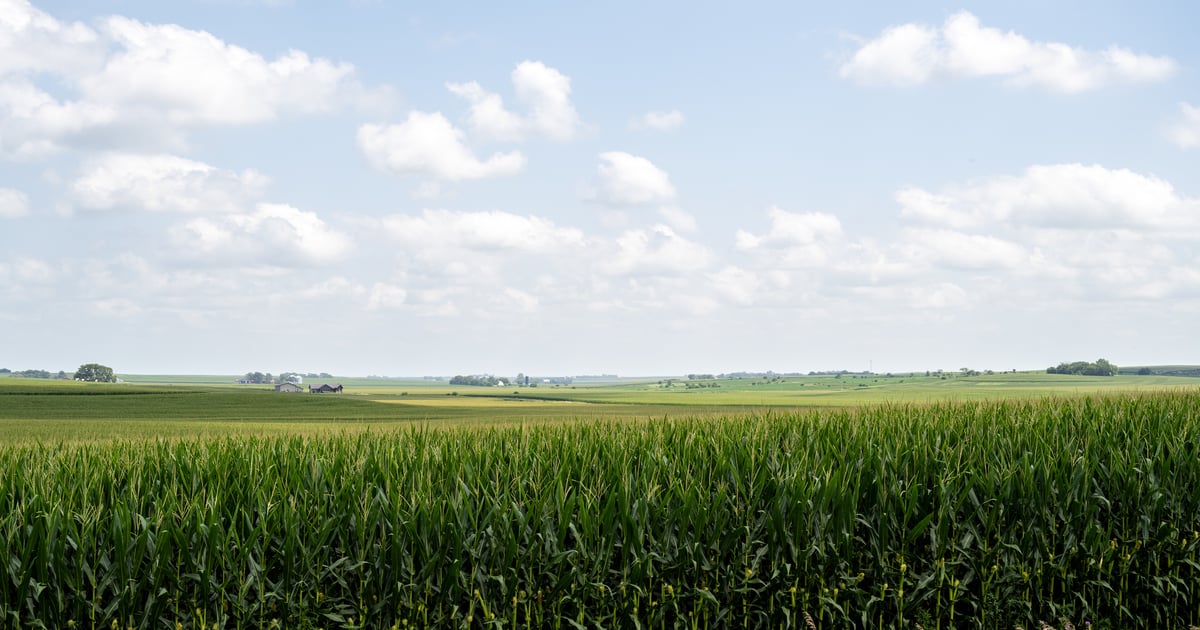
Two years ago I stood in a cornfield outside Ames, Iowa, watching a modular farm robot check insect traps over an experimental 5G network. A few miles away, the Farm Progress Show was doing what it does every year in Boone: filling up with enormous crowds and enormous machines, all aimed at improving the future of farming in America.
Two weeks ago, I went back to see both again and find out how much would change now that the little 5G experiment I watched just got a big license.
Iowa State University spent two days hosting AgWireless’26, a workshop on 6G, agricultural technology and multi-use innovation, and the FCC’s announcement landed just as the attendees were making their way to campus.
On Aug. 28, the FCC’s Office of Engineering and Technology designated the ARA wireless testbed at Iowa State University as an Innovation Zone, a five-year grant of experimental spectrum access covering Ames and the surrounding farmland. The same public notice renewed and expanded the zones tied to the other platforms in the National Science Foundation’s Platforms for Advanced Wireless Research program: POWDER in Salt Lake City, AERPAW at North Carolina State, COSMOS in New York City and the Northeastern University sites in the Boston area.
ARA is the youngest PAWR platform and the only one built around rural connectivity and agriculture. It takes its name from the star constellation and pulls some letters from “Agriculture and Rural Communities.”
“We are making room for innovation through research and development in rural wireless technologies,” FCC Chairman Brendan Carr said in a statement accompanying the designation. “By building on the work already underway at Iowa State, we can supercharge experimentation in precision agriculture that leverages the technology of today and tomorrow, whether it’s 5G, 6G, or drones.”
That’s the press release version. The interesting part is, literally, in the weeds.
Enter: The Innovation Zone
The Innovation Zone designation opens 11 frequency ranges to registered experimenters, and several aren’t the kind of spectrum a university normally gets to touch. There are four slices between 400MHz and 410MHz, some of them federal. There is 470 to 608MHz, the TV band, at up to 60 dBm per 6MHz for fixed stations. There is 1350 to 1390MHz, again partly federal. A large block runs from 2900MHz to 3700MHz, including radiolocation spectrum, with fixed EIRP up to 75.15 dBm per 10MHz. Also, there’s 5030 to 5091MHz, restricted to proof-of-concept work on drone control links. Two millimeter wave blocks run from 26.5GHz to 29.5GHz.
The geography matters as much as the bands. The boundary is drawn by 11 coordinate pairs and deliberately includes both the Ames and Boone municipal airports. The FCC’s reasoning is that those fields allow on-demand access and have no complex traffic management, which makes them “well suited for experiments involving advanced wireless and aircraft,” including drone-based phenotyping. Fear not, frequent flyers: ARA will operate in bands away from aircraft altimeters.
The NSF will coordinate frequencies. Experimenters register through the FCC’s Experimental Licensing System and wait 10 days before operating on non-federal spectrum and 15 days on federal spectrum.
Iowa State filed the application on Nov. 28, 2023. The grant came two years and nine months later.
Hongwei Zhang, ARA’s principal investigator and director of Iowa State’s Center for Wireless, Communities and Innovation, wanted credit for that time spent to go somewhere specific. “We should give the credit also to Mari Silbey,” he said, referring to the program director at the PAWR Project Office. “She has been working on this for years to make this happen.”
Roam, if you want to
The first thing the Innovation Zone designation buys, Zhang said, is room to move. It “allows ARA to have more spectrum flexibility outside the ISU campus area, for instance, allowing ARA to partner with the rural communities tens of miles away from the city of Ames,” he explained.
The second is other people’s equipment. The zone lets ARA “better support bring-your-own-device (BYOD) experiments by external partners who may need special spectrum access which the ARA project team does not have, thus expanding the scope of partnership feasible for ARA.” For telcos, their suppliers and channel partners, that’s a big deal. A vendor, an integrator or a defense contractor can now run gear in bands the university itself does not hold.
The zone lets ARA “explore ag and rural-specific spectrum challenges and opportunities, for instance, on-demand spectrum access for ag machines across farmland and ranch land,” Zhang said.
When asked to point me to something concrete behind that phrase, Zhang called out ARA-NRDZ, an NSF-funded effort to turn the testbed into a national radio dynamic zone. Its premise is that rural spectrum is not so much scarce as idle. Users are sparsely distributed, their usage varies across space and time, and Zhang sees that variability as more of an opportunity than a problem. The project proposes working in the control and non-payload communications bands used by drones and supporting sharing experiments in bands beyond ARA’s own. Its listed industry collaborators are Collins Aerospace, AT&T, Ericsson and Keysight.
If you reread the FCC’s announcement wording after reading the ARA-NRDZ project description, this whole operation goes from looking ceremonial to serious. The drone control band, the off-campus geography, the two airports and the registration path for outside licensees are the operating permissions a dynamic spectrum program needs in order to run at all.
Zhang told Light Reading that the spectrum is not the whole prize. A federal designation “would first of all raise awareness across agencies, knowing that agriculture really is something that we should at least keep in mind as we think about programs and policies. That’s always the first step before anything meaningful could happen. And then, of course, when it comes down to execution, at the end of the day, it’s all the people that matters.”
Now look at the scale of what was announced. The ARA platform spans a rural area more than 30 kilometers across, with wireless backhaul at 11GHz, 14GHz and 71 to 86GHz. It also has a free-space optical link, with capacities up to 160 Gbit/s over hops of 15 km or more and access radios in the TV band, at 3.4 to 3.6GHz, and at 28GHz. And, there’s a LEO backhaul link running on OneWeb, through Hughes equipment.
Researchers can reserve all of it remotely, for free, through a portal. The stated goal is to cut rural broadband costs by a factor of 10. Zhang said the platform has carried traffic about 10 km from a basestation in the field.
Big Ag and big broadband
The urgency of all this also showed up at the AgWireless workshop, from a company with no particular interest in overselling the problem.
Than Hartsock, John Deere’s VP for precision upgrades and its AI data accelerator, presented an overview of the enormous amount of tech sitting in a modern tractor and planter. They have more than 250 controllers. Two separate high-accuracy GNSS receivers, one on the tractor and one on the implement, because the system needs to know precisely where every row unit is. The machines shipping today from Ankeny, Iowa, also have more than 300 onboard sensors and nine GPUs for real-time edge computing.
Hartsock compared the compute load to a Waymo or a Tesla and suggested the tractor might win. He also mentioned, almost in passing, that 1 gigabit Ethernet is “now making its way to machines.”
In the field, more than six miles from the air-conditioned workshop, Deere execs gave journalists an update on their equipment, alongside the launch of its new AI assistant (more on that below).
Deere’s See and Spray system runs 36 cameras feeding nine embedded Nvidia Orin modules along the boom, identifying weeds and firing individual nozzles at 12 to 15 miles an hour. At the workshop, Hartsock put the decision budget at about 100 milliseconds, “about a third of the time it takes you to blink your eye,” and pointed out that the budget has to include the physical fall of the droplet.
In the field, in a separate conversation, Deere CTO Jahmy Hindman described what that kind of precision produces. I asked what kind of connectivity Deere could use if it had it; he said it would be the raw high-resolution imagery coming off a single sprayer at 5 or 6 gigabits per second. Deere doesn’t keep all that data. The machine reduces it on the edge to a weed pressure map, a geolocated record of where the weeds were, and discards the rest.
I asked Hindman to speculate, then ran his figures forward as a thought exercise for my own understanding, so none of the bar napkin math that follows is official. At 5 gigabits per second, one machine produces roughly 2.25 terabytes an hour. Deere moves, in his description, “a petabyte and a half” in a given year from equipment to a cloud instance and back down again. One sprayer would generate that in less than 700 hours of operation. Hindman raised the fleet number himself, asking the question aloud before answering it: about 1,500 sprayers.
And, of course, farming is seasonal, so they’d all be operating at roughly the same time.
The use case they can’t run today is the obvious one of going back over a sprayed field and, one by one, check whether the weeds are dying. Hartsock said the data and compute could answer that question but added: “We don’t enable that today because it’s a little too much data.”
Meanwhile, the demand curve is being pushed from the other end. Deere launched JD, an AI assistant inside its Operations Center, on the opening day of the Farm Progress Show. Today it queries an individual farm’s own records. Hartsock described insights drawn from aggregated data across farms as the next phase, and “not the not too distant future.” Asked what AI does to data requirements, he was blunt. “We’re going to want every ounce of unfiltered raw data that we can get our hands on over time.”
The imagery is spreading beyond sprayers, too. Hartsock described new technology putting high-resolution cameras on every row unit of a planter, looking down into the trench to check seed placement and soil condition. On a 54-row planter, that is 54 more streams, on a different machine, during a different pass.
Let’s get predictable
Back in my makeshift hotel office, feeling the sweet, sweet air conditioning, I called Zhang to share my out-in-the-field, back-of-the-envelope math and Deere’s numbers. Interestingly, he didn’t talk about capacity or coverage alone. He said those numbers need guarantees.
What agriculture needs broadly, he said, is “predictable assurance of whatever quality, throughput, latency and reliability guarantee that’s made by the individual applications.” Bandwidth that shows up when the application asks for it, at a level the application can count on.
Then he made the case for why farms belong in that conversation at all, picking up Hartsock’s own example from the keynote earlier that day. “On the surface, agriculture doesn’t seem to be that mission critical,” Zhang said. “But its direct impact, the food safety and so on, depends on how you are putting the seed. Are you putting the seed at the right spot? With the right pressure? All those [things] just matter, even though it doesn’t feel like it.”
Hartsock had spent several minutes on precisely that. A treated corn seed placed at an inch and a half, no more and no less, in slightly moist soil, firmed to a bulk density that lets moisture transfer to the seed coat, on a 120-foot planter running 10 miles an hour. Roughly 750 million seeds across a 5,000-acre corn and soybean farm, and Deere’s sensors count and locate every one.
My point? These are complicated networking problems with relatively unique use cases. At the speed and scale of modern farming, checking the work by hand is not merely expensive. “It’s also just infeasible,” Zhang said. “Even if you want to do it, we just don’t have enough time and power.”
This is a strange place for an industry to end up. The machines can count 750 million seeds and remember where each one went. The network they’re standing in sometimes can’t reliably carry a phone call.


