I’m Nigel Blacker, the photographer behind Visionaire, and I’ve been photographing weddings professionally since 1989.
My journey began at just seventeen, got far to obsessed with photography, forever dreaming of being a hip fashion photography with a large house, flashy sports car and speedboat.
I quickly separated fantasy from reality and slowly worked my way up the ladder.
Cameras
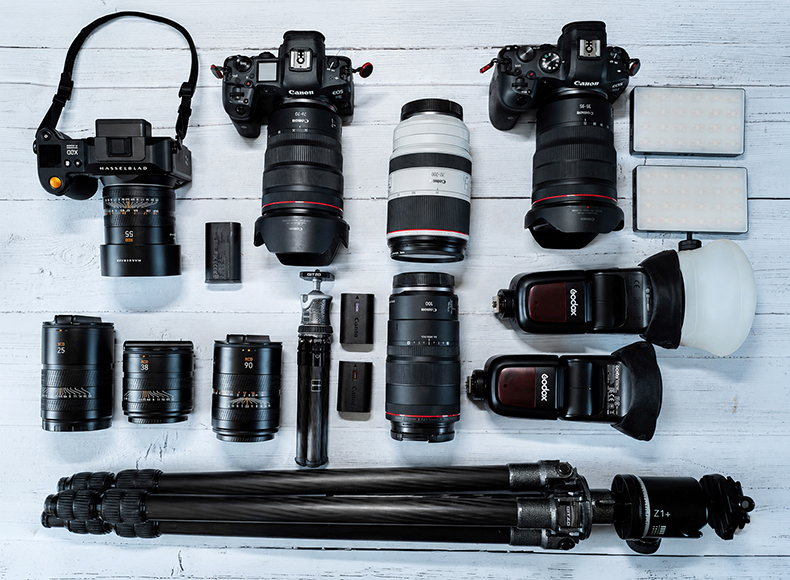
The Canon EOS R5 is my main wedding camera and does the majority of the work.
I find Eye AF enormously useful, particularly in fast-moving situations. Weddings aren’t terribly considerate about waiting for photographers, so being able to concentrate on what’s happening and the composition rather than constantly worrying about focus is a tremendous advantage.
The IBIS is another feature I’ve grown to appreciate. As the light disappears, particularly when photographing interiors, I can hand-hold the R5 at surprisingly slow shutter speeds, sometimes just over a second if everything comes together.
I also love just how quiet modern Canon cameras have become. When I’m trying to work unobtrusively during a ceremony or a more emotional part of the day, not having a camera announcing every frame is a real bonus.
The Canon EOS R6 is my second camera.
Apart from the difference in resolution and some aspects of the physical design, I find the technology every bit as good as the R5.
The viewfinder is slightly smaller, but nothing drastic, and as a second body it gives me virtually everything I need without feeling as though I’m making a compromise.
And then there’s the Hasselblad X2D.
What a camera!
It’s beautifully built, has an enormous viewfinder and a menu system that’s refreshingly straightforward. The colour is quite extraordinary.
Do I need a 100-megapixel medium-format camera to photograph a wedding? Probably not.
But that’s slightly missing the point.
The Hasselblad comes out when I have the luxury of slowing down and taking more considered photographs. Admittedly, weddings don’t always provide an abundance of those moments, but when they do, I love working with it.
The Canon encourages me to react incredibly quickly. The Hasselblad encourages me to stop, look again and make absolutely sure that everything within the frame deserves to be there.
They’re very different ways of working, and I enjoy both.
Lenses
The Canon RF 15–35mm f/2.8L is a wonderfully versatile lens and has got me out of more than a couple of tricky situations.
Try photographing a large group of people when somebody has decided the perfect location is a room approximately the size of a cupboard and you’ll understand why I carry it!
But I don’t regard an ultra-wide lens simply as something for getting more into the frame. Used intelligently, the perspective can be exploited to create quite imaginative photographs.
I use it for interiors and architecture, but also when I deliberately want exaggerated perspective, strong foregrounds and something with a little more drama.
If I had to nominate the master lens of my Canon kit, it would probably be the RF 24–70mm f/2.8L.
It accounts for at least seventy per cent of my wedding photography.
It’s beautifully designed, quick, accurate and lovely and sharp. More importantly, it’s enormously adaptable. Weddings move quickly and I don’t particularly want to be thinking about changing lenses when something interesting is happening in front of me.
It isn’t necessarily the most exotic lens in the bag, but it’s an absolute workhorse and I mean that as a considerable compliment.
The RF 70–200mm f/2.8L probably gets the second greatest amount of use.
It’s excellent for picking people out informally without interfering with what’s happening and, of course, it’s a lovely portrait lens.
I particularly like the compressed perspective. It has a very different visual character from the 24–70mm and can make backgrounds and layers within a photograph work beautifully.
It’s also invaluable during speeches. With 200mm available I can work from across the room and pick up reactions from guests without having to hover beside them with a camera.
The RF 100mm Macro earns its place because it does considerably more than just macro photography.
Naturally, it’s useful for all those small things that contribute to a wedding story like flowers, stationery, menus, place settings, jewellery and the little details somebody has spent months choosing.
But it’s also a very capable portrait lens, so it doesn’t spend its life waiting for somebody to produce a wedding ring.
The Hasselblad XCD 25mm lets me create big, sweeping vistas with tremendous depth.
It’s particularly useful for photographing the architecture of a venue and placing people within their surroundings rather than always making them dominate the frame.
The Hasselblad XCD 38mm is probably the Hasselblad lens that could live permanently on the camera.
It’s wonderfully versatile and excellent for small groups, environmental portraits and general photography. It feels very natural and rarely leaves me wishing I’d chosen something else.
The Hasselblad XCD 55mm is another hugely versatile lens and, for me, a genuine portrait lens.
It gives enough context to tell you something about where somebody is without allowing the surroundings to overpower them.
Finally, the Hasselblad XCD 90mm is my portrait lens.
The sharpness is on another level from almost anything I’ve used, while the out-of-focus areas are beautiful. It’s one of those lenses that makes you want to find an excuse to use it.
It’s a real treat.
Lights/Triggers
For flash I carry two Godox V1 units.
They’ve proved extremely reliable and the lithium batteries seem to last forever. At a wedding, that’s exactly what I want from a flashgun, something that works when I need it without requiring an unnecessary amount of attention.
I like to keep it simple.
The Godox V1 has a round head, perhaps a little different from most flashguns, once set up I can forget technicalities and concentrate in the fast moving wedding world, the battery life is staggering, just seems to go on forever.
Bags/Straps
The Canon system travels in a Think Tank Roller Derby.
I initially considered the conventional two-wheel version, but I’m very glad I chose four wheels. Once you’ve spent a long wedding day moving a considerable amount of camera equipment around, being able to roll the case easily in virtually any direction suddenly seems like one of mankind’s greater inventions.
The Hasselblad system lives in a WANDRD 30L backpack.
I was so impressed with the first one that I bought another, which is probably the shortest review I can give it.
Tripods
I don’t use a tripod extensively during a wedding, but I carry a Gitzo Mountaineer for occasions when I want to create something a little different.
It might come out for photographs of the venue or grounds at dusk, or for a dark night-time image where hand-holding simply isn’t the sensible answer.
The Gitzo is extremely easy to work with and the build quality is second to none.
On top is an Arca-Swiss Z1 ball head. It’s big, heavy and reassuringly beefy, with beautifully smooth controls. The engineering quality matches the Gitzo perfectly and I suspect both will outlive me.
I also have a Gitzo mini tabletop tripod. It’s brilliant for details and, because it’s so small, I can place it in locations where a conventional tripod simply wouldn’t work.
Hardware & Software
Back at the studio, a Mac mini handles the main workload, together with a couple of Crucial external 2gb drives.
My monitor is a 24” EIZO that I’ve owned for many years. Technology comes and goes remarkably quickly, so there’s something rather satisfying about a piece of equipment that simply continues doing its job accurately and reliably year after year.
Both Photoshop and Lightroom occupy the main workload but I also use Nik filters particularly Viveza, I edit all of the images, one by one, I enjoy enhancing the images although admittedly it can take too long at times!
Gone are the days when I used to turn up in a three piece suit, through those long hot summers I suffered!
Today things seem much more relaxed so lightweight pair of comfortable shoes, cotton trousers and casual shirt with often short sleeves, if you’re working ten hours plus with little break you really need to be comfortable.
If I could offer one piece of advice to photographers, it would be to remain curious.
After more than three decades of photographing weddings, I still arrive wondering what I’m going to find. That’s probably what keeps me interested. The moment I think I’ve seen every possible wedding photograph is probably the moment I should put the cameras away.
Don’t become too obsessed with what other photographers are doing. Inspiration is wonderful, but imitation eventually becomes a rather crowded room. Look at paintings, films, fashion, architecture, great photojournalism and occasionally look at absolutely nothing photographic at all.
Recognise good light, but perhaps more importantly, learn what to do when the light is terrible. Weddings have an extraordinary ability to place the most important moment of the day in precisely the worst-lit part of the building.
And don’t take yourself too seriously. Take the photography seriously, certainly, but not yourself.
I’ve photographed well over a thousand weddings since 1989 and I’ve learned that however carefully you plan, somebody will be late, something will go wrong, the weather will ignore the forecast and occasionally the photograph you hadn’t planned at all will become the best one of the day.
That’s rather the joy of it.
Thirty-seven years later, I’m still looking for the next photograph that surprises me.
I hope I never find the last one.


