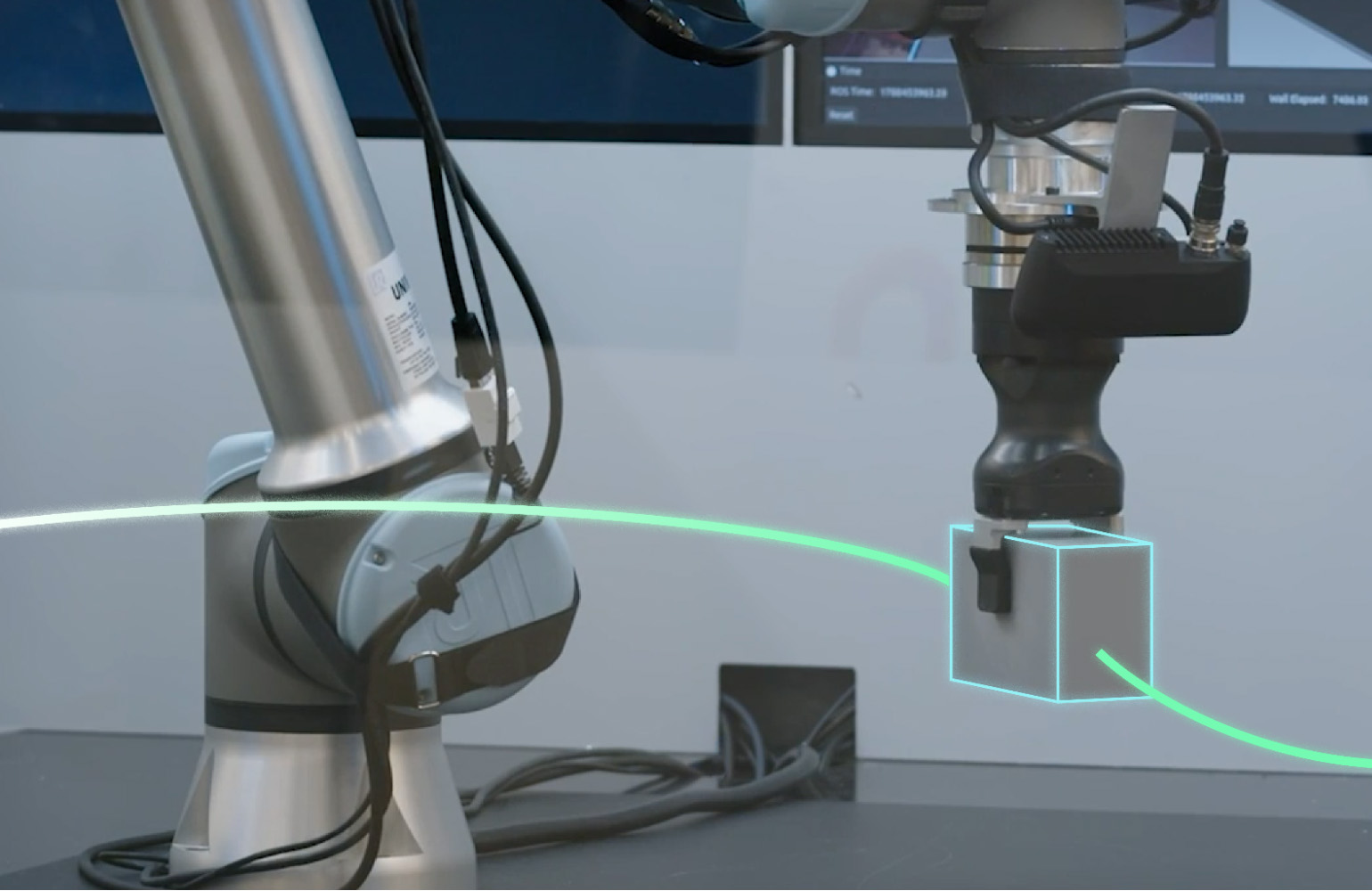
Intrinsic also released the Open Machine Tending Solution, an open reference design for CNC machine tending. | Source: Intrinsic
Today, Intrinsic, an AI robotics group that joined Google this year, released Intrinsic Core, an open-source set of Robot Operating System-compatible capabilities for building robotic applications. With the release, Intrinsic said more of the world’s developers will be able to build with foundational parts of the Intrinsic platform.
Robotics teams currently spend hundreds of hours coding robotic capabilities or infrastructure from scratch, according to Intrinsic. The company said it took the capabilities it developed for real manufacturing deployments and turned them into a pre-configured software environment that runs on local hardware. The capabilities act like the building blocks of robot behavior. Users can quickly and easily combine them to achieve adaptive AI systems, it claimed.
“From Intrinsic’s perspective, I can say this is something that we’re committing to,” Brian Gerkey, chief technology officer at Intrinsic and co-founder and board chair of Open Robotics, told The Robot Report. “This is not us coming by and dropping off some code and saying, ‘Have fun.’ What we’re sharing this week is the core of our own software stack, this is a thing that we’re also depending on. This represents a durable commitment from Intrinsic to share this with the community.”
By design, these capabilities are ROS-compatible and offer more ways to improve existing applications, or build new ones.
“The release of Intrinsic Core is both the first step and a demonstration of where I think robotics is going to go and where developing robotics is going to go. We’re going to see robots being so much easier to produce, thanks to platforms like Intrinsic Core coming out,” Geoffrey Biggs, CTO of the Open Source Robotics Foundation, told The Robot Report.
Intrinsic announced Intrinsic Core at ROSCon 2026 in Toronto. Intrinsic Core is available on Intrinsic’s GitHub today. Intrinsic released the capabilities under a permissive Apache 2.0 license.
How did Intrinsic decide what to include in Intrinsic Core?
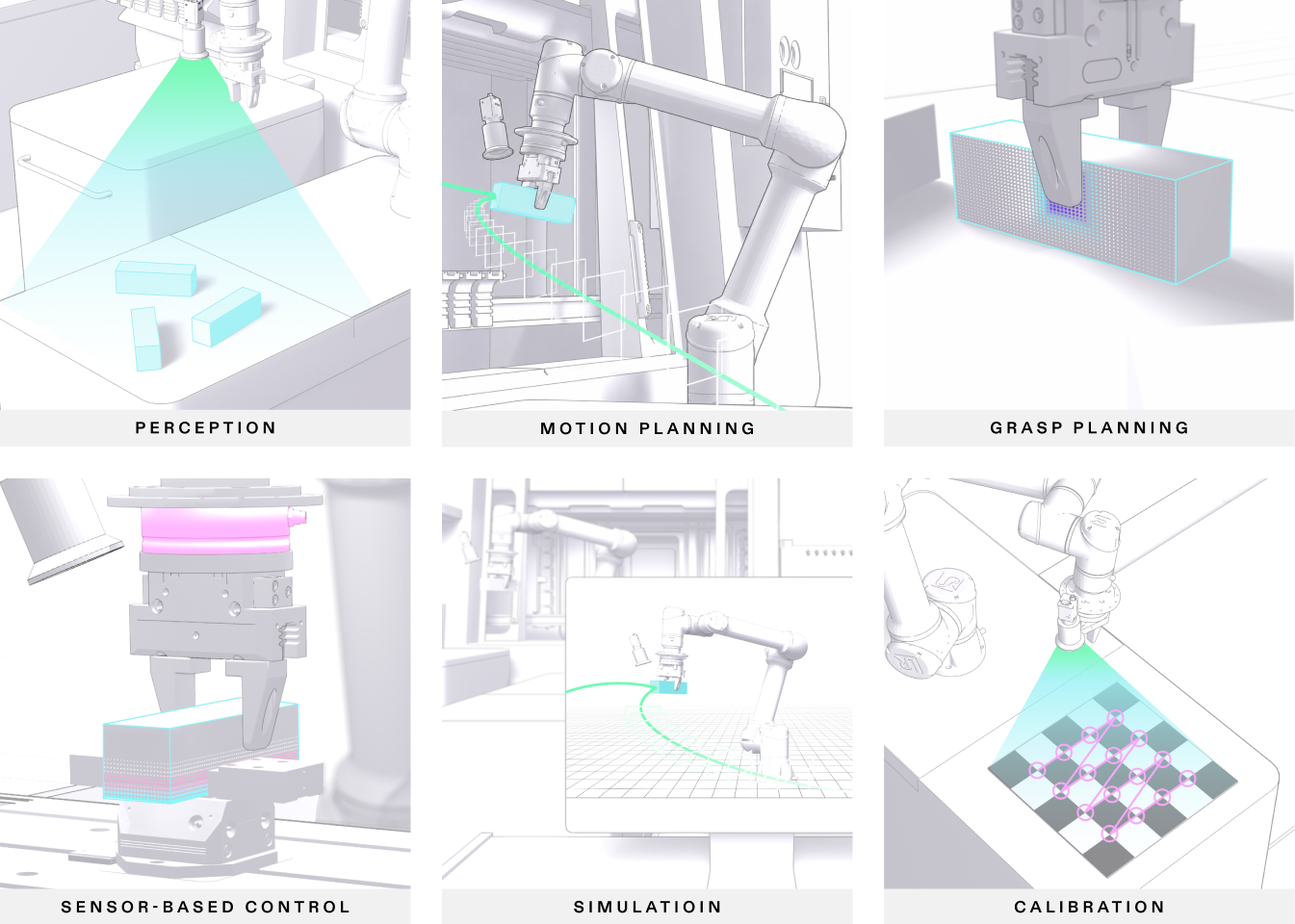
Some of the key capabilities included in Intrinsic Core. | Source: Intrinsic
“The way we thought about it is, we’ve built a lot of software; which parts of it do we think are filling in gaps that exist in the ROS ecosystem?” said Gerkey. “The ROS ecosystem is very strong. There’s a tremendous amount of things that you can do with it, and we know we’ll see a bunch of exhibitors here at ROSCon this week who are showing off the things that you can do with ROS. That doesn’t mean it’s complete or perfect.”
At the center of Intrinsic Core is Intrinsic Control, a hardware-agnostic, real-time control framework. Intrinsic said it delivers fast, sensor-based control, and allows the robot to dynamically adapt its behavior mid-trajectory based on changes in the environment. It allows users to swap out different robot arms, grippers, sensors, and more without needing to rewrite drivers.
The release also includes:
- Pose estimation: Intrinsic used NVIDIA‘s FoundationPose to provide a six degree-of-freedom (6 DoF) pose estimation of 3D parts. This enables robots to detect and handle parts, and it removes the need for rigid, expensive physical fixtures. With built-in compatibility with NVIDIA FoundationPose, a unified foundation model for 6D object pose estimation and tracking, developers can use this feature out of the box and without needing to write custom pipeline wrappers.
- Motion planning: This replaces the need to program robots manually, joint by joint, in a position-controlled way. Intrinsic said that easy-to-integrate logic auto-generates efficient paths while avoiding collisions — making it fast and easy to use a variety of robots.
- Grasp planning: This enables various grippers to automatically and dynamically adapt to the location and orientation of a part, and grasp it with a higher probability of success. It leverages real time sensor feedback to pick parts, wherever they’re located.
- Simulation services: Powered by Gazebo, this provides users with a way for testing and troubleshooting robotic solutions that update as they build. With visualization, developers can debug and validate application logic, state machines and workcell behaviors from one place.
- Camera calibration: This automates how a robot’s camera can be calibrated and physically aligned, streamlining its setup and the configuration of a robot’s vision system.
- ROS drivers: Intrinsic offers pre-configured, ROS-compatible drivers for supported robots, grippers, and 3D cameras. Through tight coupling between sensor calibration and controls, a pre-tuned setup improves the speed for getting sensors and robots talking to each other more quickly when building solutions, it said.
Intrinsic Core can make it faster, easier to build reliable robots
According to Intrinsic, Intrinsic Core can help its users with two things: faster development and building more reliable robots.
“We’ve seen this from the start with ROS, that having all these tools available right from the start really accelerated robotics,” said Biggs. “When ROS came out and started being used in academia, research started speeding up, and then people started using it in startup companies to produce new products. We saw such a massive acceleration of development.”
When it comes to reliability, Gerkey said it’s important to remember that reliability needs to be thought about in every step of development.
“It’s really important to recognize that I don’t have a store of reliability in the back, where we can bring some and sprinkle it on top,” he noted. “Reliability is about the process and approach and diligence. It’s a long-running activity that you have to be really committed to.”
There are companies that have build reliable systems and scaled on top of ROS, but they all had to build that infrastructure on their own and spend a lot of effort doing this, Gerkey said. So Intrinsic isn’t building something entirely new.
“We’re bringing in standard Linux containerization combined with Kubernetes to allow you to basically bring that together in a way that fits naturally with your ROS workflows,” Gerkey said.
“The Intrinsic Core is a step towards the point in the future where we get to have the equivalent of the red hats and the canonicals of robotics,” added Biggs. “They’re providing platforms upon which you can product a robot product at production quality, deployment quality, with minimal effort, because they provide all the stuff you need that builds on ROS.”
 Register now and help us celebrate 20 years of RoboBusiness!
Open Machine Tending Solution gives developers a jump start
To give developers and integrators an early head start with Intrinsic Core, the company is also releasing the Open Machine Tending Solution (OMTS). This runs both on Intrinsic Core and with the ROS Suite. OMTS is a ready-made reference design for a real-world machine shop use case.
“It’s important to have those well-lit paths that show you this is not just a box of parts with some potential,” said Gerkey. “It’s a box of parts with some things that we’ve gone through the trouble to build, so you can be confident that you can build a thing like that.”
Also built to be open, OMTS makes customization possible for different assets, including models from FANUC and Universal Robots. For fabricators and machine shops around the world, intelligently-adaptive machine tending systems can assist operators day to day while helping improve machine utilization and automating lower value tasks.
“We really want to give people a clear starting point, and also give them a strong value proposition,” Gerkey said. “I think having that reference application gives more value to the user, and also, frankly, it keeps us as the developers of the system honest, because it’s a way to prove to ourselves that the system is complete enough to allow us to build a system like that.”
Intrinsic starts with a specific user, but hopes to expand with time
Right now, Gerkey said the ideal user for Intrinsic Core is someone already familiar with ROS who is interested in doing manipulation-based work. In addition, Intrinsic Core is a platform for robotic arms; it doesn’t support mobile robots or humanoids. It’s also aimed at commercial deployments.
“When we launched ROS in the late 2000s, it was squarely targeted at a researcher,” recalled Gerkey. “We always had in mind, what does the best grad student in the best robotics lab in the world need to do their work?”
“We pretty quickly went way beyond that with ROS and got to domains that were not just the mobile manipulators that we had created at Willow Garage, but also many other types of robots and many other applications,” he added. “I think there’s an opportunity here for Intrinsic Core to have a similar expansion.”
Gerkey said he hopes that as Intrinsic gains trust with users in one area, it can expand to new areas.
“If you come out of the gates and say, ‘We intend to be all things to all people,’ the chances that you’re going to succeed there are pretty slim,” he acknowledged. “I think it’s important to come out and say, ‘Here’s who we’re targeting; here’s the value proposition that we think we have for them.’ Then, once we show traction there, and we’ve earned the credibility to expand, then let’s expand beyond that.”
In the meantime, Biggs said Open Robotics hopes to see more platforms like Intrinsic Core come out in the future.
“There’s going to be so much more you can do in so much shorter time, which is going to be great for accelerating the breadth of applications that robots start taking on,” Biggs said. “Intrinsic Core is going to demonstrate that in industrial manipulation.”
The post Intrinsic open sources key parts of its platform for easier development appeared first on The Robot Report.


