
1
Mimosa Networks argues broadband operators should build for the business case, not fiber-first dogma. As BEAD funding and rural economics shift, FWA in unlicensed spectrum offers another route to viable networks, from rural America to urban India. Note this article is taken from a webinar session with Mimosa Networks, which is available on-demand here.
In sum – what to know:
BEAD economics – Mimosa says rising fiber costs, uncertain take-up, and funding delays are forcing US broadband providers to rethink rural network economics.
Key deployments – Work with Prairie Hills, Viaero Wireless, and Reliance Jio show how unlicensed 5GHz and 6GHz FWA can serve very different markets.
Design principles – Choose the network technology and deployment model that fits local demand, infrastructure, and returns, says Mimosa – not a presumed gold standard.
The best network is not always based on the best technology, observes Mimosa Networks. If it was, there would be fiber everywhere – to every farmhouse, henhouse, outhouse, and doghouse (to borrow a phrase). Which would be a crazy undertaking, clearly. So the best network, quite simply, is the one that makes best sense. Sometimes, often even, the very best uses fixed wireless access (FWA) for part of the job, notably with the unlicensed 5GHz and 6GHz bands – as provided by Mimosa on every continent, ranging from backwoods rural America to the densest urban chokepoints in India’s biggest cities. It is a familiar argument, perhaps, but one that needs making again.
And it is being made at a difficult time for the US broadband industry, as the government’s $42.45 billion Broadband Equity, Access, and Deployment (BEAD) program runs into shifting tech priorities, funding uncertainty, and straighter questions about the economics of rural construction. Mimosa, owned by Indian telco Reliance Jio, makes the case for a more pragmatic approach: deploy the technology that fits the market, rather than treating fiber as the “gold standard” and the default answer. “Instead of being a tech zealot, how about doing what’s best for the business case? Deploy something you’re actually going to make money on,” says Jim Nevelle, general manager at the firm.
The company is positioning FWA as a commercially viable alternative to fiber in markets where the cost of building and maintaining a wired network is difficult to justify. As above, its solution uses unlicensed 5GHz and 6GHz spectrum, with radio equipment deployed on towers and customer premises to deliver wireless broadband without running fiber to every home. The argument is not that fiber has no place in broadband expansion, or that FWA can replace it everywhere. Rather, Mimosa wants operators to stop treating network technology as an ideological pursuit, or a funding opportunity in its own right, and start treating it as a calculated business decision.

Its message is pertinent in the US, right now. The BEAD program was designed to extend high-speed broadband into unserved and underserved areas, with states administering federal funding for network deployment. Under the original framework, providers competed for funding based on the locations they could serve and the proposed performance of their tech solutions, with fiber generally receiving preferential treatment in the selection process. This encouraged providers to build around a “gold standard” tech without knowing whether the resulting networks would be commercially sustainable. Also, the conditions underpinning their original business cases have since changed.
Fiber deployment costs have risen, says Nevelle, partly because of the AI rush for interconnect and long-haul routes. The investment environment is more difficult, too. Some regional operators that previously expected to finance fiber construction through a combination of grants, private equity, and debt are facing tougher lending and returns. Nevelle also points to changing priorities. The BEAD restructuring in 2025 sought to make the program technology-neutral, reopening the process to competing solutions, notably satellite, and changing how states select providers. That has complicated planning for providers that had already developed proposals around the original framework, he says.
There are also questions about the financial exposure providers take on when accepting grants. Mimosa says some face requirements to contribute as much as 40 percent of costs through other financing – at a time when lenders are less willing to back rural projects on the terms providers had anticipated. The issue, in its telling, is not just whether a provider can secure a grant, but whether it can build the network, attract the customers, and generate the returns. Which matters more in sparsely populated areas, where the cost of passing homes is higher and take-up rates are less clear. A network can meet its construction targets and still fall short of the subscriber numbers and earnings.
Nevelle says: “Five years ago, a lot of private equity went into regional ISPs on the assumption they could bury fiber, pass homes, and eventually sell to a bigger player at a healthy multiple. But those multiples haven’t materialised at the levels investors expected, and the focus has shifted to take-up, EBITDA, profitability and customer growth. Some networks were built on the assumption of a 60 percent take rate, but actual take-up has fallen well short. Homes passed have value, sure, but the business case changes pretty quickly when fewer customers sign up than you expected.” Mimosa lists three deployments to show how FWA works instead, in vastly different operating conditions.
These were discussed in more detail during a free RCR webinar this week – on September 23; available on demand. The BEAD case will also be under review. The common thread, says Nevelle, is that all three operators, in very different operating environments, needed the same FWA platform, deployed differently – according to subscriber density, geography, existing infrastructure and the cost of reaching each customer. Which could mean closely spaced access points in a dense settlement, longer-range links across rural terrain, or a hybrid network combining wireless access with fiber backhaul and other technologies.
Here are some brief notes on each to tide you over…
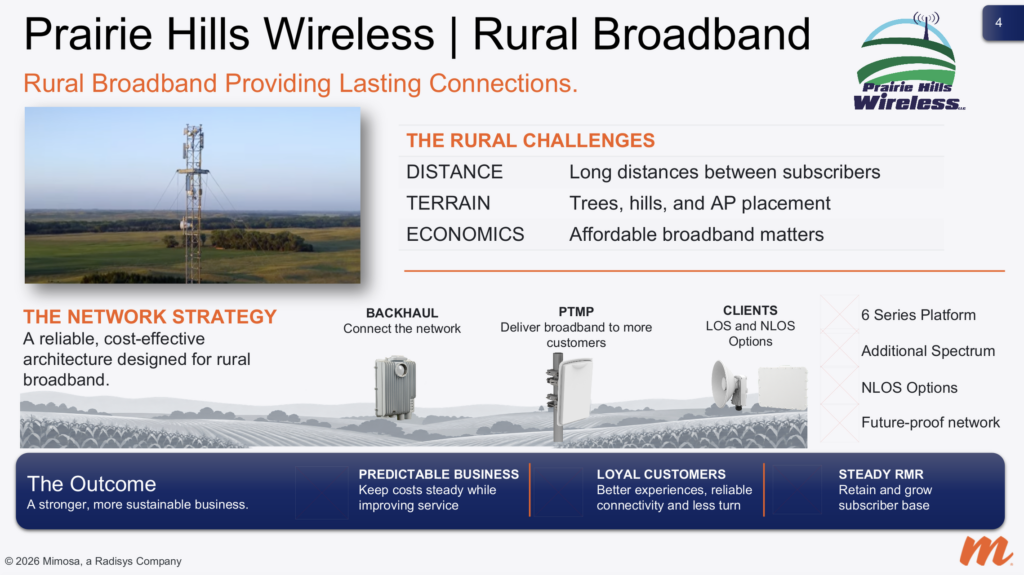
Prairie Hills Wireless | Prairie Hills operates across around 1,300 square miles, serving more than 1,200 wireless internet customers. It has used Mimosa equipment to build both rural, tower-based GigaPoP networks and smaller MicroPoP deployments in denser areas of Ravenna. The approach allows it to extend coverage and add capacity without relying on a continuous fiber build.
Viaero Wireless | Viaero operates more than 1,000 towers across Colorado, Nebraska, Kansas, and Wyoming. Its Mimosa deployment demonstrates how FWA can use existing tower infrastructure to serve rural and regional markets where fiber construction may not stack up, while satellite can remain an option for more isolated premises. A recent commercial deployment with Mimosa’s 6 Series platform supported around 50 active subscribers per sector, with links extending to 9.8 miles, according to the companies.

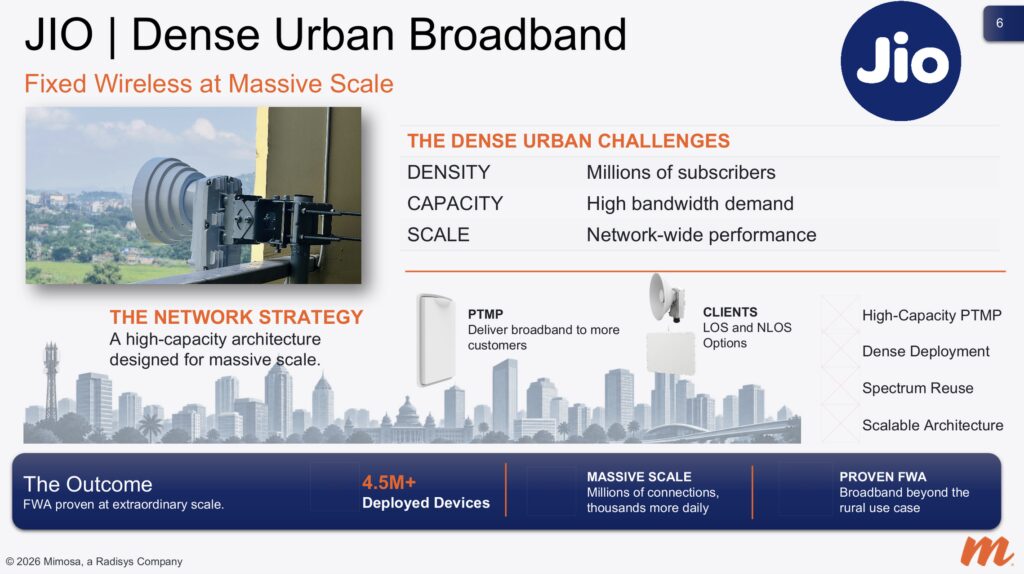
Reliance Jio | Mimosa’s parent, Reliance Jio, has more than 500 million mobile subscribers. Mimosa says Jio uses its unlicensed fixed wireless technology to provide home broadband, offloading residential connectivity from its expensive licensed mobile spectrum. The deployment shows how FWA can complement a mobile network at a scale far beyond that of a typical US WISP.
As with BEAD-related projects in the US, and similar across the world, the question is how much it costs to connect a customer, how much revenue the customer generates, and how much infrastructure is needed as the network expands. The draw with FWA is to reduce the cost and time to reach individual premises, particularly where fiber costs are hard to recover – and spiralling upwards with demand from AI route builders. “We’re having this conversation with operators in Africa, where infrastructure outside major cities is often limited,” says Nevelle. “They can’t run fiber to every village. So the question is how to build a network that makes business sense.”
He adds: “Rather than getting caught up in a war over technology, it’s about choosing the right approach.”


