What happens when a frontier model’s abilities get packed into cheaper, faster versions? That’s what OpenAI did with GPT-6 Sol and GPT-6 Luna, two new models built with methods similar to GPT-6 Astra. OpenAI is cutting API prices for both models by 50% compared with their GPT-5.6 versions, and says they bring Astra’s gains in professional work, factuality, coding, and computer use to more affordable tiers. In this article, we look at what’s new, break down the published benchmarks, run 4 hands-on tests, and flag the details worth reading twice.
GPT-6 Sol and Luna Features
These releases aren’t about topping the leaderboard; OpenAI says GPT-6 Astra remains its best model across the board. They’re about making that level of intelligence cheaper to run every day. All figures below come from OpenAI’s announcement and have not been independently verified.
Video Source: OpenAI
Two models, two price points
GPT-6 Sol is the mid-tier model, meant for demanding work at a lower cost than Astra, with higher usage limits for more iteration. Luna is the budget tier, built for high-volume tasks where cost matters most. Both replace their GPT-5.6 versions.
Lower API prices
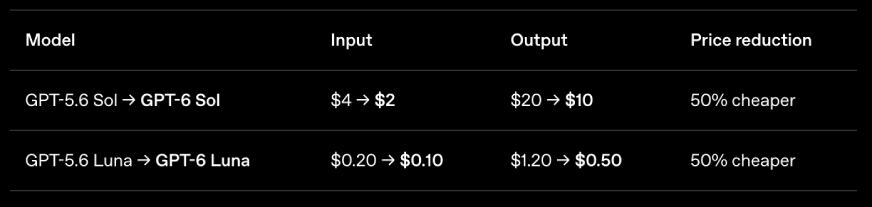
The table below compares API prices for the GPT-5.6 and GPT-6 versions of each model:
Source: OpenAI
OpenAI calls this a 50% cut for both models. For Luna’s output, the drop is actually larger: $1.20 to $0.50 works out to about 58%. It credits the cuts to improvements in caching and inference that make the models cheaper to serve.
Better caching for agents
Agents and long conversations send the same context back to the model again and again. Caching lets the model reuse that context instead of processing it from scratch each time. OpenAI says GPT-6 gets higher cache hit rates by default, with a 90% discount on cached input.
Developers also get new tools to track and improve caching. A dashboard shows how much input gets cached, and a diagnostics tool explains missed caching opportunities. Changing the reasoning effort or turning tools on and off mid-conversation no longer resets the cache. Explicit breakpoints let developers choose where the cached portion of a prompt ends.
GitHub reports that these improvements cut the share of prompt tokens needing fresh processing by more than 50% across billions of Copilot requests.
Fewer factual errors
On OpenAI’s internal factuality test, GPT-6 Sol makes about half as many mistakes as GPT-5.6 Sol, getting close to Astra’s reliability. OpenAI says GPT-6 Luna at higher effort matches GPT-5.6 Sol at about a hundredth of the cost.
Clearer collaboration style
Sol and Luna inherit Astra’s communication style. OpenAI says to expect more clarity, less jargon, fewer low-value details, and slightly shorter answers overall. It says the change will show most in technical and coding conversations.
Video Source: OpenAI
GPT-6 Sol and Luna Benchmarks
Benchmark
GPT-6 model
Score
Compared with
Context
AutomationBench (business workflows)
Sol (xhigh)
33.2%
Claude Opus 5 (max): 26.9%
Sol at 9% of Opus 5’s cost per task
Agents’ Last Exam (professional workflows)
Sol (max)
56.4%
Claude Opus 5’s highest score
Sol at 60% lower cost per task
DeepSWE v1.1 (software engineering)
Sol (max)
68.8%
Claude Fable 5 (xhigh): 69.9%
Within 1.1 points, about 80% cheaper
DeepSWE v1.1 (software engineering)
Luna (max)
66.6%
Opus 5 and Fable 5 (medium)
Comparable, 93% to 96% cheaper
OSWorld 2.0 offline (computer use)
Sol (xhigh)
60.5%
Claude Opus 5 (medium): 60.3%
Similar score, about 80% cheaper
FrontierCode 1.1 (coding)
Sol
No number given
Claude Fable 5.1 (xhigh)
Described as matching Fable at much lower cost
The pattern is consistent across the table: OpenAI isn’t claiming Sol or Luna beat the top models outright. It’s claiming they get close for a fraction of the cost.
A few points help put these numbers in context. OpenAI took competitor scores from publicly available reports rather than running them itself, and used Claude Fable 5 scores wherever Fable 5.1 scores weren’t available. It also notes that its test environment may produce slightly different results from ChatGPT in everyday use.
Hands-on test in ChatGPT
GPT-6 Sol and Luna are available in ChatGPT Work and Codex for Plus, Pro, Business, Enterprise, and Edu users, but not yet in regular chat. Free and Go users can try GPT-6 Luna in the desktop app. We ran two tests on each model, matched to what OpenAI says each one is built for.
Trying out GPT Sol 6
I am going to do 2 simple tasks in which I will be using GPT Sol 6 Medium and sharing my experience of working with the model.
Test 1: Check the facts
Prompt:
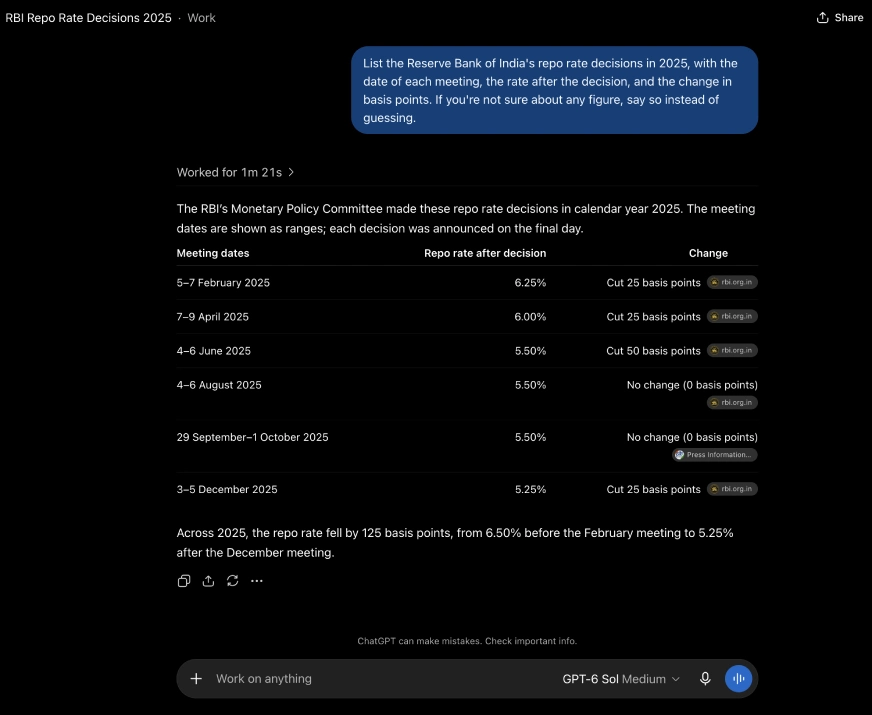
List the Reserve Bank of India’s repo rate decisions in 2025, with the date of each meeting, the rate after the decision, and the change in basis points. If you’re not sure about any figure, say so instead of guessing.
Output:
My Take:
GPT-6 Sol got all six 2025 repo rate decisions correct, including the December meeting, which I initially couldn’t confirm through our own search. Rather than hedging on that figure per the prompt’s instruction, it used live browsing to find and cite the actual RBI decision, a stronger result than either a hedge or a guess would have been. This is a clean pass, not a partial one.
Test 2: Find the bug
Prompt:
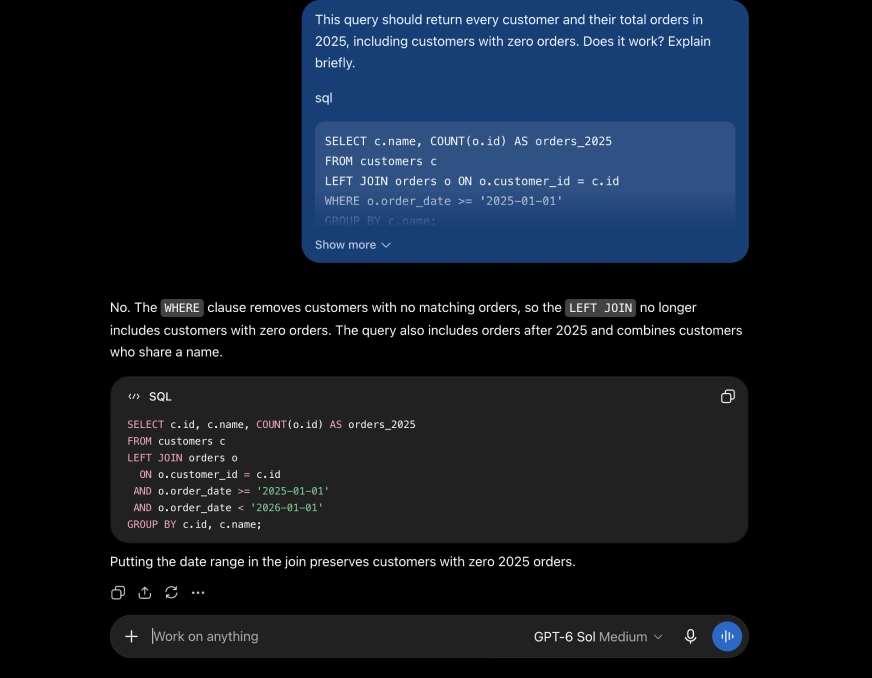
This query should return every customer and their total orders in 2025, including customers with zero orders. Does it work? Explain briefly.
sql
SELECT c.name, COUNT(o.id) AS orders_2025
FROM customers c
LEFT JOIN orders o ON o.customer_id = c.id
WHERE o.order_date >= '2025-01-01'
GROUP BY c.name;
What to check: There are two bugs. First, filtering on o.order_date in the WHERE clause removes customers with no orders, which quietly turns the LEFT JOIN into an inner join. Second, there’s no end date, so orders from 2026 get counted too. A strong answer catches both, moves the date conditions into the ON clause, and keeps the explanation short.
Output:
My Take:
I gave GPT-6 Sol a SQL query with two planted bugs: a WHERE clause that quietly turned a LEFT JOIN into an inner join, and a missing end date that let orders from 2026 leak into a 2025 report. Sol caught both, explained each clearly, and fixed the query.
It also caught a bug I didn’t plant. The original query grouped results by customer name alone, which would incorrectly merge two different customers who happen to share a name. Sol’s fix added the customer ID to the grouping, a legitimate, non-trivial catch that went beyond what the test asked for.
The response also matched OpenAI’s claim about clearer communication. It opened with a flat “No.” before any explanation, gave a fixed query and a one-line justification, and stayed under 40 words of prose for a bug with two intended issues. No padding, no restating the question back.
Trying Out GPT-6 Luna
Now, let’s see how GPT-6 Luna perfoms on real-world tasks:
Test 3: Everyday business math
Prompt:
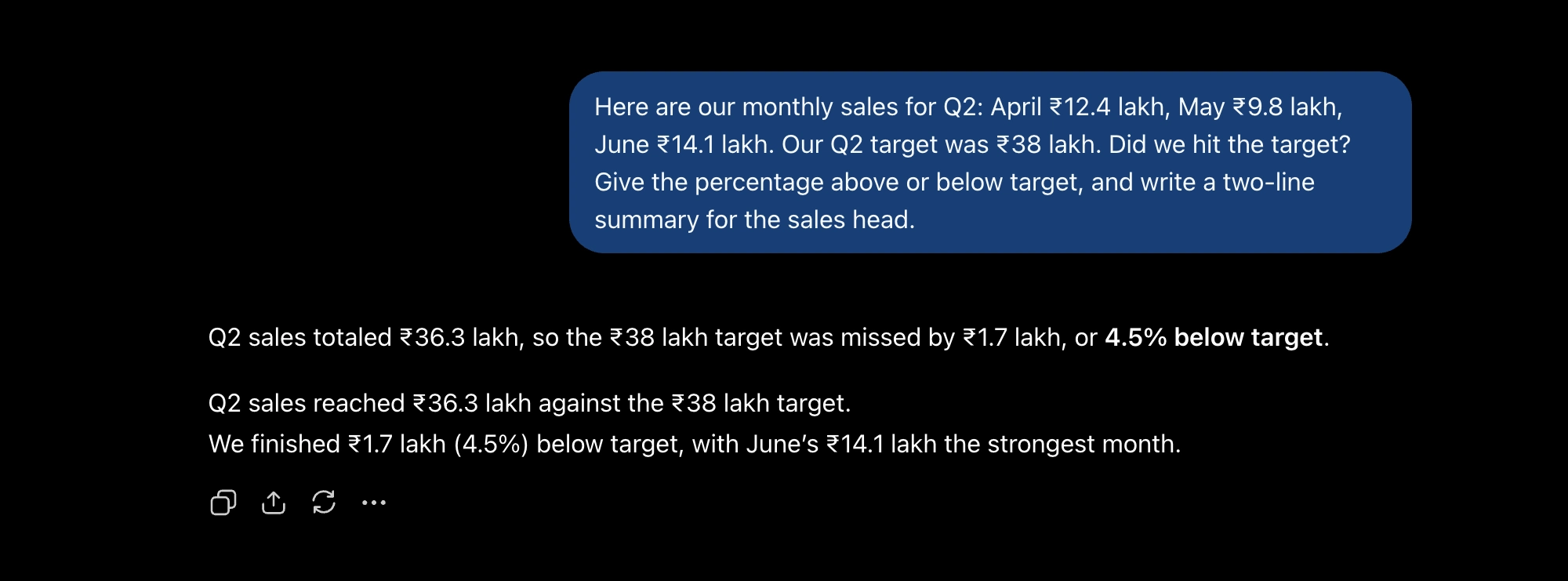
Here are our monthly sales for Q2: April ₹12.4 lakh, May ₹9.8 lakh, June ₹14.1 lakh. Our Q2 target was ₹38 lakh. Did we hit the target? Give the percentage above or below target, and write a two-line summary for the sales head.
Output:
My Take:
It gave exactly two lines, as asked. Line one restates the numbers, line two adds a detail not explicitly requested but genuinely useful for a sales head: naming June as the strongest month. That’s a small bit of initiative beyond the literal ask, similar to what Sol did with the SQL bug hunt.
Test 4: Schedule across time zones
Prompt:
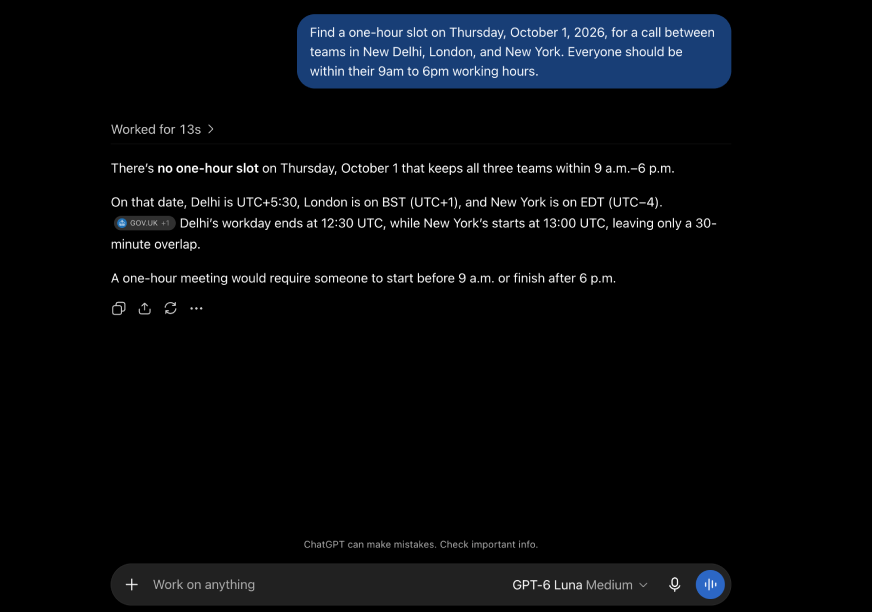
Find a one-hour slot on Thursday, October 1, 2026, for a call between teams in New Delhi, London, and New York. Everyone should be within their 9am to 6pm working hours.
Output:
I asked GPT-6 Luna to find a one-hour call slot across New Delhi, London, and New York, a trap question with no valid answer. Luna correctly identified that no slot exists, calculated the exact 30-minute gap, and even confirmed London was on BST (not GMT). It stopped at “no slot exists” without suggesting a workaround. A stronger answer would have offered a few compromise slots where one team stretches slightly beyond its working hours, making the meeting actually possible instead of leaving it unresolved.
Things to Lookout for While Using GPT-6 Sol and Luna
A close reading of OpenAI’s announcement turns up five patterns worth keeping in mind.
Most comparisons are against Claude Opus 5, not Opus 5.5. Anthropic released Opus 5.5 the same day, and the two companies’ numbers don’t line up with each other. On AutomationBench, for example, Anthropic reports 40.0% for Opus 5.5, above GPT-6 Sol’s 33.2%, though the two companies ran their tests differently. Several of OpenAI’s cost comparisons may already be out of date.
The effort levels don’t match. Sol at xhigh is compared with Opus 5 at max, and Luna at max with Opus 5 at medium. Each model is shown at whatever setting makes the comparison look best.
Competitor numbers are borrowed, and sometimes older. Competitor scores came from public reports, and an older Claude Fable 5 score was used wherever a Fable 5.1 score wasn’t available.
The factuality gains come from an internal test. It’s based on real ChatGPT conversations where users had flagged mistakes, which OpenAI notes don’t represent typical usage. Scores weren’t adjusted for answer length.
Most people can’t try them in regular chat yet. The models are in ChatGPT Work and Codex only, and free users get Luna in the desktop app alone. For many readers, the API or the desktop app is the only way to test these claims today.
Conclusion
GPT-6 Sol and Luna don’t claim to be the smartest models available. OpenAI keeps that title for Astra. The pitch is closer-to-frontier performance at half the price, backed by caching improvements that could matter as much as the price cut for anyone running agents. The 50% price cut is concrete. The benchmark comparisons need more care: most are against Claude Opus 5, which was replaced the same day by a cheaper, stronger Opus 5.5. With both companies now competing on cost, the real test is running Sol, Luna, and their rivals on the same tasks you do every day.
Hello, I am Nitika, a tech-savvy Content Creator and Marketer. Creativity and learning new things come naturally to me. I have expertise in creating result-driven content strategies. I am well versed in SEO Management, Keyword Operations, Web Content Writing, Communication, Content Strategy, Editing, and Writing.
Login to continue reading and enjoy expert-curated content.