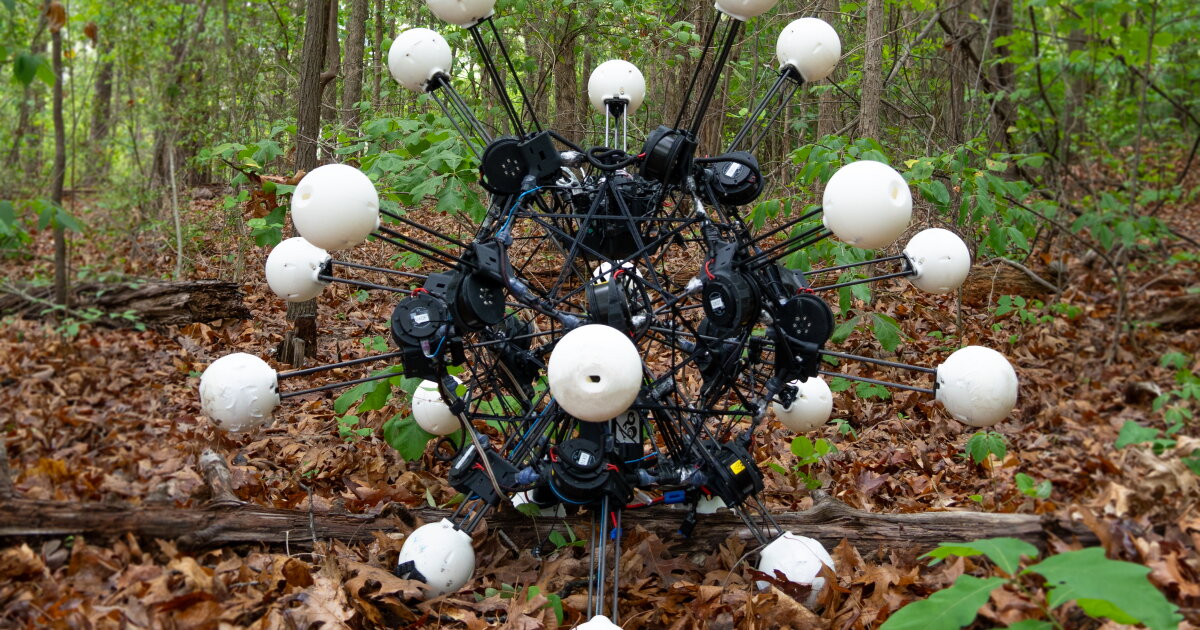
Most of nature – including humans – is symmetrical, and as creations reflect their creators, many robots we create today feature this symmetry, with the general assumption that symmetry is best. Researchers at Duke University have challenged that assumption with Argus, a sea-urchin-like robot that ditches conventional symmetry altogether.
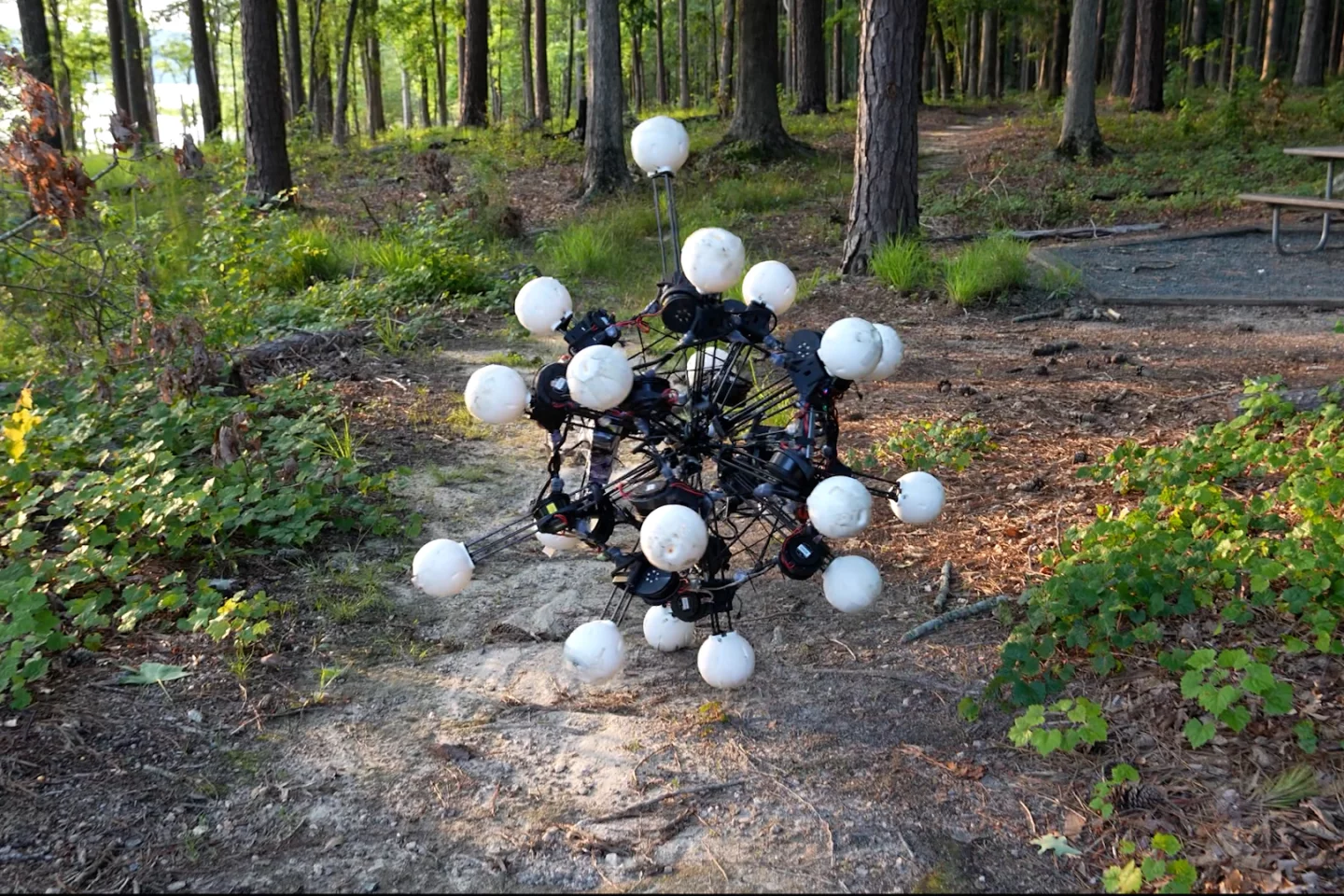
The robot has no front or back and is covered in 20 legs and 20 eyes, each pointing in nearly every direction, giving it the appearance of something that escaped from a mathematics laboratory. However, thanks to this unconventional build, Argus can traverse a wide range of terrains, move with equal ease in almost any direction, and shrug off damage that would cripple many robots.
Duke University
For decades, we have treated symmetry in robotics as a matter of shape. After all, most animals, which are the inspiration for many robots, are symmetrical. But what if shape isn’t the most important type of symmetry? What if symmetry were better defined by how uniformly a robot can move, not how it looks?
This question led Duke researchers to develop a new design principle they call dynamic symmetry, or dynamic isotropy. Instead of measuring how balanced a robot’s body appears, the concept measures how well a robot can accelerate itself in every direction. In simple terms, can it move north, south, east, west, up, or down with roughly the same ease? Think of a robot that can walk back and forth and sideways with equal ease, without having to reorient.

Duke University
“Most robotics research has framed symmetry as a question about the body, but we argue that the more powerful symmetry is at the level of what the robot can do,” says Asst. Prof. Boyuan Chen, leader of the research. “When a robot can accelerate equally well in every direction, it stops needing to face the world in any particular way. Forward and backward become the same. Left and right become the same. The whole problem of robot control changes character.”
To achieve this omnidirectional movement, the researchers simulated more than 1,500 robot morphologies, seeking a body plan that maximized dynamic symmetry. The winning design was the, frankly, weird-looking Argus.
Argus consists of 20 modular telescoping legs radiating from a central body. Each leg is mounted at a vertex of a regular dodecahedron, a twelve-faced geometric shape. This arrangement produces an unusually even distribution of forces around the robot, allowing it to generate movement from almost any direction without needing to reorient itself first.
“Watching Argus move is unlike watching any other robot we’ve worked with,” says Jiaxun Liu, co-first author and PhD student in Duke’s General Robotics Lab. “The first time we saw it navigate among trees and rough terrain, even under heavy collisions, we knew this was something different.”

Duke University
The legs do more than provide locomotion. Each one carries a depth camera, giving the robot what the researchers describe as “whole-body perception.” While traditional robots typically perceive the world through a head-mounted camera or a limited set of sensors, Argus effectively sees through its entire body. Wherever an obstacle appears, chances are one of its 20 cameras is already looking at it.
Thanks to these features, the robot can roll across concrete, grass, sand, wet surfaces, tree bark, dense vegetation, and forest trails, regardless of which side happens to be facing forward. In fact, the concept of “forward” barely applies to Argus at all. It simply moves in whichever direction is most convenient.
The robot also proved surprisingly resilient during testing. Researchers deliberately pushed it, knocked it off balance, and damaged parts of the system. Argus rapidly stabilized itself after collisions and continued moving even when three of its legs were disabled. It also carried a 10-lb (4.5-kg) payload at nearly full speed, tracked and pushed a 3-ft (91.4-cm) cube while rolling, and even climbed vertically between closely spaced walls by alternately bracing and extending different groups of legs.
Meet Argus: An Omnidirectional, Sea-Urchin-Like Robot That Defies Traditional Designs
Argus is the latest in an emerging line of robotics that moves away from traditional shapes toward shapes that mathematical analysis proves are optimal, regardless of their appearance. For instance, we recently covered an AI-evolved adaptable robot that you could literally cut in half, and it would still function.
Now, these robots still have a long way to go before they reach real-word use, and are not automatically the robots of the future. They simply aim to prove that mathematics, not necessarily biology, should be at the wheel in the evolution of robot designs.
Argus, for example, is what they call an “existence proof,” evidence that designing around dynamic symmetry could produce real-world benefits. The team hopes the principle can eventually be applied to everything from search-and-rescue systems and planetary exploration robots to autonomous machines operating in low-gravity environments.
Details of the team’s work are published in the journal Science Robotics.
Source: Duke University


