
With the pace of decline in the traditional US pay-TV sector slowing alongside a bit of growth from the virtual multichannel video programming distributor (vMVPD) segment, a “floor” for the total pay-TV industry appears to be taking shape.
With subscriber declines slowing in recent quarter, “we can now see a base Pay TV floor of 50+ million subscribers by 2030,” MoffettNathanson analyst Craig Moffett noted in his latest quarterly “Cord-Cutting Monitor” (registration required).
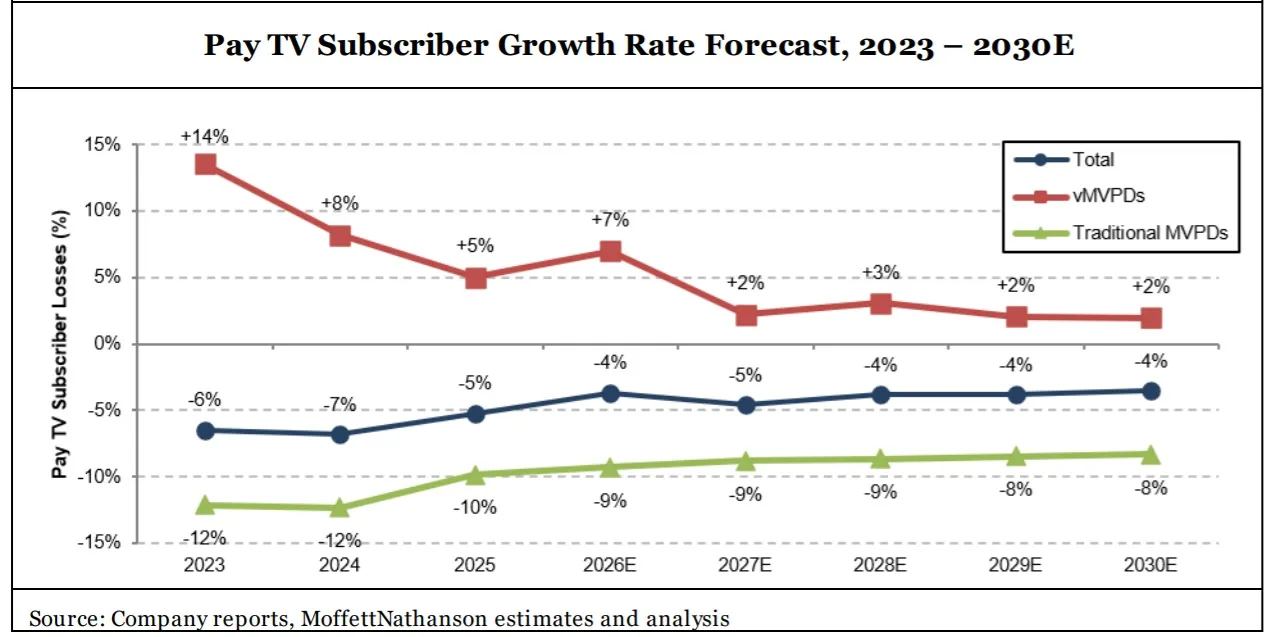
“We are not saying the ultimate floor can’t drift lower in the out years but as long as growth from vMVPDs can mostly offset the declines in traditional MVPDs, we could be closer to the floor than we previously expected,” he explained.
Moffett also stressed that this possible floor for pay-TV doesn’t capture incremental subscribers from streaming services such as ESPN Unlimited or Fox One coming from so-called “cord-nevers” that are incremental and not part of a traditional pay-TV package.
However, it appears the number of vMVPD and traditional pay-TV subs will almost draw even in the coming years. MoffettNathanson estimates that by 2030 the mix will be 49% virtual MVPD subs and 51% traditional pay-TV subs, compared to an expected breakdown of 38% virtual MVPD subs and 62% traditional pay-TV subs at the end of 2026.
The lines between linear TV and streaming ‘are getting blurred’
Still, Moffett said it’s getting increasingly difficult to distinguish differences between what is “linear TV” and what is streaming. “The lines are getting blurred,” he explained, citing examples like Peacock and Paramount+, which both offer an array of premium live sports programming, and Fox One, which streams out linear feeds that include sports and news.
Spectrum (the former Charter Communications) is also altering the status quo of pay-TV by offering the ad-supported tiers of streaming services such as Peacock, Disney+ and HBO Max to pay-TV customers for no added cost.
The business model is also changing as content is shared among traditional networks and their related direct-to-consumer streaming services. “[T]he boundaries around and between networks are beginning to disappear,” Moffett said.
Pay-TV subs losses aren’t great but are less bad
The picture for the US pay-TV sector isn’t bright, but it’s becoming less dim.
The total pay-TV sector (traditional service providers and virtual MVPDs) shed 885,000 subscribers in Q2 2026, improved from a year-ago loss of 1.34 million, or was down 4.6%. The segment ended Q2 with 61.51 million subs comprising 27.5 million cable video subs, 21.42 million vMVPD customers, 9.56 million satellite TV customers, and 3.01 million telco TV subs.
Virtual MVPDs (YouTube TV, Sling TV, Fubo, etc.) combined to add 68,000 subs compared to a year-ago loss of 201,000. YouTube TV was the bright spot with a MoffettNathanson-estimated gain of 50,000 subs in the quarter.
The traditional pay-TV segment lost 953,000 subs versus a year-ago loss of 1.14 million. Within that group, cable operators shed about 445,000 versus a loss of 594,000 a year earlier. Satellite (Dish and DirecTV) lost 386,000 compared to a year-ago loss of 426,000. The telco TV group lost 112,000 subs compared to 126,000 a year ago.
The pace of traditional pay-TV losses improved to -9.2% versus -11.1% in the year-ago period.
“A subscriber decline of over -9% per year certainly can’t be called ‘good.’ But we’ve now had ten consecutive quarters of YoY improvement in the decline rate of traditional Pay TV,” Moffett said.


