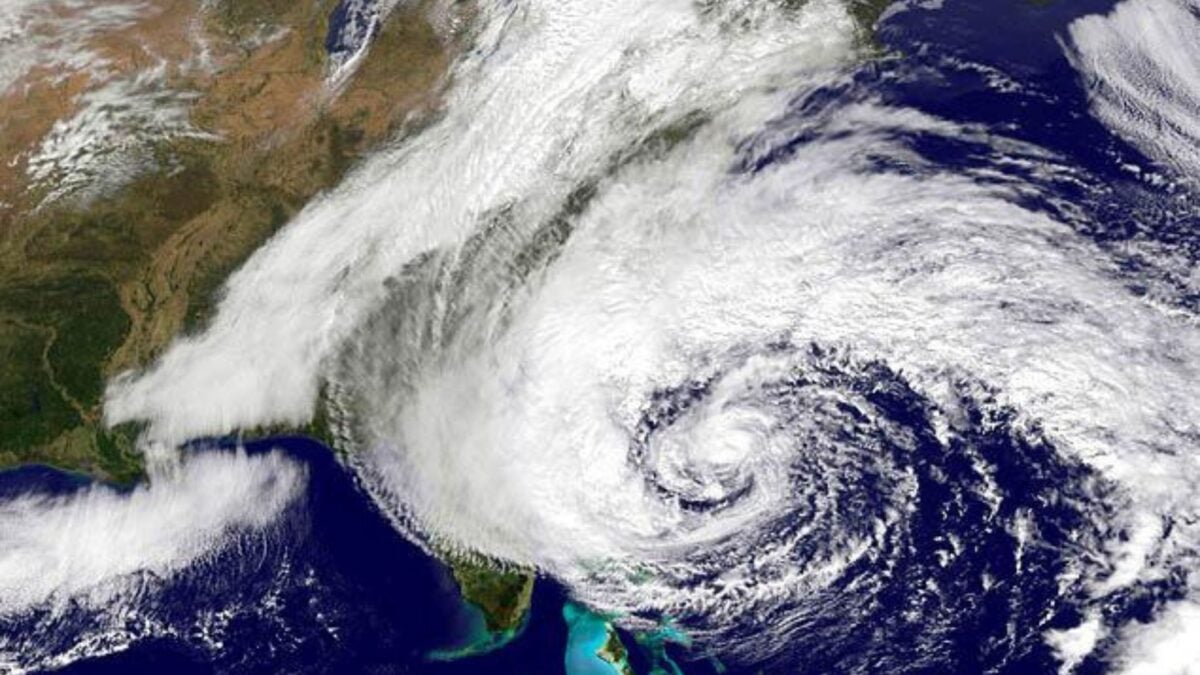
An estimated 60 million people across 24 states felt the effects of Hurricane Sandy as it moved up the Eastern Seaboard in October 2012. New York and New Jersey were hit hardest, suffering extreme storm surge that caused more than $62 billion in damages. If only meteorologists could have manipulated the storm’s path to keep it far offshore.
That may sound like wishful thinking, but the concept of weather manipulation has been a subject of scientific inquiry and debate for decades. A perspectives paper published today in the journal PLOS Water provides new evidence to suggest that meteorologists could, in theory, “nudge” storms like Sandy away from harmful trajectories using small, carefully timed cloud-seeding applications. The researchers call their proposed approach “weather jiu-jitsu.”
“Our physical and financial infrastructure—dams, levees, insurance—consistently gets overwhelmed by the most catastrophic events, and a changing climate is making those gaps worse,” co-author Qin Huang, a PhD student studying the intersection of climate science, AI, and complex systems at Arizona State University, told Gizmodo in an email.
“Meanwhile, dynamical systems theory tells us the jet stream that steers all these extremes is unstable in predictable ways,” Huang said. “We wanted to ask seriously whether that instability could be exploited: a small nudge at the right time and place, amplified by the atmosphere’s own dynamics, redirecting a harmful trajectory before it causes catastrophic impact.”
Learning to control the weather
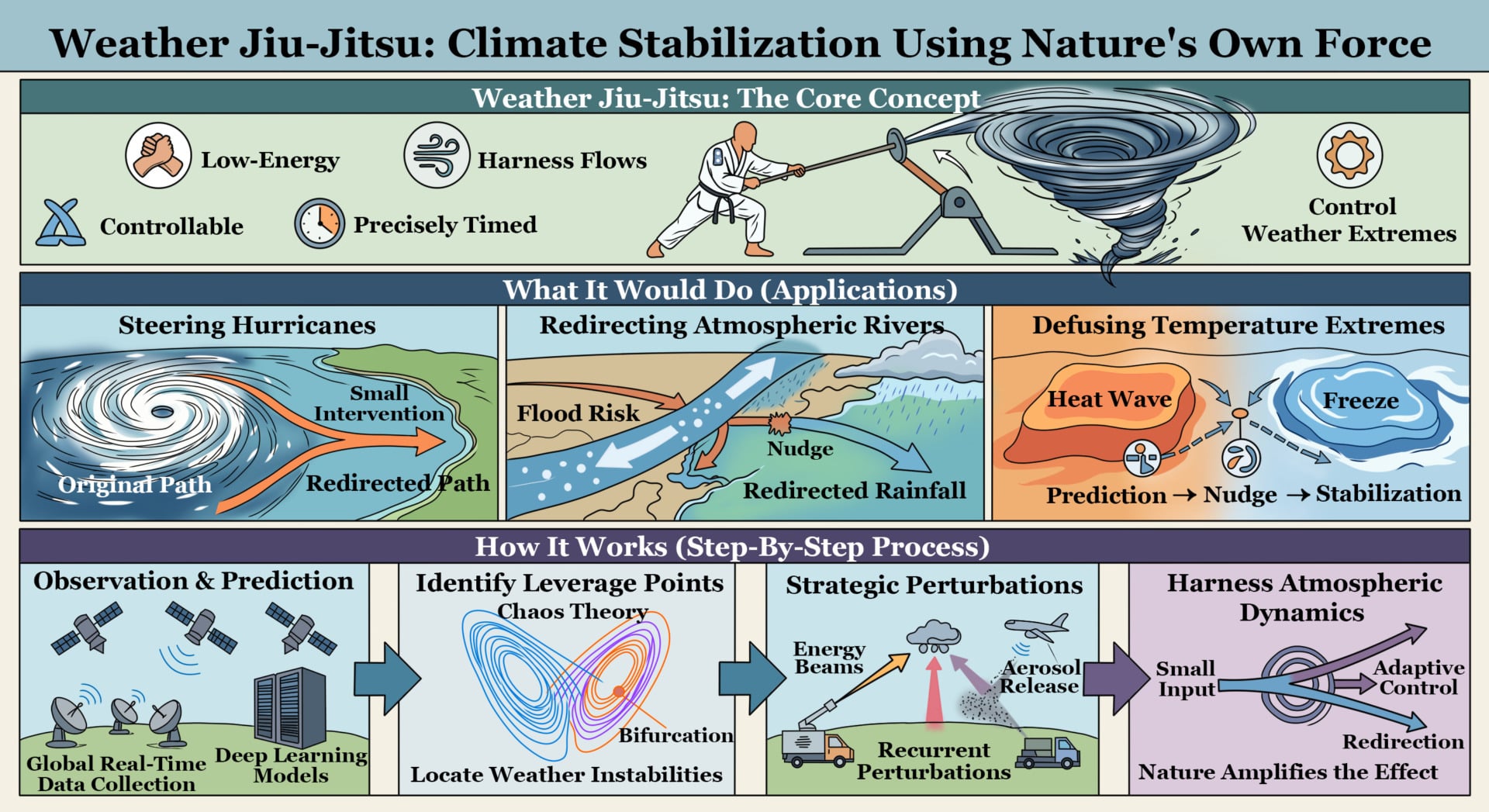
Traditional cloud seeding experiments inject particles into the lower atmosphere to increase local precipitation, but that is not the goal of weather jiu-jitsu. This theoretical weather modification technique would use cloud seeding to create a small atmospheric disturbance, or “perturbation,” days before the peak of an extreme weather event. According to the paper, this could initiate a sequence of events that shifts a storm’s trajectory away from land, protecting people and infrastructure.
“We are not trying to change what happens at the seeding site; we are trying to trigger a cascade that reshapes a weather system hundreds or thousands of miles away,” Huang explained.
She and her colleagues ran proof-of-concept simulation experiments using atmospheric circulation models and Aurora, a large-scale AI model designed for high-resolution weather prediction. They used three past extreme weather events as case studies: Hurricane Sandy, the Texas freeze of 2021, and an atmospheric river that contributed to flooding in California in 2022.
The modeling showed that carefully calculated perturbations applied before the Texas Freeze could have raised minimum temperatures by about 18 degrees Fahrenheit (10 degrees Celsius). Perturbations also could have shifted the trajectory of the atmospheric river and led to a 5% reduction in the amount of water it carried.
As for Hurricane Sandy, perturbations applied one week before the date of landfall could have shifted the storm’s track by roughly 200 miles (322 kilometers) and kept it primarily offshore, modeling suggests. However, Kerry Emanuel, a post-tenure professor of atmospheric science at the Massachusetts Institute of Technology, pointed out that the modified storm track still brought Sandy dangerously close to Cape Cod, Nantucket, and Martha’s Vineyard.
“If you steer it away from New Jersey and it destroys Nantucket, you’re going to be in for some lawsuits,” Emanuel told Gizmodo.
A long road to implementation
This problem highlights an important tradeoff between how much energy can be put into the perturbation and how predictable the outcome is, according to Emanuel. “The less energy you have to put into the atmosphere, the longer you have to let the perturbation grow. Therefore, you have to do the seeding more days in advance, and the outcome is less predictable,” he explained.
“The trade-off is predictability versus energy, and where that optimal state lies, I’m not sure,” Emanuel continued. “Whatever you do, there will be some uncertainty in the outcome, and you can bet people who might be adversely affected are going to be unhappy.”
Huang and her colleagues acknowledge this uncertainty and stress that their study serves as a first proof-of-concept for weather jiu-jitsu rather than a fully optimized modification experiment. “Our goal was to show that a small perturbation produces a measurable track shift,” Huang said. “What I can say is that an operational system would require a more sophisticated objective, not just diverting the storm but continuously steering it toward the open ocean, with the trajectory re-evaluated and corrected at each step.”
That is the next phase of this research, but the authors acknowledge additional technical, legal, social, and environmental challenges that future studies would need to address before implementation. For his part, Emanuel is skeptical that cloud seeding is the best way to create these perturbations, as it only works under certain meteorological conditions.
Huang and her colleagues plan to investigate what a realizable perturbation actually looks like in practice. “In the longer term, our team envisions field experiments in safe settings—attempting to steer a storm entirely over the open ocean, far from any populated coast, as the bridge between simulation and any prospect of real operational use,” she said.
That’s a long time coming, so for now, nature will remain in charge. But as climate change exacerbates the threat of extreme weather, the prospect of nudging storms away from land may become too tempting for scientists—and society—to ignore.


