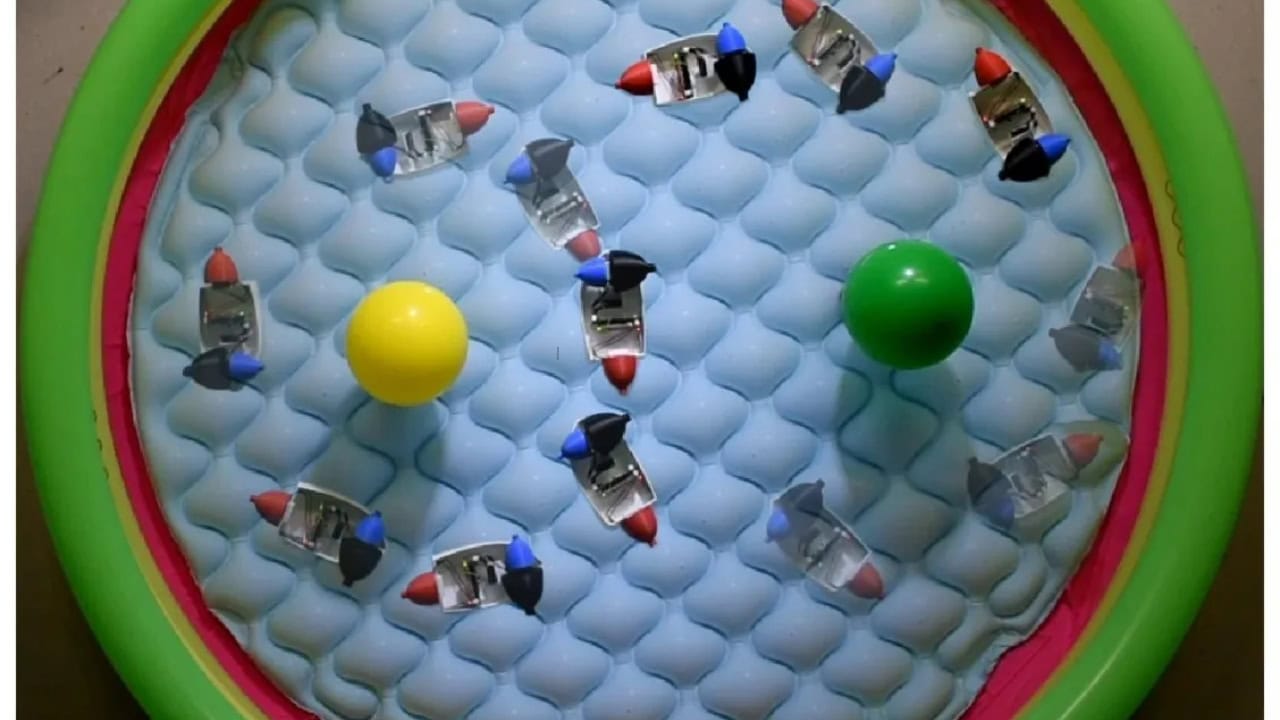
Researchers at the MicroBioRobotic Systems Laboratory, part of EPFL in Switzerland, have turned acoustic energy into movement using a basic physical effect that is easy to replicate at home.
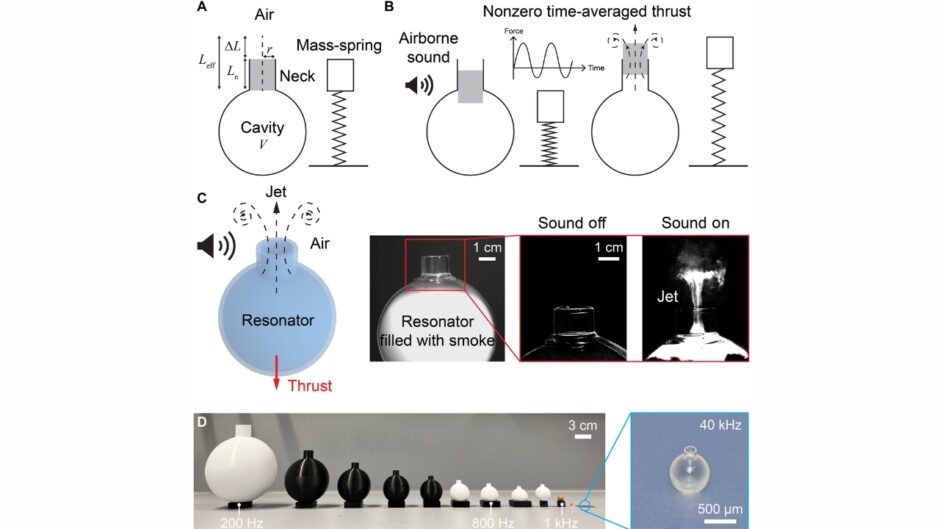
Just as blowing across the top of an open bottle creates a tone via Helmholtz resonance, air moving past a cavity causes the trapped air inside to vibrate. This oscillation amplifies significantly at specific frequencies. The EPFL team capitalized on this mechanism to design micro-robots driven entirely by sound waves.
To translate sound into physical propulsion, the investigators designed hollow, circular, and bell-shaped acoustic chambers. As sound excites the air trapped within these enclosures, the pulsating air escapes as a focused jet, whereas the intake of replacement air stays scattered.
This asymmetry creates net directional thrust. This technique marks a departure from traditional acoustic levitation; rather than relying on external sound fields to push floating objects, these devices utilize sound internally to drive their own propulsion.
Two distinct size categories of these machines were successfully tested. For the centimeter-scale version, the group constructed small watercraft outfitted with up to three chambers, each calibrated to a distinct audible pitch.
By altering the frequency of the sound, operators could independently trigger specific chambers, allowing the vessels to travel forward, navigate around barriers, and execute programmed, autonomous routes without needing any onboard circuitry.
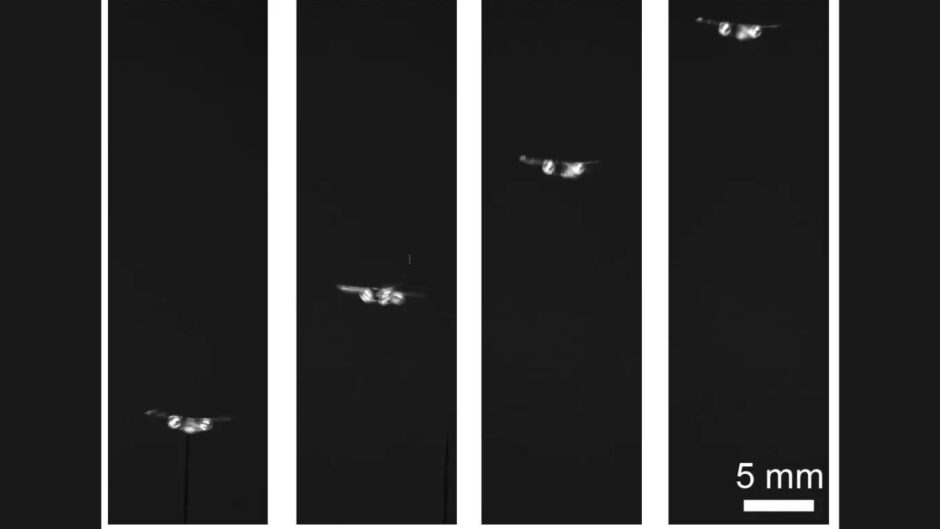
At the microscopic level, flying prototypes achieved even greater feats. Fabricated via 3D nanoprinting, these featherweight airborne devices featured three tiny resonant chambers built directly into polymer frames. One model, tipping the scales at a mere 150 micrograms, utilized its cavities for vertical, rocket-like lift-off.
A second variant paired the chambers with miniature blades rotating at up to 13,000 RPM to achieve steady, helicopter-style aerodynamic flight. High-frequency, silent ultrasound drove these tiny fliers.
Operating without batteries or internal power supplies removes the mass, mechanical friction, and reliability issues common to standard robotic systems. Since propulsion comes from empty cavities rather than gears, motors, or magnets, the machines can be scaled down dramatically.
These resonant structures can be manufactured via 3D printing using conventional plastics, flexible polymers, or glass. Potential uses range from targeted drug delivery within the human body to ecological surveillance in dangerous areas and outer space missions.
Furthermore, the absence of batteries removes the danger of electrical arcs or hazardous chemical leaks, making the technology safe for inspecting industrial pipes and volatile environments where standard electronics would break down.
The findings were detailed in the journal Science Advances.


