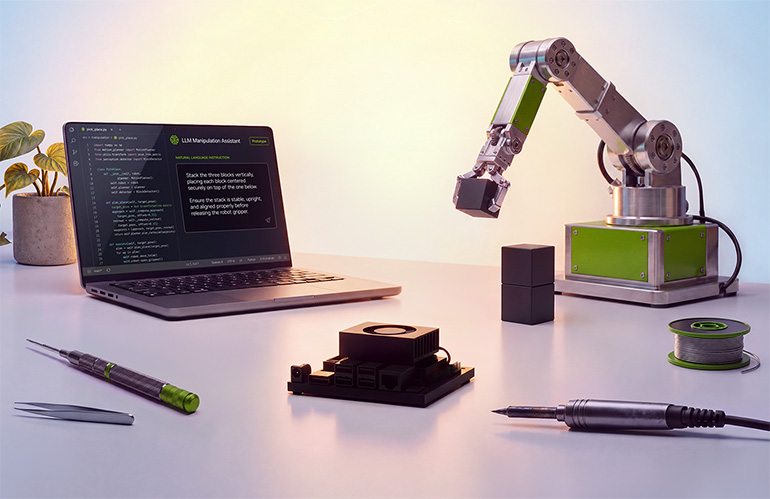
Jetson Orin Nano 2 consumes less power at the same performance level of its predecessor. Source: NVIDIA
As AI models become more efficient, more devices can become autonomous, but developers need compact, energy-efficient computers built for edge AI, asserted NVIDIA Corp. The company today introduced NVIDIA Jetson Orin Nano 2, a new entry-level computer for edge AI that it said enables millions of developers worldwide to build systems for physical AI applications.
“Today’s small and medium frontier models have reached the accuracy of last year’s largest frontier models, unlocking real time intelligence for edge devices,” stated Deepu Talla, vice president of robotics and edge AI at NVIDIA. “The Jetson Orin Nano 2 computer puts that breakthrough within reach of millions of developers, delivering the performance and energy efficiency needed for real-time reasoning in smart drones, robots, and vision AI systems.”
“Over the past three months, we’ve seen the evolution of open models powering physical AI and how important they’ve become,” he added during a press briefing. “One year ago, frontier models which were 600 billion or 1 trillion parameter models. A year later, we’re able to bring that level of accuracy all the way down to intro-level edge AI products in Orin Nano 2. This is amazing.”
NVIDIA Jetson Orin Nano 2 is part of the company’s “three-computer, full-stack” approach to robotics, with Omniverse with Cosmos providing simulation for testing, DJX supporting training, and Jetson as the “robot brain” providing runtime deployment.
 Register now and save on your pass to RoboBusiness 2026
Jetson Orin Nano 2 advances accuracy, processing speed
“Jetson Orin Nano 2 delivers a significant leap in AI and video processing performance in a cost-effective, power-efficient system,” said NVIDIA. The system features 78 trillion operations per second (TOPS) of AI compute, 8GB of memory, and an eight-core Arm CPU.
Jetson Orin Nano 2 doubles the inference performance of Jetson Orin Nano Super through improved Tensor Cores and higher memory bandwidth, while maintaining the same compact form factor. In 15-watt mode, Jetson Orin Nano 2 consumes 40% less power to deliver the same peak-to-peak performance as its predecessor, Talla told The Robot Report.
NVIDIA noted that its existing open software stack can run on Nano 2, which is built on the same GPU architecture as data centers. It is designed to be a drop-in for existing Orin customers.
In combination with Jetson agent skills and the company‘s technology ecosystem, developers can now run the latest large language models (LLMs) and vision language models (VLMs) optimized for memory-efficient edge inference. These include open models such as NVIDIA Cosmos and Nemotron, Gemma 4, and Qwen 3.
“This now suddenly unlocks a level of intelligence that was impossible — we’ve been dreaming about this for a decade in edge AI,” said Talla during a press briefing. “This is a significant moment in time, where now for all of these robotics and physical AI applications, we can actually put frontier AI models such as LLMs and VLMs on top of the other autonomous capabilities. We believe this will speed up the development and deployment of AI in the physical world.”
NVIDIA had already refreshed its higher-end Jetson offerings, including the Orin NX, Orin, and T3000/T2000 for mainstream applications and the Jetson T5000/T4000 for advanced uses.
Developers use NVIDIA stack for physical AI applications
NVIDIA said that more than 3 million developers are already building on its robotics stack. Partners such as Cognex, Doosan Bobcat, Matic, and Wing are evaluating or using Jetson Orin Nano 2 for real-world edge AI in compact devices.
“Thousands of companies ship with entry-level edge AI on Jetson, and more than 10,000 companies are shipping or developing products built on Jetson,” said Talla.
Alphabet subsidiary Wing is using Jetson Orin Nano Super and the NVIDIA software stack in its delivery drone fleet. It plans plans to evaluate Jetson Orin Nano 2 to advance real-time AI perception and reasoning for faster, safer deliveries from local businesses to residential yards.
“Drone delivery depends on AI that can enable fast, reliable understanding of the real world,” said Dinuka Abeywardena, head of perception at Wing. “Wing is exploring Jetson Orin Nano 2 to give us a path to more responsive, energy-efficient drones that can help make deliveries quicker and more dependable for customers.”
Matic Robots is using Jetson Orin Nano 2 to enable more intuitive interactions with its home cleaning robots. The company is giving the robots conversational AI, gesture detection, precision mapping and semantic understanding of the home environment, and greater autonomy.
“Home robots need to understand people, map spaces precisely, understand the layout of objects and spaces, and clean autonomously in dynamic and constantly changing environments,” said Navneet Dalal, co-founder and CEO of Matic Robotics. “With Jetson Orin Nano 2, Matic can run state-of-the-art AI models at the edge in a compact home robotics platform built for real-time perception, interaction and navigation.”
“The problem with companion robots has been that the intelligence has not been good, but now, with the availability of all this frontier-level intelligence, which can run in real time on Orin Nano or Orin Nano 2, we can enable a new class of applications,” said Talla. He also mentioned Hugging Face‘s Reachy Mini, which uses a small LLM for speech recognition.
NVIDIA cited AAEON, ADLINK, Advantech, Aetina, Antmicro, Aptiv, Auvidea, AVerMedia, Chuanglebo, Connect Tech, ForeCR, JWIPC, Neurealm, Plink, Realtimes, RidgeRun, RS, Seeed Studio, Tauro Tech, Twowin, TZTek and YUAN as other Jetson partners building carrier boards, hardware, customized AI software, and reference systems to help customers accelerate time to market.
Talla said he expects NVIDIA’s technology to enable generalized navigation and dexterous manipulation, as well as improvements in robot training, safety, and independence. NVIDIA said the Jetson Orin Nano 2 module and developer kit will be available in the first half of 2027.
The post Jetson Orin Nano 2 doubles inference performance for robotics on the edge, says NVIDIA appeared first on The Robot Report.


