
Shopping ad click-through rates are rising while impressions are falling, according to an analysis by Mike Ryan, head of ecommerce at Smarter Ecommerce — a pattern he thinks could be connected to how Google serves AI Overviews.
Why it matters. AI Overviews have created what Ryan calls the SEO “crocodile effect,” where publishers gain impressions but lose clicks. Shopping ads appear to be experiencing the opposite: fewer impressions, but higher CTRs.
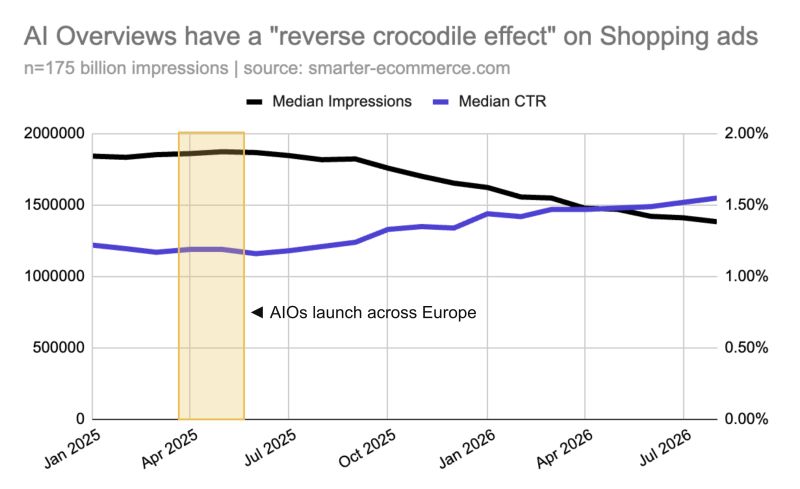
Why we care. Rising Shopping CTRs may not mean ads are performing better, they may simply be appearing less often. If AI Overviews are changing which queries receive Shopping ads, advertisers may need to look beyond CTR and pay closer attention to impression volume, clicks and overall traffic when judging performance.
Driving the news. Ryan had been seeing Shopping CTRs climb in Smarter Ecommerce’s Market Observer benchmark data. After separate ecommerce data from Optmyzr showed CTR up 17% year over year — close to the roughly 20% increase he was seeing — he took a deeper look.
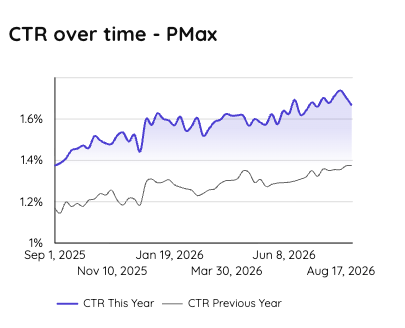
Across thousands of Shopping and Performance Max campaigns spanning hundreds of advertiser accounts, Ryan found a consistent pattern: clicks were often relatively flat or slightly down, while impressions had fallen more noticeably.
In other words, Shopping ads aren’t necessarily generating significantly more clicks. They’re being shown less often, which is pushing CTR higher.
The intrigue. Ryan’s hypothesis is that AI Overviews could help explain why.
He theorizes that Google may be more likely to serve AI Overviews for queries with a lower predicted likelihood of generating an ad click, while preserving Shopping ad placements for searches with stronger click propensity.
If that’s happening, Google could reduce the overall number of Shopping ad impressions without reducing clicks at the same rate.
That would allow two seemingly contradictory things to be true: AI Overviews could suppress some advertising opportunities while Google’s remaining ads continue to monetize effectively.
Between the lines. Ryan describes the idea as “experience switching.”
Depending on the query, Google already serves very different Shopping experiences in its main search results. Ryan also says that, anecdotally, he rarely sees Shopping ads and AI Overviews together on the same SERP — it’s typically one or the other.
That raises the possibility that Google is becoming more selective about when each experience appears.
Yes, but. Ryan is clear that the data doesn’t prove AI Overviews are causing the change.
The timing could be coincidental, AI Overviews could be contributing through another mechanism, or something else entirely could be responsible for the decline in impressions.
For now, it’s a hypothesis.
The big picture. If Ryan’s theory is right, the current pattern could be temporary.
He expects Google to move from more “either/or” search experiences toward “both/and” experiences as it develops AI-native advertising formats and puts more Shopping ads directly inside AI Overviews.
What to watch. For advertisers, the key signal isn’t simply that Shopping CTR is rising. It’s why it’s rising.
If higher CTR is being driven partly by Google showing Shopping ads less frequently and on more commercially valuable queries, traditional CTR benchmarks could start telling a very different story about campaign performance.
Dig deeper. Mike Ryan shares dreaded reverse crocodile effect of AI Overviews


