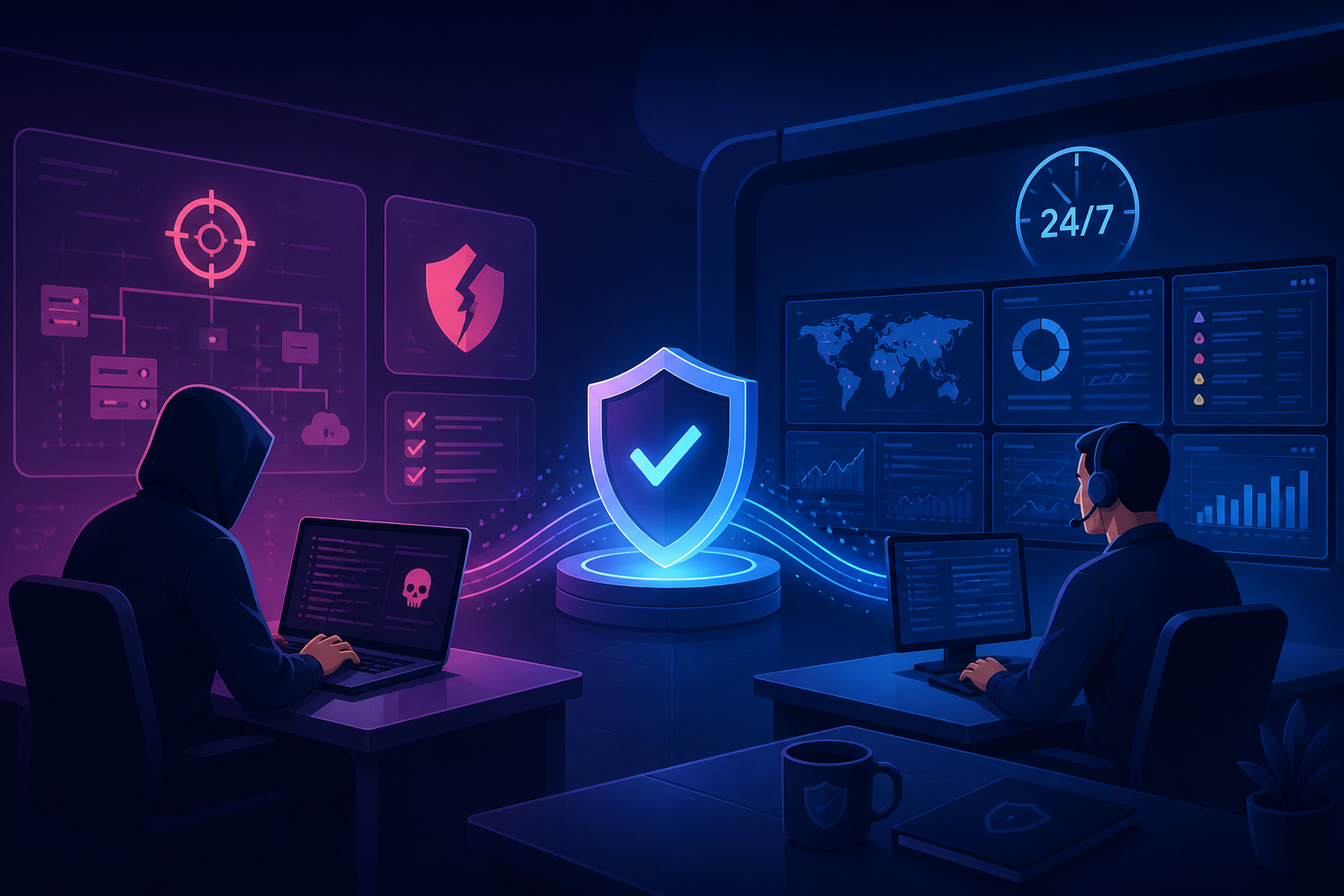
The best MDR providers combining offensive security testing with 24/7 monitoring do not just sell both capabilities under one contract; they actively feed penetration testing results into security operations center (SOC) detection rules. Providers like DeepSeas, Rapid7, eSentire, Sophos, Arctic Wolf, Trustwave, and GoSecure represent the top options bridging this divide today. For years, offensive and defensive teams operated in separate organizational silos. Red teams tested environments and produced static reports, while SOC analysts fielded alerts without seeing the adversary techniques used during those drills. Attackers exploit that seam. When findings directly update your detection playbooks, and unresolved defensive blind spots shape the next test scenario, security operations sharpen with every exercise.
Demand for unified defense is accelerating as environments grow more complex. According to research from MarketsandMarkets, the global MDR market is projected to reach $17.64 billion by 2031, driven largely by organizations seeking to close internal skill gaps and replace fragmented tooling with continuous, coordinated defense.
What “Combining” Actually Means Here
True integration means your offensive testing directly updates your defensive detection rules in an automated or structured feedback loop. Most cybersecurity vendors offer both services, but few connect them operationally. Before comparing vendors, it helps to distinguish three levels of integration, because only the deepest delivers meaningful defense:
- Bundled but separate: The provider sells penetration testing and MDR as distinct engagements that share a sales team and an invoice. Findings from an exercise rarely change monitoring configurations.
- Referral and hand-off: The offensive testers deliver a final report to the SOC, which reviews the document manually. This approach helps, but it relies entirely on individual engineers remembering to follow up.
- Closed loop by design: Offensive findings automatically trigger updates in detection rules, while documented SOC visibility gaps define the scope of future penetration tests.
The rest of this guide evaluates each provider on where it sits on that integration scale. We also examine traditional core criteria: the practical depth of the offensive practice and 24/7 SOC maturity. Attack surface scope and demonstrable operational improvement complete the evaluation.
The 7 MDR Providers, Ranked by How Closed the Loop Is
1. DeepSeas: The Closed Loop, by Design
DeepSeas is built around the exact premise this article describes: offense and defense as one continuous system rather than two purchases. Its offensive suite, DeepSeas RED, pairs directly with DeepSeas MDR+, so adversary intelligence gained during a simulated exercise flows straight into active threat hunting rules.
The offensive side
The vendor’s DeepSeas RED suite delivers a complete offensive practice, including red teaming, penetration testing, and continuous security validation, expanded through the acquisition of RedTeam Security. Engagements simulate complete attack paths across identity directories, cloud environments, and user endpoints. Testers map how adversaries move through a corporate network rather than compiling a checklist of isolated flaws.
The monitoring side
On the defensive side, DeepSeas MDR+ delivers 24/7 threat detection and response across operational technology and corporate IT networks. Protection also covers cloud infrastructure and mobile fleets, backed by decades of defensive operations and a top-five Frost Radar ranking in MDR. The SOC serves more than 350 organizations, including Fortune 100 enterprises.
Best for
- Closed-loop maturity: Offensive findings and SOC telemetry feed each other by design rather than through manual hand-offs.
- Full offensive suite: Red teaming, penetration testing, and continuous validation managed under one operational team.
- Converged monitoring: 24/7 detection across operational technology, corporate IT, and cloud resources.
- Proven scale: Over 350 enterprise clients, including Fortune 100 companies.
- Measurable improvement: Engagements that lift detection and response metrics instead of simply documenting vulnerabilities.
2. Rapid7
Rapid7 pairs an around-the-clock SOC with an established vulnerability management practice, connecting active attacker behaviors with exposed internal assets. Its Managed Threat Complete package bundles managed detection and response with broad vulnerability assessments on the Insight platform.
The offensive side
Rapid7’s primary proactive strength lies in vulnerability management and attack surface visibility through InsightVM, alongside hands-on penetration testing. Its heritage with the Metasploit project gives the organization deep roots in adversarial tooling, helping security teams prioritize flaws based on real-world exploitability.
The monitoring side
Managed Threat Complete delivers 24/7 SOC coverage built on the InsightIDR SIEM, supported by bi-directional Microsoft Defender integration and bundled incident response. It is a solid choice for mid-market and enterprise teams seeking customizable detection engineering.
3. eSentire
eSentire provides both halves of the security equation by offering dedicated offensive security services alongside its multi-signal MDR platform. The vendor protects a large international customer footprint through continuous monitoring and automated disruption.
The offensive side
eSentire conducts penetration testing and red team simulations designed to discover exploitable weaknesses before adversaries locate them. This gives customers access to specialized ethical hackers who can validate defensive controls under realistic conditions.
The monitoring side
Its multi-signal MDR combines XDR technology with 24/7 threat hunting across endpoints, networks, and cloud workloads. Identity stores feed into those same investigations. eSentire is known for hands-on remediation and for protecting thousands of customer environments worldwide.
4. Sophos
Sophos provides around-the-clock detection through global operations centers using an architecture that integrates with third-party tools. Its offensive testing assessments complement that defensive core, with additional threat intelligence capabilities gained through its integration with Secureworks.
The offensive side
The company delivers penetration testing and posture assessments. The combination with Secureworks brings deep adversarial research and countermeasure development, supporting the broader Sophos Adaptive Cybersecurity Ecosystem.
The monitoring side
For defensive operations, Sophos MDR analysts ingest telemetry from firewalls, email gateways, identity providers, and cloud environments, alongside native Sophos sensors. Its vendor-agnostic ingestion model and preapproved response playbooks make it practical for organizations with diverse software environments.
5. Arctic Wolf
Arctic Wolf runs a concierge SOC model, pairing customers with named security experts who guide detection, incident containment, and posture management over time. It has built a major footprint in the mid-market through steady customer support and continuous risk reduction.
The offensive side
Arctic Wolf focuses mainly on defensive monitoring and external attack surface management rather than full-scale adversarial red teaming. In-depth penetration testing or custom exploit testing is typically delivered through third-party partners rather than internal red teams.
The monitoring side
Defense is Arctic Wolf’s primary strength. Its Concierge Security Team provides dedicated guidance, documented runbooks, and 24/7 alert handling across endpoints, identity directories, and cloud infrastructure, while pulling in network telemetry to minimize alert fatigue.
6. Trustwave
Trustwave is a long-standing managed security provider combining 24/7 SOC operations with deep offensive expertise through its SpiderLabs unit. The firm brings extensive operational history to both sides of the cyber discipline.
The offensive side
The SpiderLabs team provides penetration testing, physical security assessments, red teaming, and threat research. That investigative background provides customers with detailed insight into novel exploit chains and adversary tradecraft.
The monitoring side
Trustwave runs global security centers that supply 24/7 detection and response across hybrid cloud and on-premises environments. Its portfolio covers managed detection, database protection, and compliance management for enterprises and government agencies.
7. GoSecure
GoSecure delivers managed detection and response alongside hands-on testing services, tailoring its operations to mid-market organizations that want proactive testing and around-the-clock defense from a single vendor.
The offensive side
GoSecure maintains an offensive security unit capable of conducting web application penetration tests, wireless assessments, and red team engagements. These evaluations help clients find exploitable gaps before deploying critical systems into production.
The monitoring side
Its MDR team provides continuous monitoring, automated mitigation, and live threat hunting. The service targets organizations that need rapid containment capabilities without the overhead of building an in-house security operations center.
Why the Offense-Defense Loop Beats Either Half Alone
Independent security evaluations routinely fall short when they operate in isolation from everyday defense. When penetration testers uncover an exploitable pathway, their final report rarely alters defensive configurations on its own. Meanwhile, front-line monitoring teams stay restricted by the default detection logic configured in their systems. Without active input from offensive exercises, analysts have little visibility into how creative attackers chain minor misconfigurations together. Separation creates that risk.
Closing the loop resolves the dwell-time crisis facing enterprise infrastructure. According to the IBM Cost of a Data Breach Report, the average breach lifecycle spans 241 days, with organizations taking 181 days to identify an intrusion and another 60 days to contain it. When an offensive drill tests live telemetry, defensive engineers can verify whether alerts fired, identify where triage stalled, and rewrite playbooks within days rather than months.
Telemetry feedback also reshapes future offensive work. If your SOC repeatedly struggles with lateral movement alerts in cloud environments, that weakness becomes the exact attack path the red team simulates next quarter. Testing stops being a generic compliance checkbox and becomes a targeted hardening tool. For a business leader, the question to ask a prospective vendor is simple: show us how an offensive finding last month changed a defensive detection rule this month.
FAQs
What does it mean to combine offensive testing with MDR?
It means linking proactive evaluations, like penetration testing and red teaming, directly with 24/7 security monitoring. Findings from offensive tests are used immediately to update detection signatures and response playbooks, while identified monitoring blind spots establish the targets for future testing.
Why do offense and defense work better together?
Simulated attacks expose actual bypass techniques before adversaries exploit them in production. Integrating those findings into live monitoring allows analysts to tune alert thresholds against demonstrated tactics. Over time, recurring tests validate whether previous detection gaps were resolved.
Isn’t offering both services the same as combining them?
No. Many providers market penetration testing and MDR on the same webpage, but deliver them through disconnected business units. A true closed loop requires operational workflows where offensive engineers share attack telemetry directly with detection engineers to adjust active defensive controls.
What is the difference between MDR and red teaming?
Managed detection and response provides continuous defensive surveillance, with human analysts investigating anomalous behavior and isolating compromised assets. Red teaming tests that resilience by staging realistic adversary campaigns against your systems. When evaluating an MDR provider, verifying that these two functions actively inform one another ensures your defensive spend translates directly into hardening your business against real-world compromises.


