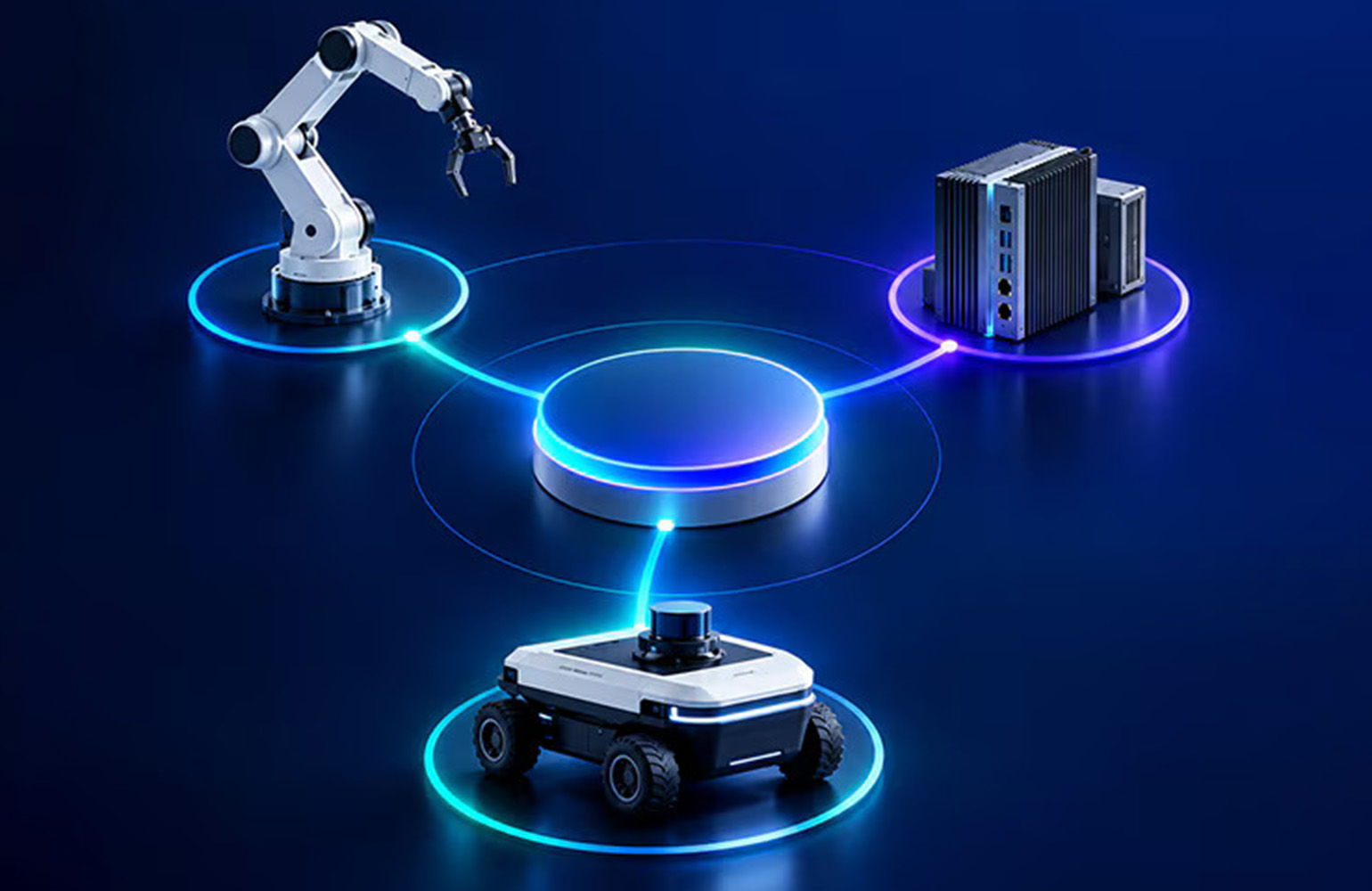
Autonomous vehicles and robotics are tackling similar challenges across perception, AI, real-time control, safety, and efficient computing. | Source: Arm
Arm Holdings PLC recently released Arm Total Design for Physical AI, a program that brings together more than 80 companies spanning the physical AI technology stack. The company also introduced a Robotics Capability Framework as a starting point for a common language to define and advance robotic capabilities.
“The goal with Arm Total Design for Physical AI is to bring together those companies that are participating in the physical AI space, but are maybe looking at ways to work better together,” Dermot O’Driscoll, vice president of go-to-market and customer solutions for physical AI at Arm, told The Robot Report.
Already, the program’s members include AWS, ECARX, Hugging Face, Liquid AI, NXP, PlusAI, Psyonic, QNX, Qwen, Siemens, Unitree Robotics, and others. O’Driscoll said Arm drew on its experience from building a similar community in the cloud ecosystem when it started creating Arm Total Design.
“We built that in the cloud ecosystem, and then when I moved over to the physical AI space in March, I noticed that we had the same gap,” he recalled. “There was no place where companies could come together and either share technology and ideas, or collaborate.”
Arm Total Design aims to increase interoperability
Robotics is a fragmented industry, bringing together people from a range of disciplines and industries. Any single completed system could include hardware and software from any number of companies. Arm said it hopes to help ease the challenges that come with this, struggles the Cambridge, U.K.-based company saw firsthand.
“There were a lot of people wanting to build solutions on the Arm architecture but struggling to either get partnerships going or get companies to enable that or to make things worth together,” O’Driscoll said. “So, it was worth us putting together an ecosystem whereby we could seed in our IP, our technology, and other partners could bring their technologies.”
Arm Total Design for Physical AI brings together expertise in software stacks, AI models, sensors, compute hardware, virtual platforms and digital twins to enable companies to develop and validate interoperable systems earlier.
“We think that the ecosystem could really use a point of coherence where companies can come together,” O’Driscoll said. “It’s for everything from the silicon ecosystem to cloud companies, to companies in the actuation and sensing space, to companies building software frameworks, to people doing security and safety, all the way up to and including a whole bunch of robotics companies and end-customers.”
Robotics Capability Framework to encourage collaboration
Arm said its Robotics Capability Framework will define levels of increasing sophistication for robotic systems. O’Driscoll claimed that this framework can help those within and outside of the industry to better understand robots.
“Robots are being used,” he said. “They’re being propagated, but it’s a bit fragmented in how we talk about them, and how we define them.”
To start, Arm has identified six levels of capability, from zero to five. On one end, you have robots that can react to stimuli and execute commands, but must adhere to fixed rules. On the other end, you have robots with evolving behavior that learns and self-optimizes. Moving forward, however, Arm wants to hear from the industry, and is open to adjusting these levels.
“Those original six were the ones that stood out to us as the areas and the types of robots that are being deployed in places today, and sort of give you a clear understanding of where companies are taking the industry,” O’Driscoll said. “We’re inviting people to come and work with us on this. We think that this is something that’s better done as an ecosystem, as a community.”
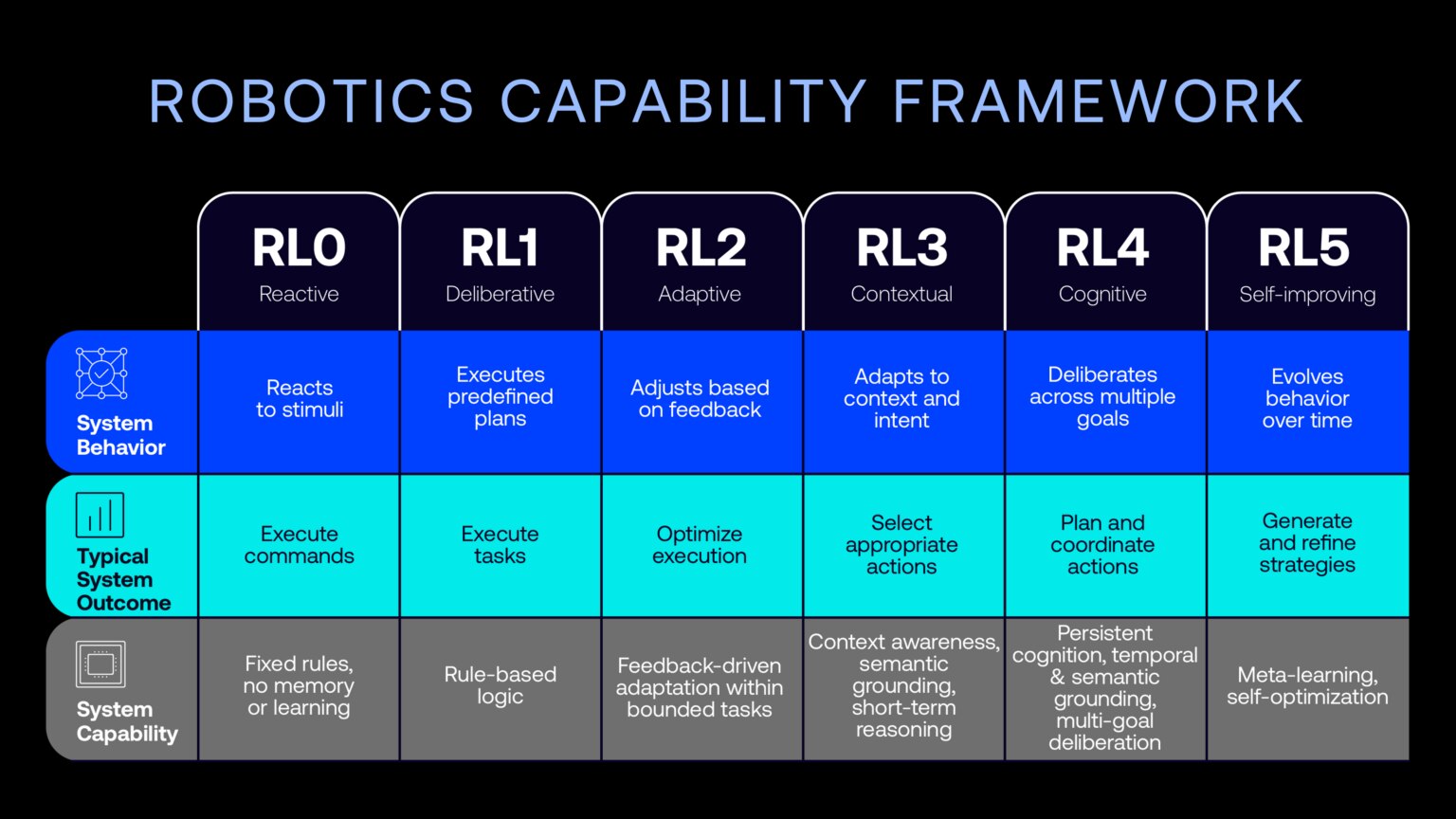
A Robotics Capability Framework maps levels of sophistication, from reactive to context-aware, cognitive, and self-improving systems. | Source: Arm
Robotics has more to learn from the automotive industry
Arm has a long history in the automotive industry. According to O’Driscoll, every vehicle out there today does some, if not all, of its computing on an Arm chip. From that experience, the company saw that robotics and automotive manufacturers require similar safety criticality, real-time computing, computer vision capabilities, and more.
This is why the company took inspiration from SAE International’s levels of autonomous driving for its framework. “Robotics is more complex and, therefore, it’s more of a multi-dimensional framework. That’s what made us think there’s an opportunity to bring a little more organization to it,” O’Driscoll said.
On the Arm Total Design side of things, O’Driscoll said automotive companies are also recognizing this overlap with robotics, and are interested in getting involved in the industry.
“A lot of [automotive] companies are looking at robotics and going, ‘Wait, the technology we developed in the automotive space could also be used in the robotics space,’” O’Driscoll said. “So we were very quickly able to connect with existing partners.”
Arm aims to ease robot development and deployment
O’Driscoll said Arm Total Design and the Robotics Capability Framework go hand in hand. With Arm Total Design for Physical AI, the company aims to make it easier to build robotics applications. With its framework, it aims to make it easier to deploy that technology.
“That common language will fast-track deployments as people start to figure out where robots can be used,” O’Driscoll said. “The next step of this is to start bringing these companies together in settings where they can collaborate.”
Looking ahead, Arm said it wants to continue growing its community and creating opportunities for collaboration. The company plans to start running sessions with its members in the coming months. O’Driscoll said its important for Arm to give its members real benefits sooner rather than later.
“There’s a benefit both from a technical perspective and a commercial perspective to being part of an ecosystem that is helping shape and guarantee the interoperability of solutions within a robot,” he said.
Companies interested in being part of Arm Total Design can request to join.
Editor’s note: O’Driscoll will leading the session on “Building Physical AI that Scales,” at RoboBusiness 2026, which will be on Oct. 20 and 21 in Santa Clara, Calif. This year marks the 20th anniversary of the event, which is produced by The Robot Report and Arrowfly. Buy your full conference pass to the show now.
 Register now and help us celebrate 20 years of RoboBusiness!
The post Arm Total Design for Physical AI brings more than 80 developers together appeared first on The Robot Report.


