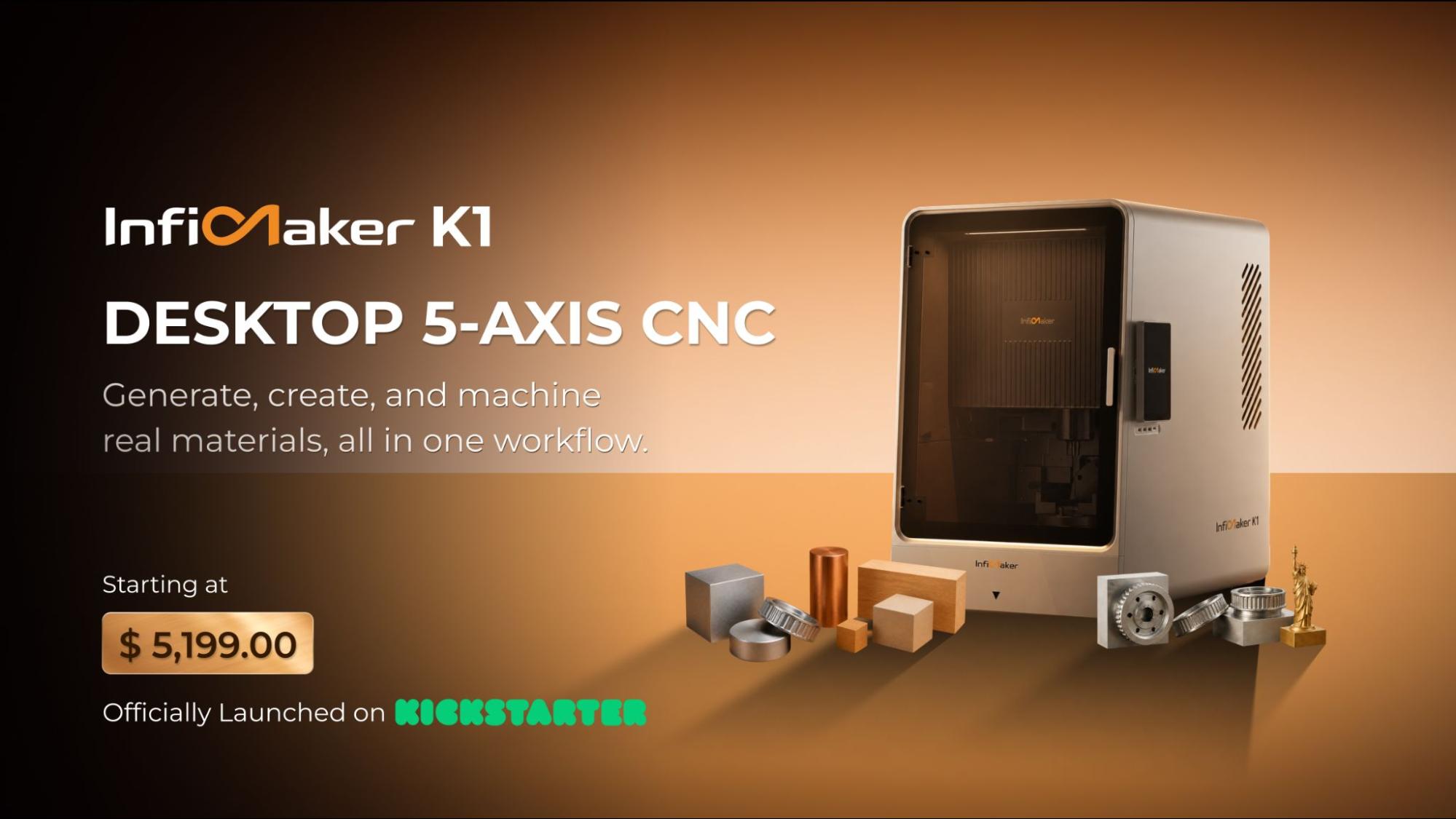
Every so often, a desktop CNC page claims 5-axis, and you go looking for the asterisk. Usually it’s there. Sometimes it’s buried in “3+2,” which is a different machine wearing a bigger number. InfiMaker’s K1, now on Kickstarter, is claiming the real thing, and after reading through the spec sheet twice, I think it’s worth taking that claim seriously enough to unpack.
So what’s the actual difference? Most machines at this price reposition the workpiece between cuts — five axes on paper, but not five axes moving at the same time. The K1 does move all five at once, mid-cut, so a compound curve or an undercut doesn’t need three re-clamps and a hope that the registration held. Anyone who’s machined jewelry, or anything organic-shaped really, already knows why that’s worth more than the number printed on the box.
I went in expecting the mechanical claims to be the weak point, and they weren’t, at least not on paper. The layout is vertical and spindle-centered, sitting on a one-piece cast bed, and InfiMaker claims 72.8% greater effective working volume than similarly sized desktop machines without increasing the footprint. Underneath that there’s a three-point gantry and preloaded ballscrews, which is the sort of rigidity you’d expect on a shop floor and not really on a desk.
Where the AI actually shows up
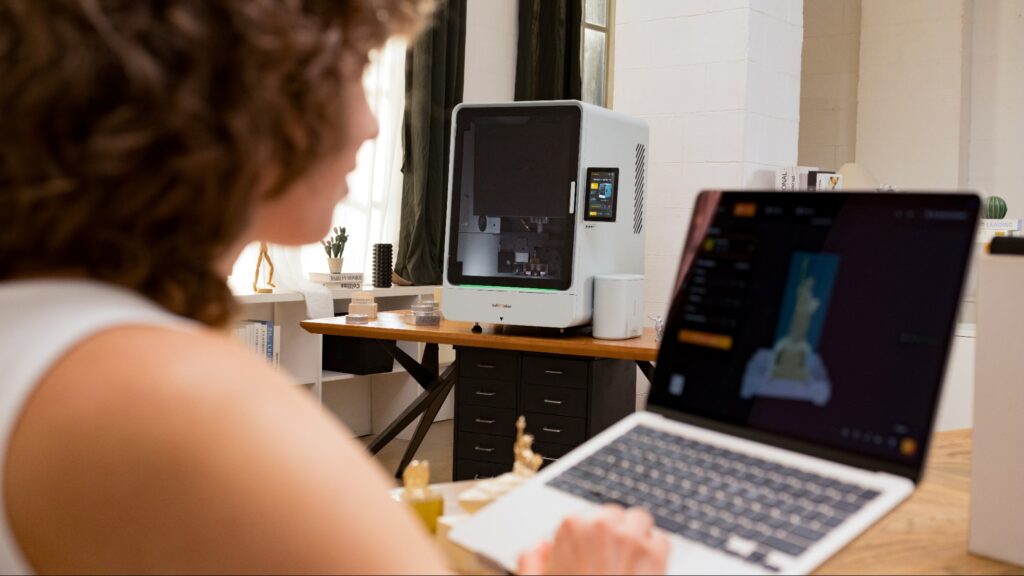
Whenever “AI” gets bolted onto a spec sheet these days, I get a little wary, mostly because half the time it just means marketing found a fancier word for autopilot. What’s here is at least narrower than that. Text prompt or a reference photo goes in, a part comes out, and it’s already been checked for whether it can actually be cut before anyone touches a toolpath. The camera sitting over the stock is doing something similar in spirit — it looks at what’s clamped down and picks feed, speed, and depth itself, which sounds small until you remember how much of a beginner’s first year on a CNC machine is just guessing at those three numbers. Tool wear gets watched too, mostly so you find out a bit is dying before it ruins the part rather than after.
That said, InfiStudio isn’t the only way in. If you already run Fusion 360, UG/NX, PowerMill, or similar CAM software, the K1 will take your standard G-code just fine — InfiStudio just lowers the barrier for people who haven’t gotten there yet.
The specs, without the marketing gloss
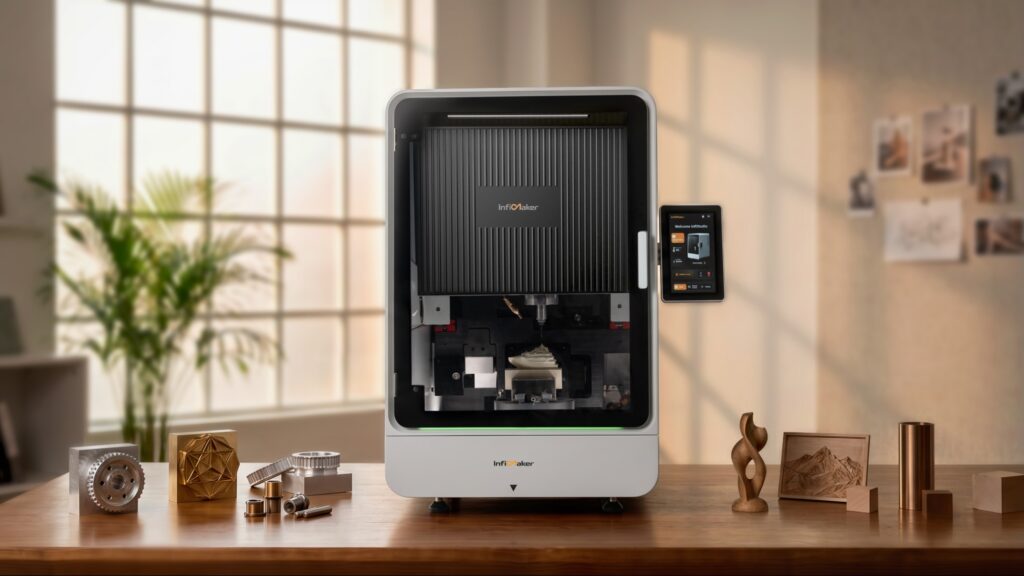
0.01mm positioning accuracy. A 1.5kW spindle that tops out at 20,000 RPM. Six tool slots on the automatic changer, with a built-in probe for centering and calibration, so you’re not doing that part by hand either. Working volume in full 5-axis mode is 120 x 120 x 150mm, and it expands further when you drop to 3-axis or 3+2 setups. The material list is long enough to cover most of what a hobbyist or small shop would actually reach for — titanium, steel, aluminum, brass, copper, wood, acrylic, wax, jade, resin, a handful of engineering composites.
One detail I hadn’t seen on a machine this size before: an integrated high-pressure coolant system, which InfiMaker calls InfiFlow, built specifically for the materials that usually punish desktop machines with heat, titanium and stainless steel in particular. Noise stays under 70dB under their tested conditions, and there’s an electronic door that locks the moment cutting starts and won’t release until it’s actually safe.
Who this is really for
This isn’t aimed at someone deciding between a desktop router and their first hobby mill. The simultaneous motion, the tool changer, the coolant system — all of it points toward someone who’s already outgrown a smaller machine and doesn’t have the floor space or budget for an industrial cell. InfiMaker does list first-timers as part of the audience too, mostly on the strength of the auto-calibration and material detection, but I’d read that as “approachable” rather than “entry-level.” The ceiling here sits well above for those who want more than a first machine.
What’s actually on offer right now
Worth being clear about what stage this is. It’s now on Kickstarter, with lucrative early bird prices. And like any hardware campaign before it ships, the specs and price you see today aren’t locked until backers actually have machines on their benches, so I’d treat the numbers as a strong signal of intent rather than a promise.
I came away more interested in this one than I expected. If InfiMaker delivers anywhere close to what’s on this spec sheet, it’s a genuinely different machine than what’s typically called “desktop 5-axis,” and that’s a category that’s been growing over the years. Worth keeping an eye on as the campaign gets closer to going live.
Madhurima Nag is the Head of Content at Gadget Flow. She side-hustles as a parenting and STEM influencer and loves to voice her opinion on product marketing, innovation and gadgets (of course!) in general.


