
New research from BSR and GlobeScan shows that the motivations behind corporate sustainability efforts have shifted over the past 10 years, with regulation becoming significantly more important in driving initiatives. In April and May 2026, GlobeScan and BSR conducted an online survey of corporate sustainability professionals working at companies with $1 billion or more in annual revenue to understand the current state of sustainable business and its evolution over the past decade.
The findings highlight how the relative importance of various drivers has changed since 2016.
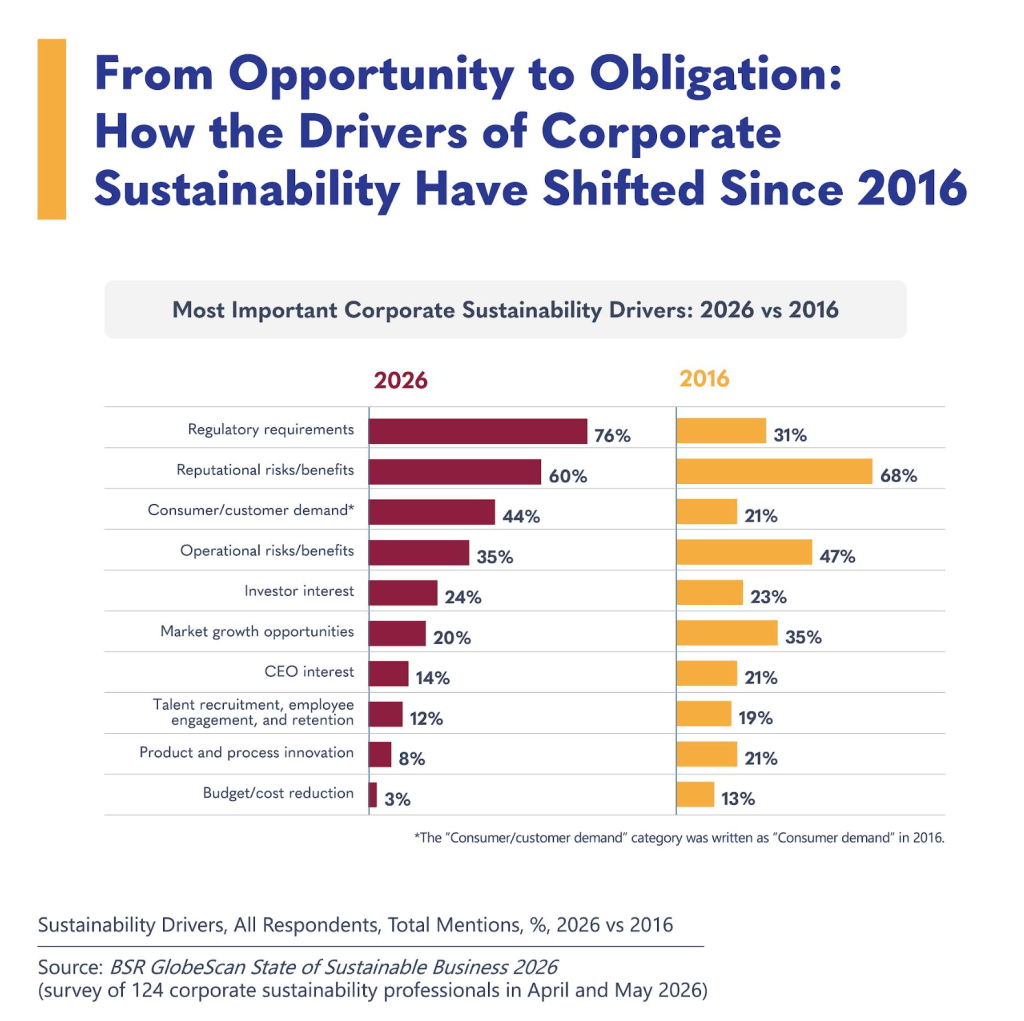
The most striking development is the rise of regulation. Over the past decade, regulatory requirements have increased more than any other driver, reflecting a global environment in which sustainability is increasingly shaped by formal rules, standards and reporting expectations, and where growing regulation has pushed companies to focus more on compliance than on other motivations.
Consumer demand has also gained ground over this period. This suggests that external pressure is not limited to regulation, but is also being reinforced by expectations from consumers. By contrast, investor interest has remained largely unchanged, indicating that not all stakeholder pressures have evolved at the same pace.
Running parallel with these increases is a broad decline in several traditional business-oriented drivers of sustainability. Compared with 2016, factors such as market growth opportunities, product and process innovation, operational benefits and cost reduction have all lost influence. Internal drivers such as CEO interest and talent recruitment, engagement and retention have also weakened. The research specifically highlights the decline in growth, talent, innovation and cost-related motivations as notable changes over time.
Taken together, these shifts point to a clear rebalancing in motivations behind corporate sustainability. A decade ago, sustainability was more strongly associated with forward-looking business value, including growth, efficiency and innovation. Today, the emphasis appears to have moved more toward responding to external expectations, particularly regulation and, to a lesser extent, customer demand.
What this means
The changing drivers of corporate sustainability suggest a shift in how sustainability is understood within companies. As regulatory pressure has intensified and traditional business-case drivers have lost influence, sustainability appears to be increasingly framed through the lens of compliance and external accountability, rather than opportunity and value creation. While growth, innovation, talent and cost efficiencies remain important outcomes, they seem to play a less prominent role in motivating sustainability efforts than they did a decade ago.
This creates an important challenge for sustainability leaders. Compliance can drive action, but it rarely inspires transformation. Regulation can establish the floor, yet it is unlikely on its own to generate the investment, innovation and cross-functional commitment needed to deliver meaningful change. As sustainability becomes more shaped by external requirements, organizations may need to work harder to demonstrate how it contributes to growth, resilience, competitiveness and long-term value creation. The companies best positioned for the future may be those that can meet rising regulatory expectations while continuing to treat sustainability as a strategic opportunity and not simply a compliance exercise.
Based on an online survey of 124 corporate sustainability professionals at companies with annual revenue of $1 billion or more across sectors and global headquarters regions.


