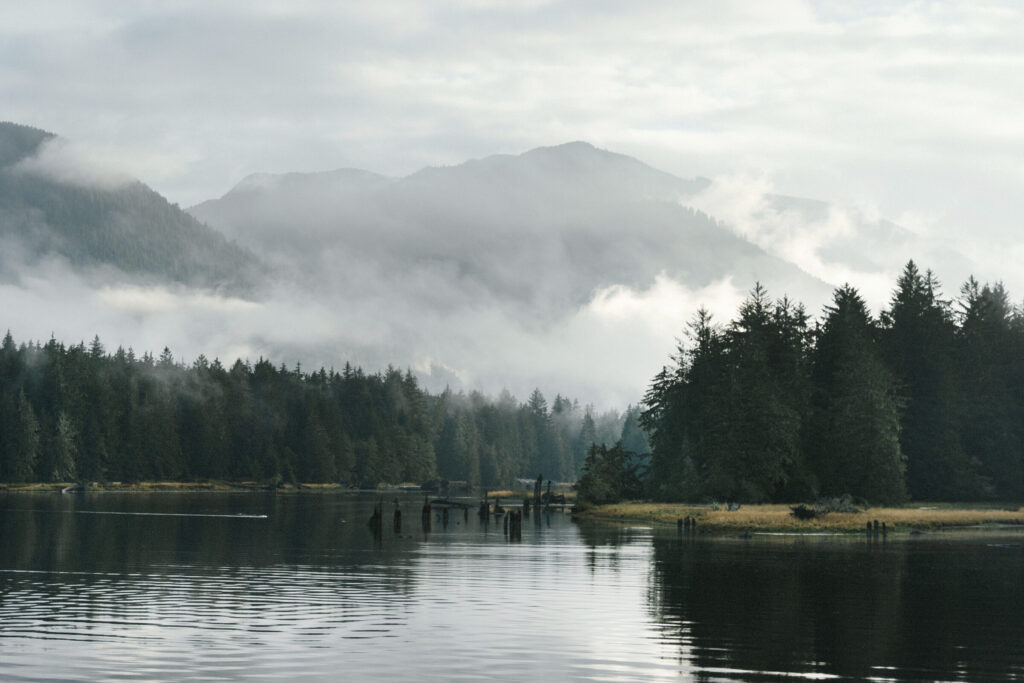
Morning fog hangs over the Gordon River, occasionally shifting to reveal the distant peaks up valley as the morning light permeates the sleepy inlets and coves of Port Renfrew, British Columbia. My brothers Sam and Isaac take up their sixty-pound packs with startled groans at the burdens we’ve committed to carry on the journey ahead. With six other hikers, we’ve just finished the required safety talk, a procedural ritual required by Parks Canada of all hikers before stepping into the forty-seven rugged miles of Vancouver Island’s West Coast Trail, an overland route as legendary as it is unforgiving.
We walk with a spring of anticipation as the ranger leads us toward Butch’s Wharf, the first of two ferry crossings that mark the start of our journey. Butch, member of the Pacheedaht First Nation, operator of the ferry, and apparent curator of every odd tool and artifact imaginable judging by his cavernous, cluttered workshop, watches us with laughing eyes as we load into his skiff. “If you want sore legs, I could save you the trouble and give you a whack with my bat,” he chuckles. “And don’t go getting hurt out there, alright? I don’t want to have to come rescue anyone.”
We laugh, unsure of how seriously to take his side-handed warning. Later, I learn that roughly a hundred hikers are evacuated from the West Coast Trail each season, an unspoken truth beneath his grin.
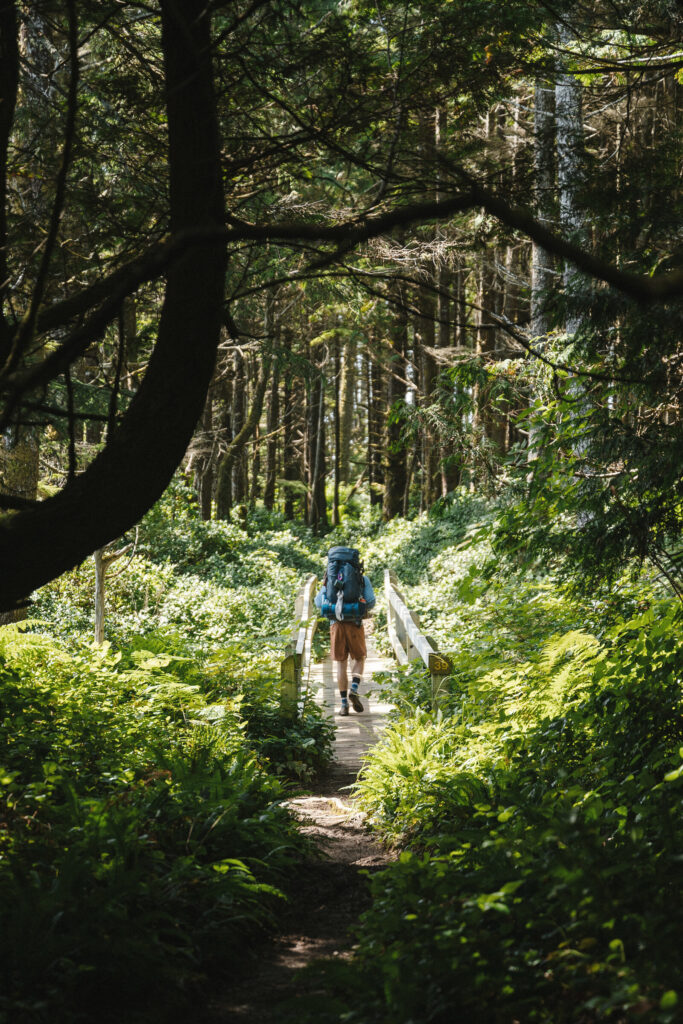
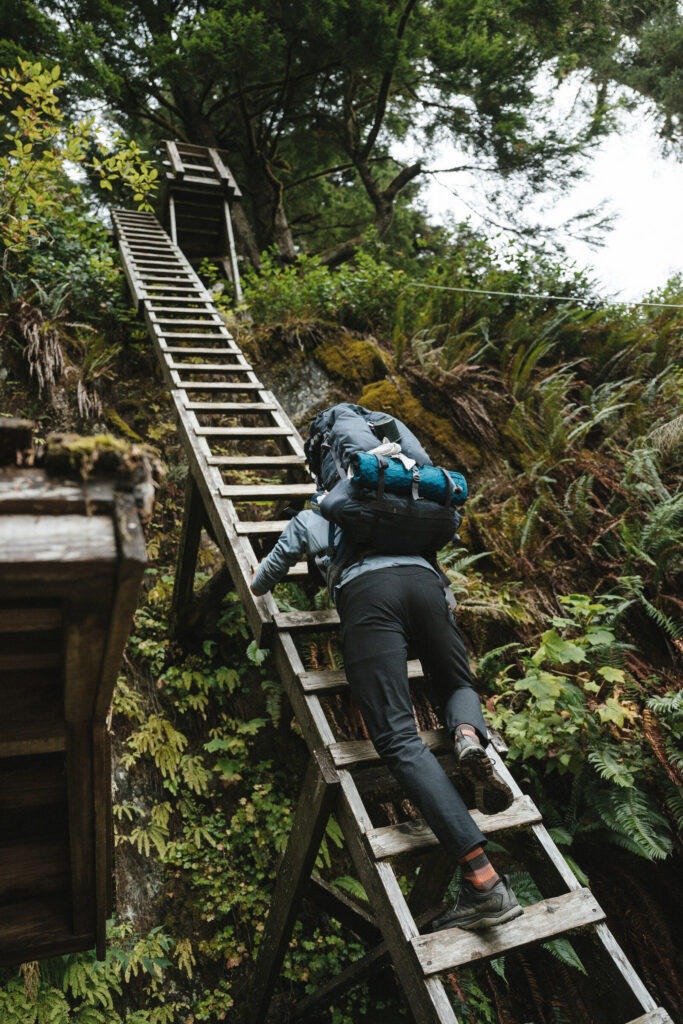
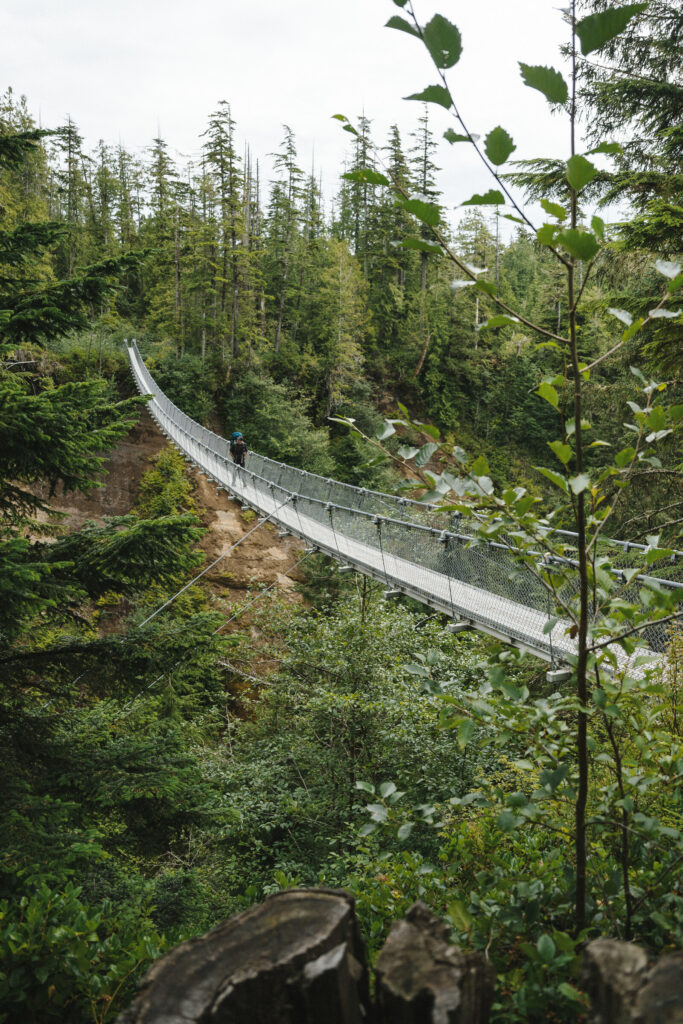
On the far side of the river, Butch noses the skiff into the wet sand and we step off with the rest of the group, staring up at a sixty-foot wooden ladder disappearing into dense coastal rainforest. It’s the first of more than a hundred ladders, one hundred thirty bridges, and four cable cars that make the West Coast Trail only slightly more attainable as a through-route. All smiles, we shoulder our packs and climb skyward into the green unknown, beginning the first multi-day backcountry trip we have ever taken together, just us three.
Although the memories are faint, we can still recall the first times our parents dragged us out on hikes and, if I’m honest, how much I hated it. My mom, Jennifer, devised a clever trick to keep us moving: she’d place Skittles along the trail on a root or stump, a breadcrumb trail of color and sugar meant to coax us forward. It was her committed effort to help us find joy in something that otherwise felt like suffering.
Our first real multi-day backpacking trip as a family was a week-long venture into the Bighorn Mountains of Wyoming with our father Alex’s brothers and their families. Looking back, the effort my parents put into making that happen with three kids all under the age of ten must have been monumental. I’m sure each of us whined and cried about the miles, the weight, the cold, the sheer unfairness of being asked to walk so far into wild country. But what has stayed with me all these years since in that now distant memory isn’t the perceived suffering. It’s the flashes of fellowship: cousins swimming in the mountain lakes, uncles playing music around a campfire, my parents shepherding us through something that felt remarkable in its challenge. Those moments formed an early blueprint for adventure, framed by the people I admired most.
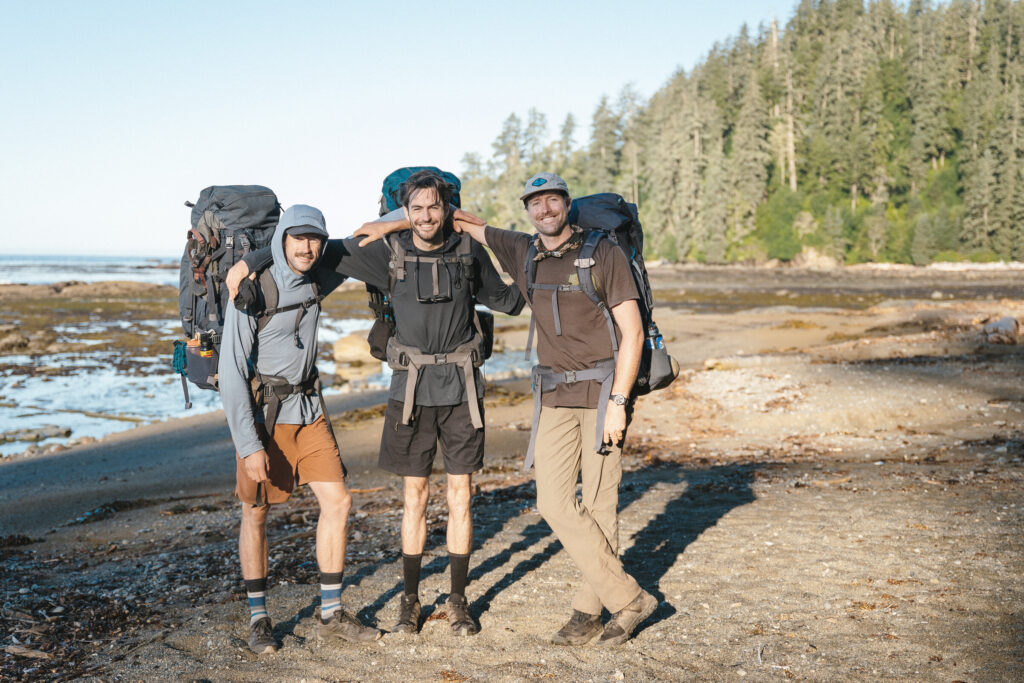
It’s that feeling I’m reaching back toward now as I step into the muddy forest behind my brothers, two men who have shared so many chapters of this story with me, and who lead the way again into what lies ahead.
The story of the West Coast Trail is rooted in the long, complicated romance between humans and wilderness. Long before its formal creation in 1907, the Huu-ay-aht, Ditidaht, and Pacheedaht First Nations traveled and stewarded this rugged coastline on the exposed western edge of Vancouver Island. Their footpaths and game trails formed the backbone of what would later become a lifeline for mariners wrecked along one of the most treacherous stretches of shoreline in the world.
The catalyst for the trail’s modern incarnation came in the winter of 1906, when the American steamship SS Valencia, attempting to navigate the Strait of Juan de Fuca in brutal weather, struck an underwater reef and sank just south of Pachena Bay. One hundred thirty-six passengers and crew were lost, an event so tragic and public that it forced a national reckoning. In response, a massive effort began to fortify the existing First Nations routes into a dedicated rescue corridor. Working in partnership with the First Nations trail guardians, the government funded construction of boardwalks through the dense rainforest and erected ladders, suspension bridges, and cable cars to make the landscape more passable for both shipwreck survivors and the crews sent to save them. Over the next century, that lifesaving infrastructure slowly transformed into what is now the West Coast Trail—a physical journey that leads hikers not just north or south along the rugged coastline, but back in time.
All three of us brothers grew up understanding that our relationship with the outdoors was part of a much larger legacy. Our parents, Jennifer and Alex Lowe, both raised in the mountain town of Missoula, Montana, had inherited from their own parents a deep respect for the perspective that wild country can instill. Alex’s career as a professional mountaineer dovetailed with their desire to start a family, and adventure naturally became the language through which they taught us about the world.
Across the many chapters of our family story, there has never been a moment when challenge and exploration weren’t used as tools to shape character, offer perspective, or reveal some truth of the world. From the time I was barely a year old to now, we were raised with the quiet understanding that the minor discomforts—sleeping on the ground, trudging for miles under a heavy pack—held the promise of something larger: some inexplicable sense of enlightenment earned only through effort, shared hardship, and movement through wild country.
By the end of our first of what would be eight days on the trail, our packs felt significantly heavier than when we’d hoisted them that morning. The week leading up to our start date, the coastline had been pummeled by an unprecedented rain event, turning long stretches of the trail into greasy black bogs of muck. By the time we trudged into our first designated campsite, Camper Bay, we were greeted not by the quiet coastal solitude we’d imagined, but by one of the busiest backcountry scenes any of us had ever encountered.
The West Coast Trail operates on a lottery system, permitting up to seventy-five hikers to start each day between May 1 and September 30. We brothers had submitted our application the minute the portal opened in mid-January and managed to secure spots for late August. That first night, wedging our tents onto one of the only small scraps of flat earth still free above the high-tide mark, as dozens of other hikers continued to arrive weary and worn well after sundown, any assumptions about solitude slowly dissolved.
“I had no idea it would be like this,” my youngest brother Isaac said, looking around at the bustling camp. “I imagined it would be just the three of us…with a few other groups passing by here and there. But it seems like we’ll be making new friends!”
Leaving Camper Bay, we fell into step with another hiker, Scott McKenzie from Vancouver, out on a solo trip inspired by the journey he once took as a kid with his dad and brother. When I tried to commiserate with him about how packed camp had been the night before, Scott offered a different perspective. “I love that there are all these people out here,” he said. “These places are beautiful in their solitude, but they’re so much better when shared.” As we passed groups of friends, families, and solitary hikers, each crafting their own stories of challenge and wonder, I carried Scott’s words and felt the quiet truth settle in.
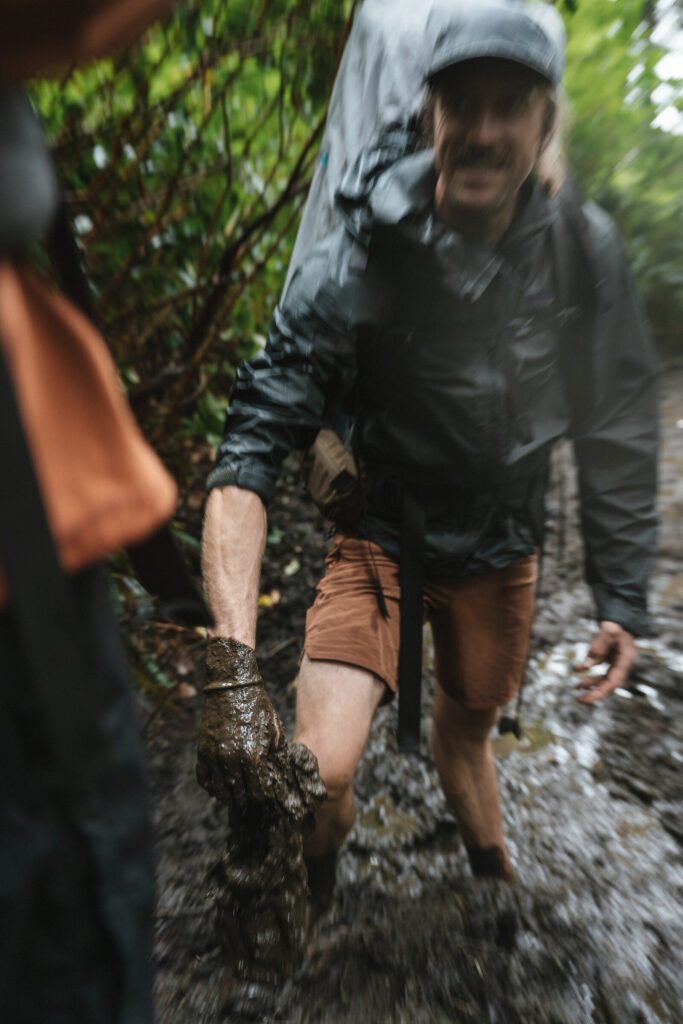
Coming from Montana, where most backcountry trails are relatively smooth going, the reality of walking the West Coast Trail caught us all off guard. Though the route never rises more than seven hundred feet above sea level, it is a relentless rollercoaster of terrain: collapsing and half-rotted boardwalks bristling with rusted nails, ladders missing rungs, bridges smashed by treefall, ankle-twisting root snarls, and mud bogs that seem to multiply with every step. After the previous week’s atmospheric river, which had battered the landscape around us, much of the trail had transformed into outright swamp—pools of muck deep enough to suck a boot clean off and a sheen of slime coating every surface you hoped might hold your next footfall.
When we finally staggered into our planned camp for the night, exhausted and having covered only seven miles, we faced a choice. “Do we bet it all on the next tiny camp?” Sam asked. “It supposedly only has five or six sites. Or do we just accept our fate and stay here with everyone else who slogged through the bog from Camper Bay?”
Isaac didn’t hesitate. “This is what we came for, to push the edge a little. Let’s send it.”
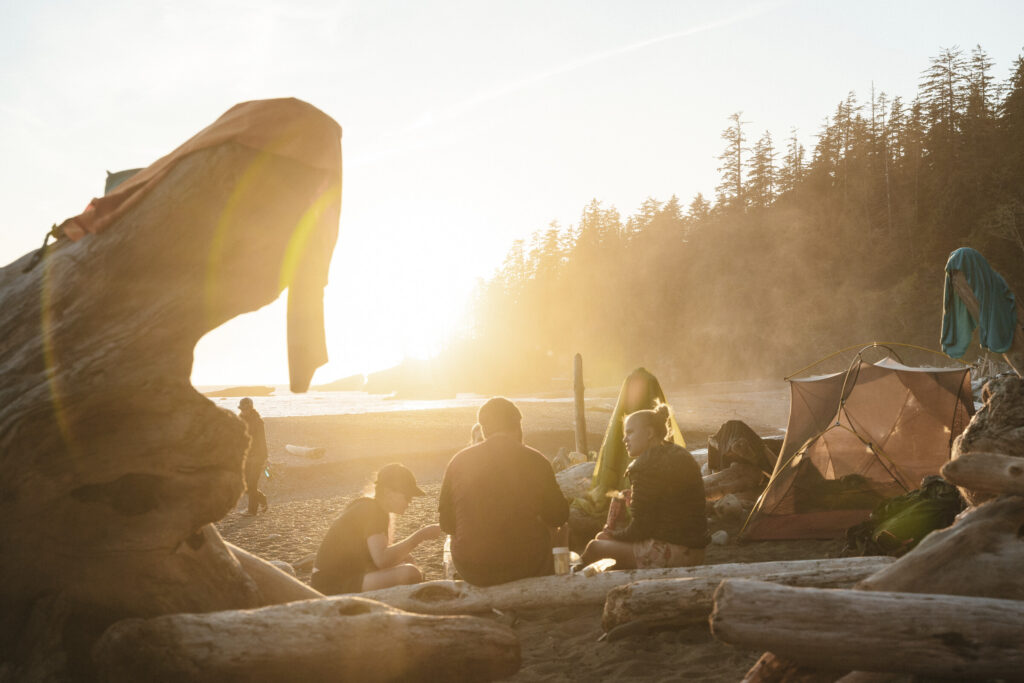
To cross Walbran Creek, we stripped down to our underwear and waded into the frigid emerald water spilling from the forest into the ocean below. Hiking on in our skivvies so they could dry, we let our long legs finally open up on the firm sand, a welcome reprieve from the bogged-down misery of the woods. Somewhere in that stretch, moving freely beneath the open sky, the ocean lapping the sand on our left, we felt the familiar undercurrent of wild beauty our parents had taught us to look for—the kind that reveals itself only when you’ve earned it.
When we reached Bonilla Point Camp, we were stunned to find it nearly empty, just one other group tucked into the driftwood. We rinsed the mud and fatigue from our bones beneath a waterfall pouring straight out of the rainforest, its cold spray erasing the day’s aches in a way nothing else could. Later, sitting on the beach as our dehydrated dinners softened, we watched the setting sun ignite the Olympic Peninsula across the Strait of Juan de Fuca while a lone heron hunted in the tide pools below. In that quiet, we felt closer than we had in a long time, opened to one another by the shared toil it had taken to reach this place, the aches and frustrations somehow transmuted into an indescribable lightness.
The next morning we woke to the soft patter of rain on the tent fly. As we sipped instant coffee, our new friend Scott rounded the point toward us with a new companion of his own: a weathered fishing buoy with a crudely drawn face, which he’d rightly named Wilson. He lifted the buoy in greeting, called out, “See ya down the trail, brothers!” and disappeared into the mist.
In spite of the thickening downpour, we joked and laughed as we stuffed our soggy gear into packs and set off down the beach toward the distant Carmanah Point Lighthouse. Walking three abreast through the rising fog, the edge felt closer, and something about the moment—its exposure, its softness—stirred me to speak. “We’ve been through a lot together since Dad’s death,” I said quietly. “I hope you both know you can talk to me about anything.” Without hesitation, they each threw an arm around me, pulling me in as we walked. For a long moment we moved in step, silent, three brothers alone on the edge of the world—a fleeting, fragile blink in time that felt immeasurably whole.
Our father, Alex, lost his life while pursuing the edge, and this has complicated my brothers’ and my relationship with risk in ways that are difficult to articulate. Before his death, Alex often spoke of the unique kinship found among those hanging from a cliff together high in the mountains—how something elemental and irreplaceable forms when people move beyond the borders of comfort side by side.
From the coastal First Nations who once traversed these wilderness routes, to the mariners who clung to life on these storm-wracked shores, to every hiking group who tracks the West Coast Trail today—the lasting impact is the same. It is the shared kinship born of breaking and reforming the edges of the world as we know it, and rediscovering together what we’re capable of, that allows us to know a belonging found rarely in any other experience.


