9
As enterprises move from AI assistants to autonomous agents, Nick Earle, executive chairman of Eseye, argues that success will depend less on compute power and more on access to trusted, real-time data grounded in physical reality.
For most of history, leaders have made their worst decisions when they were cut off from reality. A battlefield commander working from delayed reports. A ship’s captain navigating in fog with faulty readings. A control room responding to yesterday’s picture of today’s problem. The pattern is always the same, intelligence fails when it loses contact with the real world.
Enterprise AI is now approaching its own version of that moment.
The first wave of AI has already proved its strategic value. It has helped businesses accelerate knowledge work, improve productivity, analyse information faster and make software more powerful across the enterprise. That remains hugely important.
But a new phase is taking shape. Enterprises are moving beyond AI as an assistant and towards AI as an agent: systems that can recommend, orchestrate and increasingly act across live operational environments. That changes the game.
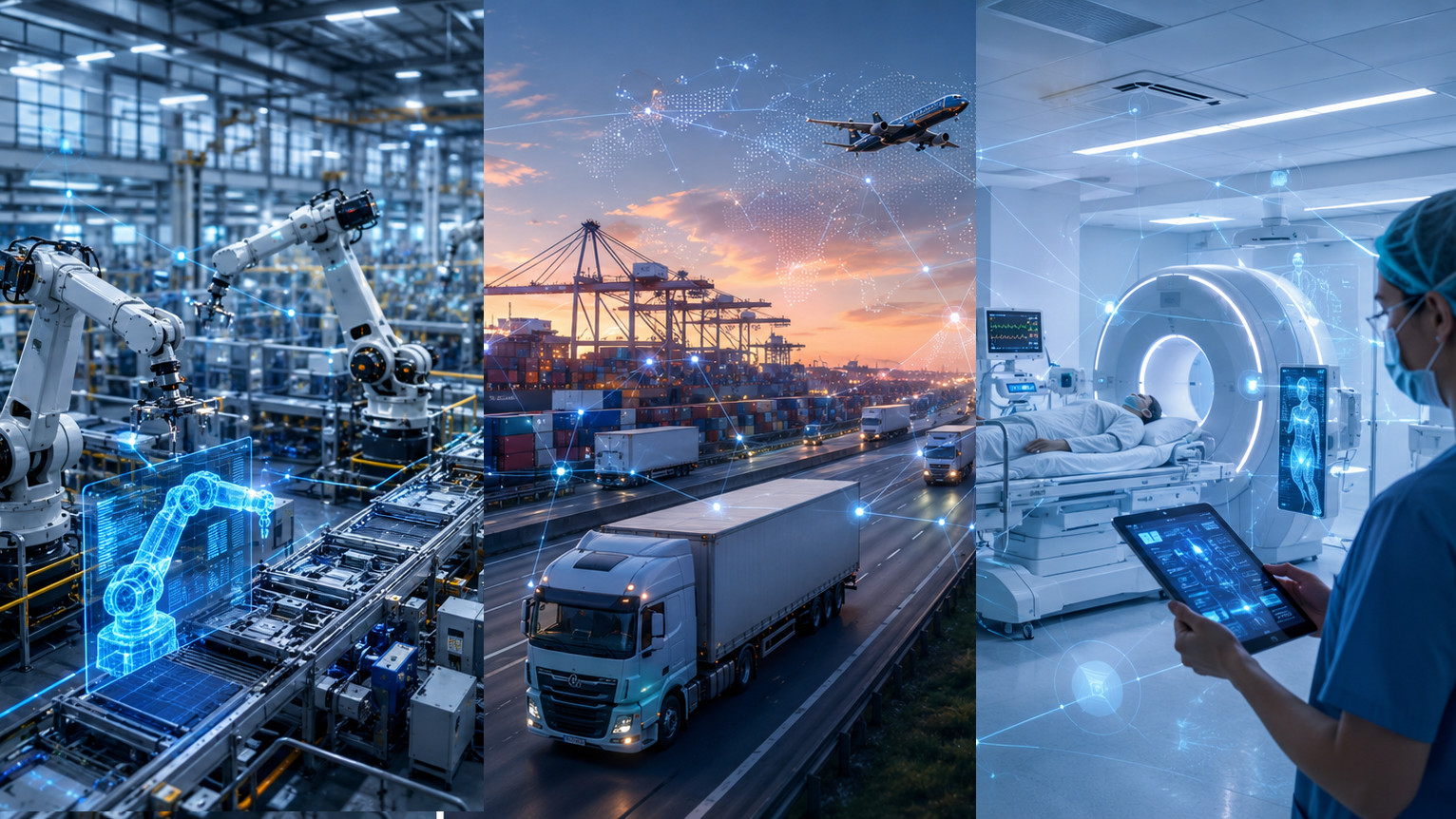
Once AI starts influencing what happens in factories, healthcare settings, supply chains, field operations and connected products, success depends on more than model size, inference speed or access to compute. It depends on whether the system has access to trusted, real-time signals from the physical world.
It depends on ground truth. That is the challenge enterprises now need to confront. Where is intelligence actually sitting? Where is inference happening? Can systems respond in real time? Can outcomes be trusted and audited? And is the connectivity layer strong enough to keep AI anchored to reality?
Connected intelligence

IoT has already been strategically valuable because it connected assets, improved visibility and gave enterprises better control over operations.
But AI is taking IoT to a new level of importance. Connected systems are no longer just reporting what has happened. They are becoming the source of the live operational context that agents need in order to understand what is happening, decide what matters and respond intelligently. And this is what takes us on the path towards sentient AIoT.
By that, I don’t mean machines becoming conscious like something from a sci-fi movie. I mean connected systems becoming context-aware enough to sense, interpret and respond intelligently to changing real-world conditions.
At the device layer, that means more processing and decision-making at the edge, close to the asset or event. At the application layer, it means more repeatable, auditable and closed-loop systems.
At the networking layer, it means connectivity can be orchestrated more intelligently, based on factors such as network state, service quality and device location. In other words, intelligence is no longer sitting only in the model. It is being distributed across the connected system itself.
Raising the stakes
An AI assistant can still be useful with incomplete context. An operational agent cannot. If an AI system is helping to manage a fleet, monitor machine health, optimise energy use or trigger maintenance workflows, then the quality of its actions depends directly on the quality of the live data entering it.
If that data is delayed, inconsistent, partial or missing, the problem is not simply that the AI becomes less accurate. The problem is that it becomes detached from reality. It may produce an answer that looks perfectly logical in software but is wrong on the ground. In live operations, that is where cost, risk and failure creep in.
Ground truth is not an abstract data science term. In enterprise AI, it is the stream of trusted, real-world inputs that keeps systems aligned with physical reality. Without it, even powerful models will struggle to deliver reliable outcomes in the environments that matter most to the business.
This does not diminish the importance of compute. It builds on it. Compute remains critical. Model innovation remains critical. But as AI becomes more deeply embedded in operations, enterprises will discover that reasoning alone is not enough. Agents need grounding as much as they need intelligence.
What enterprises should ask
There are four practical questions that matter.
First, where is inference happening? If every decision has to travel back to the cloud, latency and resilience quickly become constraints. In many AIoT use cases, intelligence needs to sit partly at the edge so systems can process signals and respond in real time. As David Linthicum, founder of Linthicum Research and former Deloitte managing director, put it recently on the IoT and AI Leaders podcast: “If I’m losing connectivity, I’m losing the device.”
In operational environments, that is not a theoretical problem. An aircraft system, a connected vehicle or an industrial asset cannot afford to wait for a round trip to a model hosted thousands of miles away before acting on a critical event.
Second, can the application produce outcomes that are repeatable and auditable? As AI moves into operations, enterprises need more than impressive outputs. They need systems they can trust, verify and improve over time.
Third, is connectivity being treated as a static utility or as an adaptive control layer? In a world of agents and sentient AIoT, network decisions increasingly need to respond to changing conditions in real time, not rely on rigid predefined logic. As Linthicum also warned: “Bandwidth doesn’t save you.” More capacity on its own does not solve for latency, resilience or architectural fragility if intelligence still depends on constant reach-back to centralised systems.
Finally, are models being trained on the right operational data? If they are trained only on application logic, but not on the realities of network behaviour and field conditions, their decision-making will break down in live environments.
The next competitive divide
A large number of IoT estates have grown in a fragmented way: multiple operators, legacy platforms, local workarounds and inconsistent service models. That may have been manageable when connected devices were used mainly for monitoring and reporting.
However it becomes far more problematic when the same infrastructure is expected to support AI-driven operations.
At that point, the issue is no longer just connectivity. It is confidence in the data layer underneath enterprise decision-making.
The organisations that win in this next phase will not simply be the ones with the biggest models or the largest AI budgets. They will be the ones that understand the relationship between intelligence and reality. They will recognise that AI agents are only as effective as the ground truth that guides them. And they will invest not only in AI itself, but in the connected infrastructure required to feed AI dependable, real-time operational data.
That’s why AI’s next big challenge is not compute. It is ground truth.
Because in the end, the future of enterprise AI will not be decided only by how intelligently systems can reason. It will be decided by how reliably they can stay connected to reality.
Nick Earle is Executive Chairman at Eseye. His career in technology spans more than 30 years, including large corporations and dynamic start-ups. Previously, he led organisations and cross-company transformation programs for two $50bn global corporations: Cisco, where he ran the Cloud and Managed Services business as well as its Worldwide Field Services function; and Hewlett Packard, where he ran the global Enterprise Marketing function and the internet transformation strategy.


