3
AI-RAN promises a software-driven path to greater capacity, programmability and operational efficiency
The RAN’s next phase will not be defined by AI, cloud or openness in isolation, but by the convergence of all three. During a recent RCR Wireless News webinar (available on demand here) Téral Research founder Stéphane Téral, Nokia Head of AI-RAN and Cloud RAN Aji Ed and TELUS Director of RAN Strategy Sushil Rawat traced the progression from network automation to the outlook for AI-RAN.
Téral placed AI-RAN in a longer continuum. Self-organizing networks were formalized in 3GPP Release 8, while machine-learning algorithms began augmenting SON functions roughly a decade ago. The RAN Intelligent Controller and its application ecosystem are less a clean break than an evolution of the industry’s effort to reduce manual intervention.
That history changes how Open RAN should be judged. Its value is not limited to assembling the maximum number of vendors. Téral rejected the idea that Open RAN had failed: “No, it did not. It gives you flexibility. That means you pick and choose whoever as a vendor or supplier you want in your network.” Open interfaces also created a programmable foundation for cloud-native functions and AI-driven applications.
Téral characterized today’s market primarily as AI for RAN: applying AI to improve performance, automation and spectral efficiency. Shared infrastructure for RAN and AI workloads, followed by edge-based AI services, represents the longer-term direction. Despite unresolved business cases, he was unequivocal: “This is where we are going. You know, there is no way back.”
Nokia’s answer is an AI-native RAN platform built on its anyRAN software and NVIDIA’s Aerial AI-RAN platform. It offers three adoption paths: an accelerated plug-in for existing AirScale deployments, a standalone AI-RAN node and a cloud-native implementation on accelerated COTS servers. All meet Open RAN specificaitons and use a common software architecture and are designed to let operators modernize without imposing a uniform deployment model.
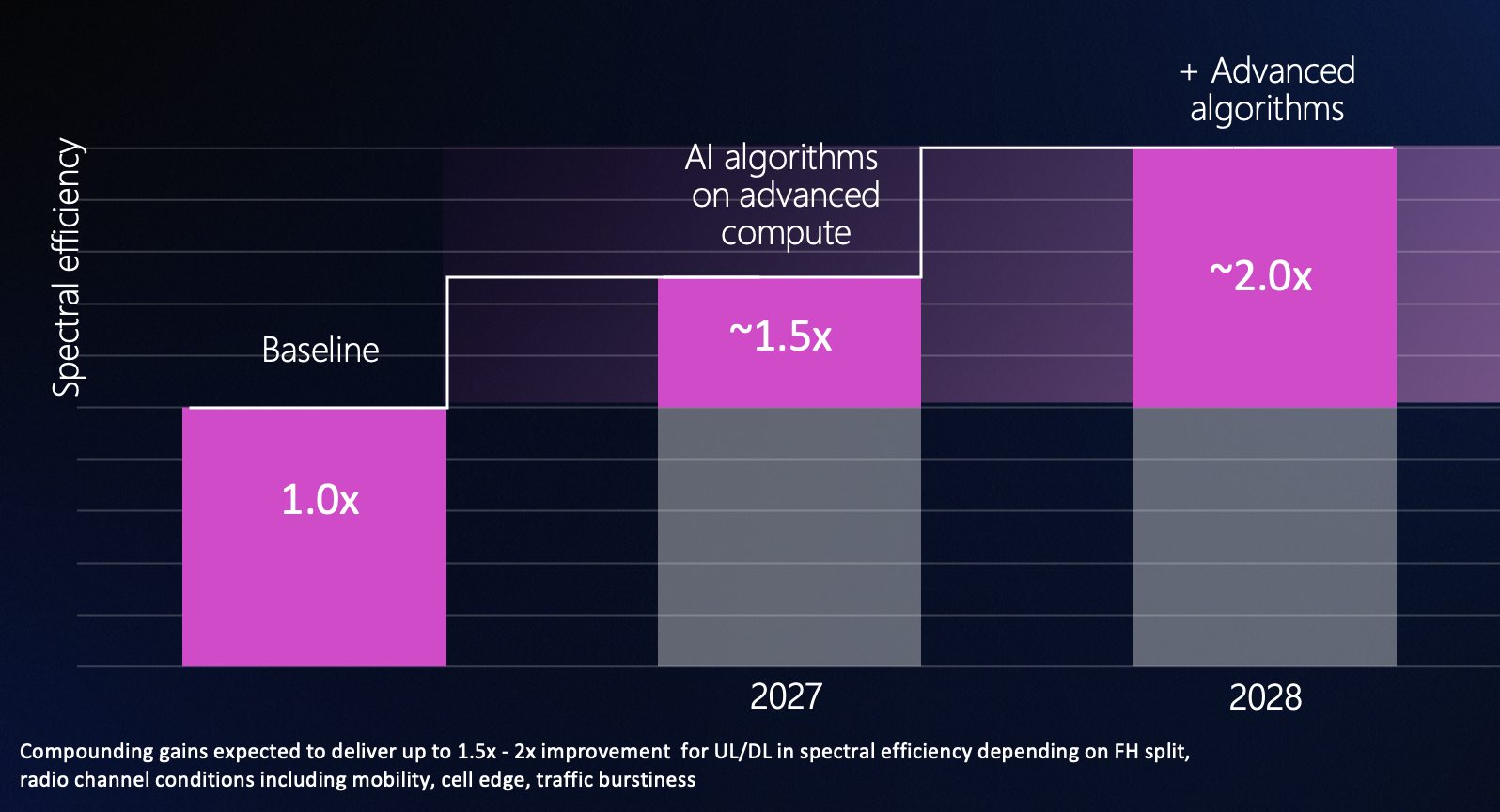
The immediate proposition is capacity. Nokia says AI-driven radio algorithms have demonstrated more than 20% spectral-efficiency gains, with a roadmap to 50% by 2027 and more than 100% by 2028. Ed summarized the ambition: “We bring twice the network capacity, twice the spectral efficiency compared to what we have today, and we are not going to stop there.”
But Ed argued that AI-RAN should not become a debate about a particular processor. Deployment choices should follow the workload, location and economics. “It’s about bringing the right compute at the right place, and with the right configuration.” The larger shift is from radio systems tied to multi-year silicon cycles toward platforms that gain new algorithms and capabilities through software.
Rawat grounded the discussion in TELUS’ brownfield Open RAN transformation. The operator began the program in late 2023 during a hardware-refresh cycle and says Open RAN now represents about 25% of its network, with targets of 40% by year-end, 50% by the end of 2027 and 100% by 2029. Its multi-vendor deployment treats interoperability as an operational requirement rather than simply a standards claim.
For TELUS, the AI-RAN taxonomy is secondary. “It’s basically driven by outcome, right? It really doesn’t matter what you call it,” Rawat said. Based on current requirements, he does not expect TELUS to need GPUs at cell sites within the next 12 months, although centralized accelerated computing is relevant for model training, digital twins and anomaly detection.
The harder problem is moving AI from demonstration to safe production. Rawat emphasized identity and access management, conflict controls, guardrails and integration with change-management processes. “You can build a use case. You can demonstrate it in lab, quick and easy. Taking it to the production, scaling it for day-to-day operation. This is a very important aspect of it.”
AI-RAN’s value will ultimately be determined less by branding than by measurable capacity gains, controlled automation and effective orchestration. Open RAN and Cloud RAN provide the foundation; AI must now prove that it can improve the economics and reliability of production networks.


