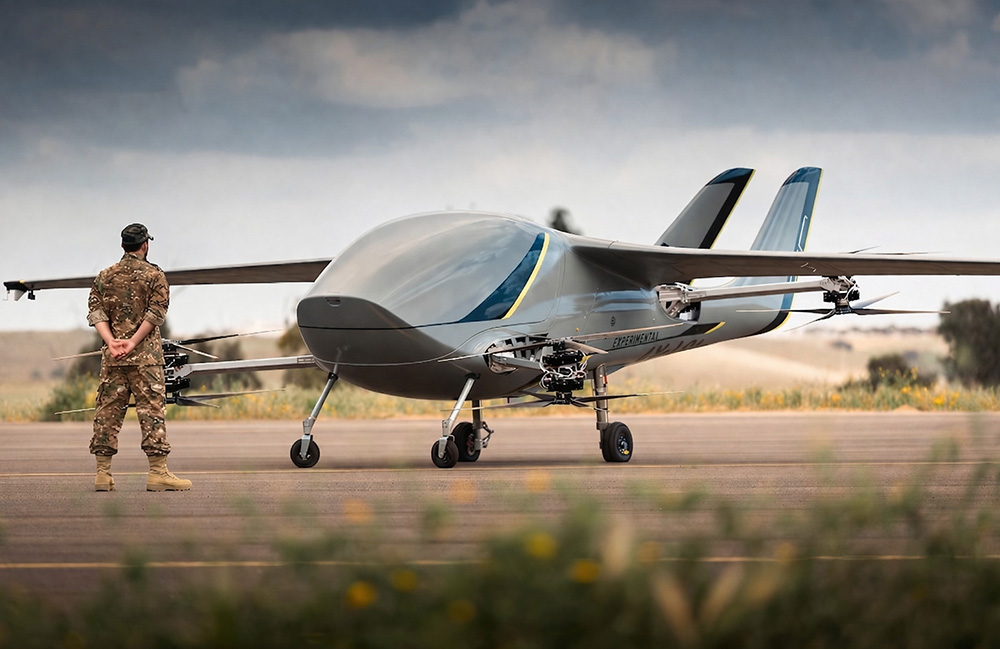
AIR brings together advanced flight systems, intelligent automation, and purpose-built design to create smart aircraft. | Source: AIR
AIR VEV Inc. last week announced a strategic partnership with Elmo Motion Control Ltd. Elmo will integrate its high-performance motion control system into AIR’s Heavy Lift UAS, or uncrewed aerial system.
The partnership brings together Elmo‘s compact, high-power density servo drives and AIR’s electric aviation design. Elmo’s Gold HV drive will power the company‘s eight electric propulsion motors, delivering precise, responsive control for the AIR 120D VTOL-capable cargo drone.
“AIR selected Elmo based on the combination of performance, power density, weight, efficiency, and system-level integration capabilities of its high-voltage servo drives,” AIR CEO Rani Plaut told The Robot Report. “For an electric aircraft, every gram matters, and the propulsion system needs to deliver high power while remaining compact, efficient, reliable, and thermally manageable. Elmo’s Gold HV platform offered a strong fit for these requirements.”
“The selection was part of AIR’s broader effort to identify best-in-class technologies that could improve the performance and efficiency of our cargo aircraft without adding unnecessary weight or complexity,” he added. “Elmo’s experience in high-performance motion control, combined with its ability to work closely with our engineering team, made it a strong partner for the AIR 120D platform.”
Elmo technology enables air cooling
As part of this integration, the high-efficiency drive system will enable air-cooled operation, eliminating the need for complex liquid cooling systems, said the partners. By removing this component, the platform benefits from reduced weight, lower system complexity, and increased payload capacity.
“Elmo’s high-power-density Gold HV servo drives are designed to operate efficiently while managing the thermal loads generated during high-power operation,” Plaut said. “This enables AIR to use an air-cooled propulsion architecture rather than relying on a liquid-cooling system.”
“The benefit is more than simply eliminating a cooling component,” he explained. “Removing the liquid-cooling loop reduces system weight, packaging requirements, and overall system complexity. In an aircraft, that weight reduction can be directly translated into additional useful payload or additional performance margin. For the AIR 120D, optimizing the propulsion and thermal-management architecture is particularly important. The result is a more compact and efficient propulsion system and a very strong payload-to-size ratio.”
 Register now and save on your pass to RoboBusiness 2026
AIR designs dual-use drones
Auburndale, Fla.-based AIR’s uncrewed cargo aircraft has a payload capacity of 550 lb. (249.4 kg) and a 1-hour flight endurance. It is categorized as a Group 4 UAS by the U.S. Department of War.
Through its dual-use architecture, the AIR 120D is able to service multiple industry needs, including flexible logistics, mid-mile delivery, maritime resupply, and rapid aid deployments.
“The integration is already under way as part of the AIR 120D development program,” said Plaut. “Elmo’s Gold HV motor drives are being integrated to power the aircraft’s eight electric propulsion motors.”
“We are currently focused on completing the integration and validation process and will share additional details on testing and operational deployment as we reach the appropriate milestones,” he noted. “Our priority is to ensure the technology is fully validated against AIR’s performance, safety, and operational requirements before moving into the next phase of deployment.”
To date, over 25 units of AIR’s Heavy Lift drones have been ordered and paid for, continuing to signal strong market demand. This announcement came on the heels of recent partnerships by AIR, including with Dynon Avionics.
Customers can expect capability improvements
Once integration is finished, AIR’s customers should start seeing its biggest impacts in mission capability.
“Reducing the weight and complexity of the propulsion system allows the aircraft to dedicate more of its available weight to useful payload while maintaining the performance required for demanding missions,” Plaut said. “This can translate into greater flexibility in how customers use the aircraft — whether for defense logistics, commercial cargo operations, or humanitarian missions.”
“The air-cooled architecture also removes a more complex liquid-cooling system from the aircraft, which has the potential to simplify maintenance requirements,” he said. “Ultimately, our goal is to give operators an aircraft that can carry more useful cargo, operate efficiently, and perform reliably across a wide range of missions.”
According to Plaut, AIR is interested in future collaborations with Elmo.
“We see this as a strategic relationship rather than simply a component-level supplier relationship,” he said. “The initial focus is the integration of Elmo’s motion-control technology into the AIR 120D Heavy Lift UAS, but we are interested in continuing to work together on optimizing propulsion performance, efficiency, and system integration as the platform evolves. As both companies continue to develop their respective technologies, there is also potential to explore additional applications across AIR’s autonomous aircraft portfolio and future electric aviation platforms.”
The post AIR to use Elmo Motion Control technology in uncrewed cargo aircraft appeared first on The Robot Report.


