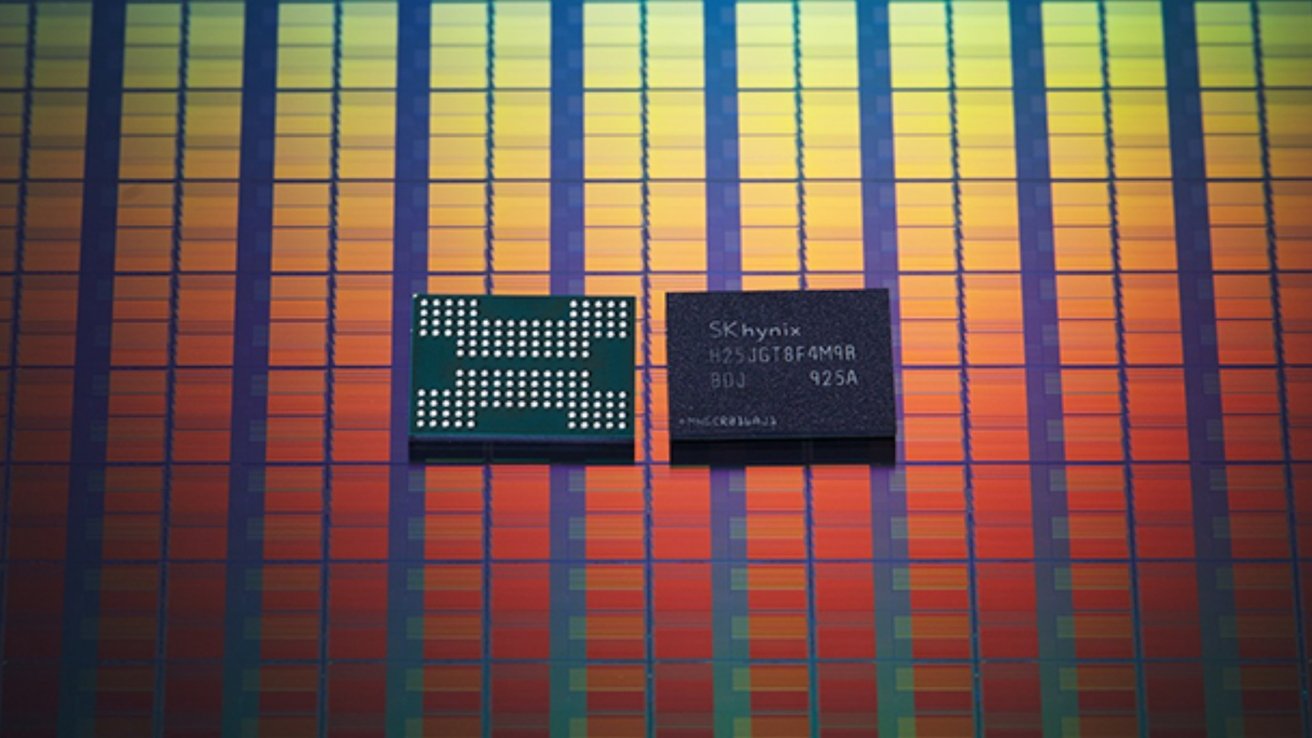
One of Apple’s memory suppliers is making a massive investment to expand chip production amid global shortages, but it won’t make your next iPhone any cheaper.
On Friday, SK hynix announced that it has approved a 54 trillion won ($38.3 billion) investment to build two new semiconductor fabrication plants in South Korea.
The investment includes 35.2 trillion won ($24 billion) towards the Yongin Y2 facility, which will produce high-bandwidth memory (HBM) and next-generation DRAM products. Construction will begin in 2027 and wrap up by 2029.
A 19.1 trillion won ($13.6 billion) investment will go towards building the Cheongju M17 facility set to open in late 2028. The facility would serve as a NAND production base, geared toward enterprise SSD and AI inference storage.
SK hynix is one of the world’s largest memory chip manufacturers. It’s one of Apple’s key memory suppliers and provides components used across Apple’s lineup, including the iPhone, iPad, and Mac.
Unfortunately, neither of these investments directly helps the average Apple consumer. Instead, the new facilities are being built to serve high-growth AI and enterprise markets, not traditional consumer electronics.
Rockets and feathers
Of course, one could argue that by creating dedicated facilities for increasing enterprise products, SK hynix could give itself breathing room to manufacture consumer-grade products.
And, maybe that’s true.
Even still, SK hynix’s investment isn’t going to solve issues anytime soon. After all, the plants aren’t even slated to open until late 2028 at the earliest.
We’ve said it before, and we’ll say it again: this is going to get worse before it gets better.
Currently, DRAM prices are edging up to an untenable level for even large corporate customer bases, with nothing to say of the average consumer.
DDR-5 DRAM prices have very nearly sextupled on average on the consumer side. In February 2025, two 16GB sticks of DDR5-6000 RAM sold for about $100.
Present pricing is around $600.
We’ve most recently seen the effects as Apple increased prices on most of its product lineup.
The increase wasn’t surprising. Inflation and supply chain issues often drive prices “up like a rocket,” especially on consumer-level products.
The market, bolstered by consumers at all levels rushing to buy products “before they get any more expensive,” stands to make a good profit. That is, at least, until people genuinely can’t afford the costs.
And while we’ll likely see a drop in pricing due to increased manufacturing and market correction, I wouldn’t expect it to be fast or dramatic.
Instead, prices will float “down like a feather.” Slowly, and likely in a sine-wave pattern.
The point, as it often is, is that asymmetric price transmission is a real pain in the ass for the end consumer.
There’s more than supply and demand
Global supply chain shortages are a real thing. The boom of AI has put a lot of stress on manufacturers to keep up with demand.

iPhone 17 Pro Max has been limited by supply chain constraints
But let’s not point the accusatory finger purely at data centers and general market scarcity. There’s plenty of blame to go around.
It’s important to remember that SK hynix is also one of the companies targeted in a recent price fixing suit.
The complaint centers on DRAM, the working memory used in computers, smartphones, tablets, servers and many other electronic devices. Samsung, SK hynix and Micron dominate the global DRAM market, giving them enormous influence over memory supply.
Allegedly, Samsung, SK hynix and Micron shifted manufacturing capacity toward HBM, which commands much higher prices from AI companies. This shift has left DRAM supplies dwindling across the tech industry.
And yes, companies are allowed to pursue more profitable products. But the real question is whether these companies coordinated the production decisions or reached them independently.
Ultimately, whatever investments SK hynix makes right now doesn’t solve the immediate problem. Suppliers have already sold their entire production capacity of memory at high prices through 2027.


