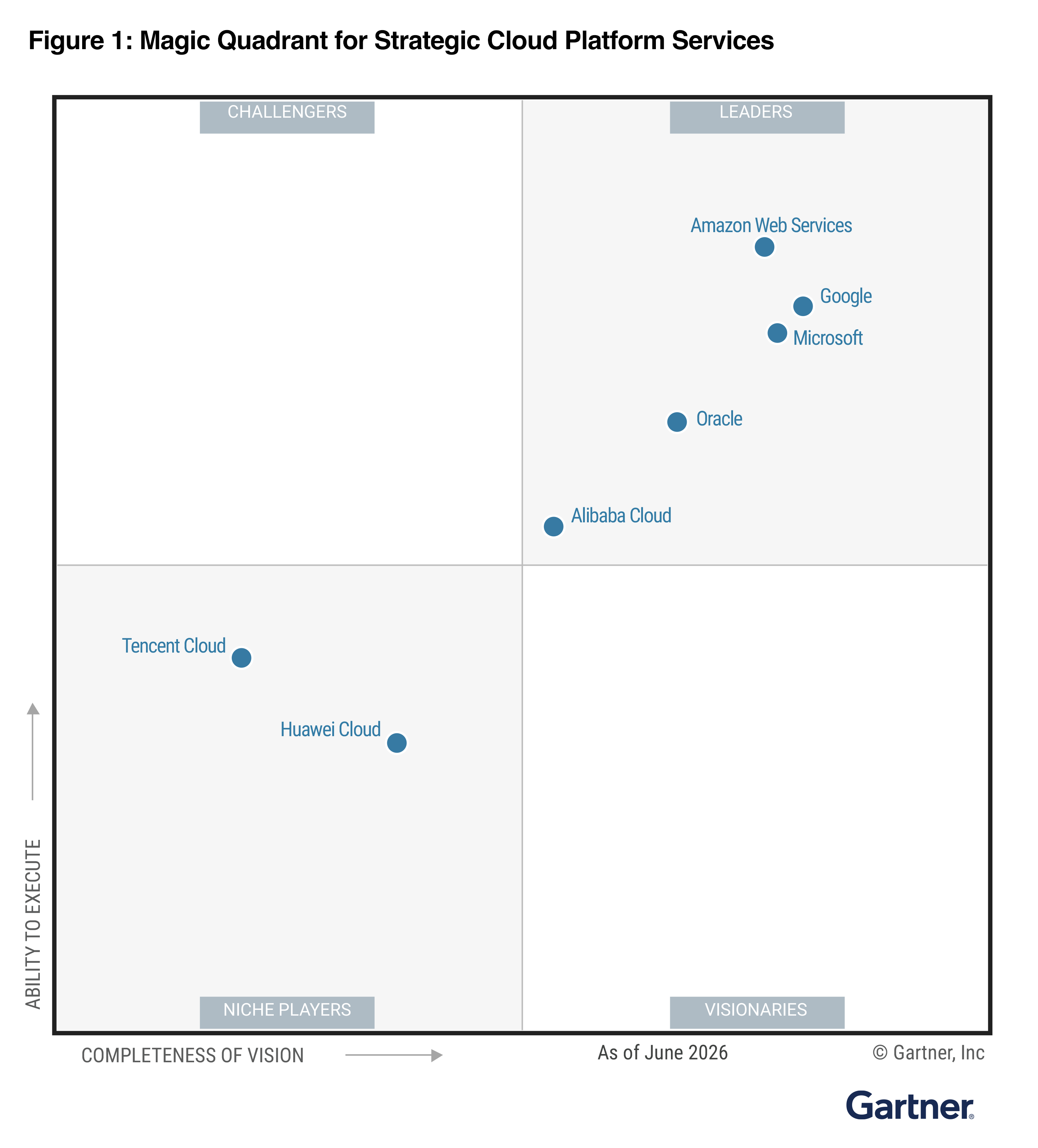
On September 1, Gartner published its Magic Quadrant for Strategic Cloud Platform Services (SCPS). Amazon Web Services (AWS) is the longest-running Leader in this Magic Quadrant, with Gartner naming AWS a Leader for the sixteenth consecutive year.
In the report, Gartner once again placed AWS highest on the Ability to Execute axis. We believe this reflects our commitment to help customers innovate faster, operate more securely, and build at any scale, particularly as agentic AI drives the need for a data foundation that is production-ready.
Here is the graphical representation of the 2026 Magic Quadrant for Strategic Cloud Platform Services.
For the full evaluation and methodology, download the complete 2026 Gartner Magic Quadrant report and read our lead announcement post.
Your AI strategy is only as good as your data strategy
Your agents are only as powerful as the data they rely upon. Agents need access to your data and shared context to reason accurately and deliver reliable responses.
Today the knowledge agents need is scattered across databases, data lakes, warehouses and third-party applications with no shared context or governance. And the scale of the problem is new. Agents generate 10 to 100x more queries than humans. This means your data architecture must be agent-ready from day one. If it isn’t, your AI investments underperform.
AWS gives your agents an open data foundation with governed context intelligence, built to scale while optimizing the cost of AI. Agentic data capabilities meet industry-specific compliance, security, and schematic requirements so you can move to production with confidence.
An open data architecture for your data and AI
Agents need to discover and access your data, wherever it is stored. That’s why AWS delivers an open architecture on Apache Iceberg so agents can use data across these silos. We offer the broadest native Iceberg support of any major cloud provider, with native Iceberg compatibility across every layer of the data stack – ingestion, storage, catalog, and analytics.
Amazon Simple Storage Service (Amazon S3) supports Apache Iceberg natively. S3 Tables delivers fully managed Apache Iceberg tables that automate compaction and maintenance as data grows. It works with any Iceberg-compatible engine, from Spark to Redshift, and supports natural language queries through MCP.
Amazon SageMaker lakehouse architecture is built with Apache Iceberg. It enables Amazon S3, Amazon Redshift, Amazon OpenSearch Service, Amazon EMR, and Amazon Athena to access the same Iceberg tables through a unified catalog, from a single governance layer. Zero-ETL integrations and federated querying remove remaining barriers across on-premises and third-party cloud sources.
AWS MCP Server, part of the Agent Toolkit for AWS, gives any tool (Amazon Quick, a third-party agent, or a developer’s IDE) governed access to your data through a single path with inherited permissions. It standardizes tool discovery, authentication, and contextual data access for AI agents interacting with AWS services.
AWS embraces open standards for flexibility and the best value. This includes PostgreSQL via Amazon Aurora and Amazon RDS, Apache Kafka via Amazon MSK, OpenSearch via Amazon OpenSearch Service, Apache Spark via Amazon EMR and Trino via Amazon Athena.
From data to contextual intelligence
Agents need more than data access to be accurate. They need contextual understanding of your data and the business rules governing how it should be used before they can make trusted decisions.
This is why we introduced AWS Context, a new service that automatically maps the relationships across your existing data into a knowledge graph and provides agentic search so AI agents in the organization can access governed data relationships, business rules, and domain knowledge at runtime.
For governance, AWS Glue Data Catalog provides a single catalog for AWS and third-party Iceberg tables, while AWS Lake Formation enforces row-, column-, and cell-level access control so the right data reaches the right agent with the right permissions. AWS Glue Data Quality and SageMaker ML Lineage Tracking add the governance layer that production AI demands.
Foundational excellence at scale
Agentic AI workloads require resources that are always available, dynamically allocated, and optimized for price-performance. AWS delivers the most powerful combination of services and capabilities for automatic resource allocation, zero-tuning price performance, and the reliability that millions of customers have trusted for over 20 years.
AWS Databases offer a high-performance, secure foundation to power agentic AI and data-driven applications at any scale. Amazon Aurora delivers unparalleled high performance and availability at global scale for PostgreSQL, MySQL, and DSQL. Amazon DynamoDB and Amazon ElastiCache serve up to tens of billions of requests per second at microsecond to single-digit millisecond latency at any scale, operating at agent speed. With native vector search built into Aurora PostgreSQL, DynamoDB, and ElastiCache, you can perform vector search — from billions to trillions of vectors — and integrate effortlessly across AWS services to build agentic applications.
Amazon S3 has evolved to support the demands of AI with purpose-built storage tiers. S3 Files gives agents a shared file system directly on S3 data, so an entire agent fleet can read inputs, write outputs, and persist memory with no duplicated data and no new APIs to learn. S3 Vectors is the first cloud object store with native support to store and query vectors. It cuts the cost of uploading, storing, and querying vector data by up to 90%, making it practical to build the large-scale vector datasets that give AI agents memory, context, and semantic search.
For search and retrieval, AWS provides purpose-built vector engines that bring intelligent search to your data where it already lives. With OpenSearch Service Serverless, your agents take advantage of lexical, vector, hybrid, and agentic search in a single system with high throughput, low latency, and relevant results at scale.
Key takeaways
The companies moving fastest with AI are the ones that treated data readiness as strategy from the start. We believe the Gartner recognition of AWS as a Leader for 16 consecutive years reflects the breadth and deepest set of core public cloud services and capabilities, including the data foundation that makes this possible.
Ready to see the full evaluation? Download the 2026 Gartner Magic Quadrant for Strategic Cloud Platform Services.
Gartner does not endorse any company, vendor, product or service depicted in its publications, and does not advise technology users to select only those vendors with the highest ratings or other designation. Gartner publications consist of the opinions of Gartner’s business and technology insights organization and should not be construed as statements of fact. Gartner disclaims all warranties, expressed or implied, with respect to this publication, including any warranties of merchantability or fitness for a particular purpose.
Gartner and Magic Quadrant are trademarks of Gartner, Inc., and/or its affiliates.
This graphic was published by Gartner, Inc. as part of a larger research document and should be evaluated in the context of the entire document. The Gartner document is available to download: Complete 2026 Gartner Magic Quadrant report.
Gartner, Magic Quadrant for Strategic Cloud Platform Services, By Alessandro Galimberti, Carolin Zhou, Douglas Toombs, Dennis Smith, Ed Anderson, Tobi Bet, Chuck Lawton , 1 September 2026
About the author


