Key Takeaways
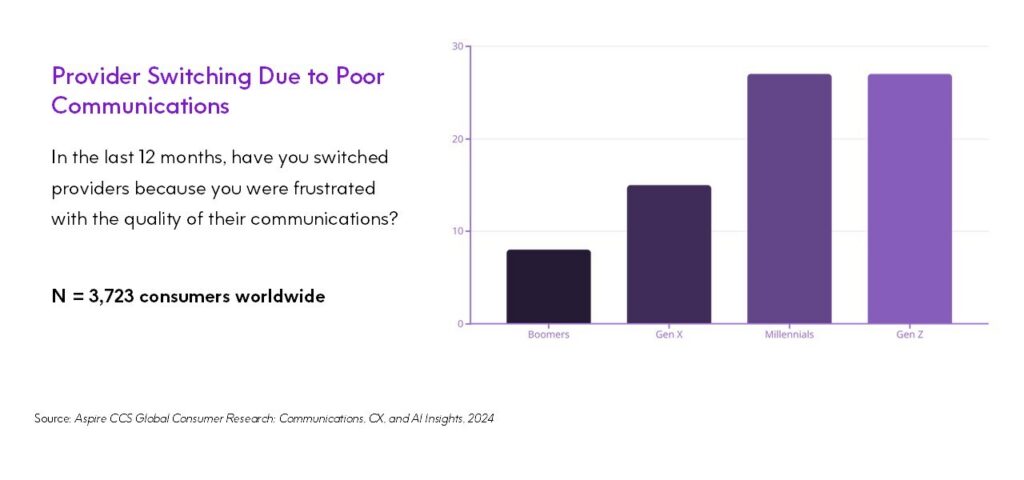
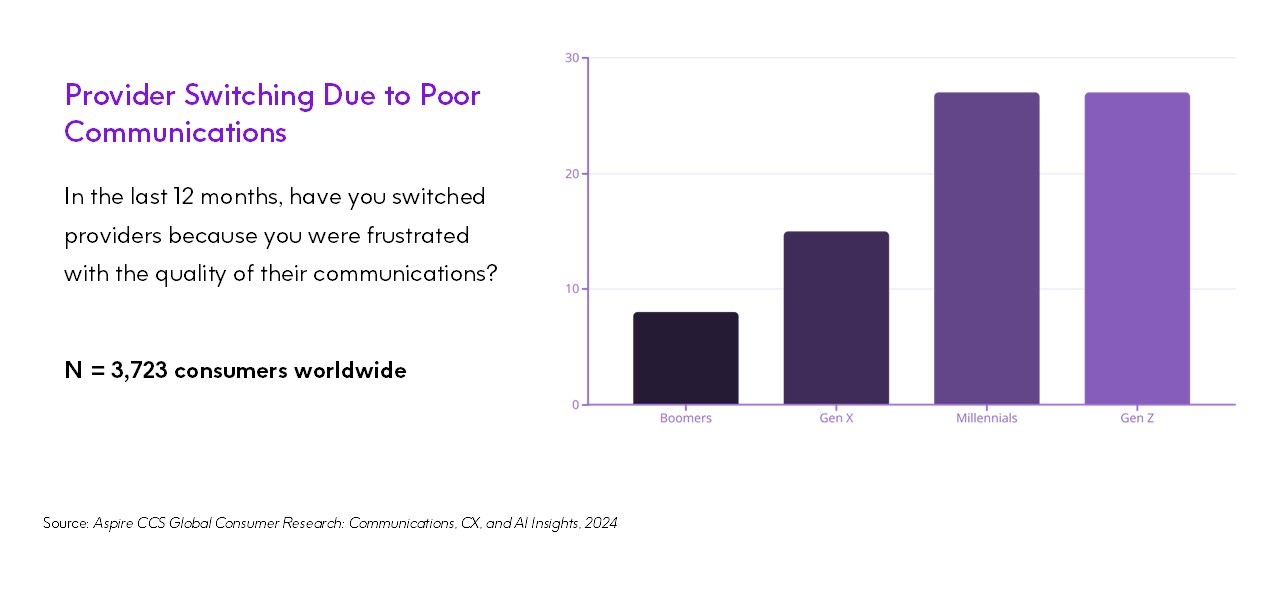
- Poor communications are driving customer churn, with one in four consumers aged 18–43 switching providers after a bad experience.
- Clean data is table stakes, not a differentiator; what creates a superior customer experience is integrated, contextually applied data that powers personalized, real-time communications.
- To modernize customer communications, financial institutions need a modular approach across technology, data, and people.
When speaking with our financial services customers, we’re noticing some remarkably consistent challenges: fragmented systems, unrealized returns on digital investments, mounting AI complexity, and the ever-present pressure to maintain customer trust.
These common challenges often feel like we’re all singing the same song, just with slightly different lyrics.
However, there has been a shift recently and that urgency. Customers are done being patient. And for banks still operating with document-centric, one-way communications, that impatience is showing up directly in churn numbers — making customer experience modernization less of a roadmap item and more of a competitive imperative.
Why Poor Bank Communications Are Driving Customer Churn
According to research from Aspire, one in five consumers have switched providers in the past 12 months due to a poor communications experience. Among consumers aged 18–43, that number jumps to one in four. It’s clear that younger, more affluent, and tech-savvy consumers aren’t going to wait for you to figure out your communications challenges.
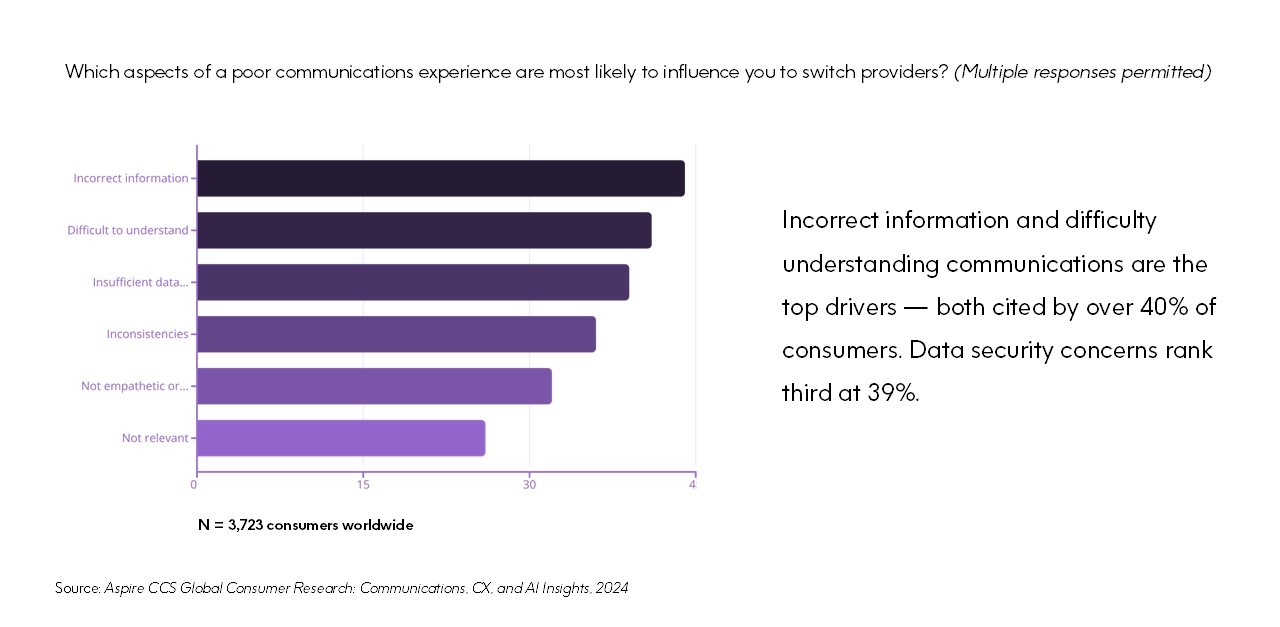
And when you look at why they’re switching, it’s not about rates or fees. Five of the top six reasons come back to the communications themselves: incorrect information, content that’s hard to understand, inconsistencies across channels, messaging that doesn’t feel relevant.
I think about this personally. My dad and I both had the same insurer. I had a terrible experience — confusing billing, poor communication, zero personalization — and I left. He stayed, even though he complains about the payment process every single quarter. His expectations of brand experience are lower, and he’s willing to tolerate communication missteps.
That’s fine, but it illustrates something important: if you’re trying to grow and retain customers, tolerance isn’t the same as loyalty.
Why Are Exceptional Banking Experiences So Hard? Four Challenges We’re All Navigating
When we talk to banking and financial services organizations, four themes repeatedly come up.
- Unrealized returns. We’ve been talking about digital transformation for years, and yet many of those investments haven’t delivered. Experiences still fail to contextualize a customer’s actual situation or guide them toward a logical next step. We’ve bought a lot of things, they’re just not working together.
- System fragmentation. That tech stack problem is real. Siloed data, legacy systems, and disconnected teams mean that even when the right data exists somewhere, it’s not flowing where it needs to go to power better communications. An audience poll during our recent webinar with American Banker confirmed what we see constantly in the field: 53% of respondents cited organizational silos and lack of cross-functional alignment as their biggest barrier to improving customer communication — the runaway answer, well ahead of legacy systems, data quality, or regulatory constraints.
- AI risk. AI is genuinely helping teams work faster and smarter. But building with AI without the right governance foundations is asking for trouble, including hallucinations, bias, compliance failures, or simply “garbage in, garbage out.” Even as AI agents become more capable, the need for human approval loops and lifecycle controls has only grown.
- Customer trust. Even with personalization capabilities in place, organizations are often limited in how far they can take it. Customers are increasingly aware of how their data is being used, and any interaction that feels invasive or “creepy” can erode trust quickly. Getting hyper-personalization right means earning that trust transparently, not just technically.
Why Clean Data Isn’t Enough for Your Customer Communications
You can have an address that’s spelled correctly. You can have account numbers that match. You can have technically accurate data across your systems … and still send a communication that feels cold, irrelevant, or confusing.
Data quality is table stakes. What creates a compelling customer experience is data that’s integrated, contextually connected, and applied intelligently at the moment of communication.
Think about it this way: a customer might have a mortgage, a checking account, and a credit card with the same bank. But if those three product lines live in separate systems (which they often do), the communications coming out of each can feel like they’re from three different companies.
Worse, you can end up in situations where a collections notice for a missed payment goes out on the same day as a “you’re a valued customer” promotional offer.
Most of us have likely been on the receiving end of these mishaps. And the real issue isn’t that the data was wrong, but that the context was missing.
Aspire’s 2025 enterprise research found that three quarters of businesses worldwide believe AI will fundamentally transform the way they communicate with customers. Six in ten have already implemented AI into their communications at some level.
WEBINARFrom Documents to Dialogue: Modernizing bank communications with trusted data and AI
In this session, you’ll learn how a modern, cloud-native and governed communications platform enables banks to improve clarity, maintain compliance, accelerate workflows, and deliver personalized, consistent engagement across every channel.
How to Modernize Financial Services CCM: Three Areas to Address
There’s no single lever to pull here. Real modernization-powered transformation — moving from static, one-way documents to personalized, two-way dialogue — requires progress across three interconnected areas.
- Modern omnichannel platforms need to do more than support digital channels. They need to support AI-assisted workflows, integrate with the broader tech stack, and operate within a secure, cloud-native environment. A critical piece that often gets overlooked: as organizations build out AI agents across departments, you need a shared semantic layer — essentially a knowledge graph — to help those agents communicate meaningfully with each other and avoid creating new silos under the hood.
- Trusted, decision-ready data requires deliberate investment in data products, governance across risk, fraud, underwriting, and servicing functions, and embedded intelligence that can enable real-time decisioning at the point of customer action. The more proactive you can be with that intelligence, the better the experience and the stronger the brand loyalty.
- Organizational alignment. Poll after poll, conversation after conversation, this is the one. Getting communications right in financial services goes far beyond just technology. It requires business lines, IT, compliance, and customer-facing teams to stop operating in their own silos. That means having conversations with your Chief Data Officer, your Chief Compliance Officer, your cards team, and more. — Building a cross-functional governance model that treats communications as a shared responsibility is critical.
Another poll in our American Banker webinar reinforced just how early most organizations still are in this process: 44% said they’re actively modernizing but only partway through, and another 33% are still evaluating modern platforms. That’s nearly 80% of respondents mid-journey or earlier — which means the window to build a real competitive advantage through communications is still wide open.
Your Legacy CCM?
Short answer: probably not.
The more honest answer: it depends on what you’re working with. If you have a homegrown solution that someone stitched together 30 years ago, has no documentation, and the architect retired — and you’re now trying to layer AI on top of it — then yes, that’s a problem that eventually needs to be solved. But for most organizations, the path forward isn’t a big-bang replacement.
What works better is a modular approach: identify where the pain is most acute, where the governance risk is highest, where a regulatory change that should take a day is still taking 90. Start there. Migrate those high-stakes communications first, establish your governed platform, build the data foundation — and then expand.
And critically: make sure the strategy is clear before the investment is made. Deploying AI for AI’s sake, or buying technology without a defined problem to solve, rarely ends well.
Make the Shift from Document-Centric to Dialogue-Driven Communications
The vision is a customer communications experience that feels like a natural, personalized conversation.
One where a mortgage customer gets a personalized, engaging video summary of their loan terms before they come in to sign, rather than sitting through an hours-long, in-person walkthrough. One where a collections notice reflects what’s actually happening in a customer’s life. One where a banking app proactively surfaces the right information at the right moment, rather than sending the same generic app-download prompt to someone who’s been using the app for a decade.
That kind of experience requires the right data foundation, governance model, and communications platform. EngageOne RapidCX from Precisely is built for exactly this — helping financial institutions move from fragmented, document-centric CCM to governed, AI-assisted, omnichannel engagement, designed to work within the compliance and regulatory requirements that make financial services uniquely complex.
But more than any single product, what matters is a strategic approach: know the problem you’re solving, build on trusted data, align your organization — and then invest in technology that moves you forward. Learn more:
- Watch our on-demand webinar: From Documents to Dialogue: Modernizing bank communications with trusted data and AI.
- And get your copy of the Aspire report: Building Dialogue – Driven Engagement
The post Bank CCM Modernization: From Documents to Dialogue with AI appeared first on Precisely.


