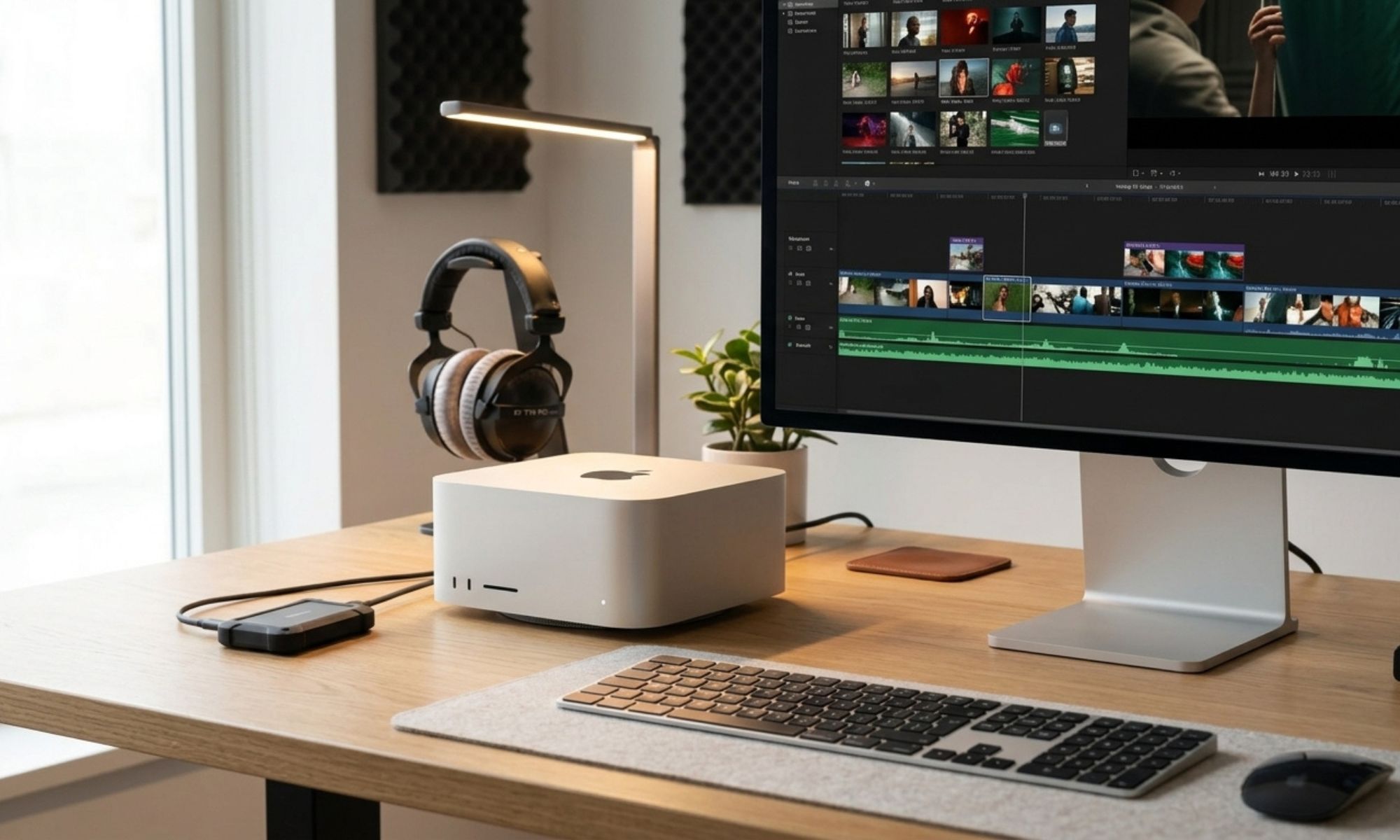
Three 4K angles on a Resolve timeline, a Magic Mask crawling along a subject’s shoulder through a handheld walk-and-talk, two noise reduction nodes, and a scrub bar you’ll be dragging back and forth for the next four hours. That’s the afternoon you want a Mac to survive. Premiere Pro editors get their own flavor of suffering. H.265 clips out of a mirrorless body, warp stabilizer on half of them, ProRes master promised by Friday. If that indeed sounds like your kind of workload, well, you’re in luck. Apple rebuilt the desktop Mac lineup on August 25.
Related: Mac mini M6 vs. Mac Studio M5 Max, and why the $1,600 gap is harder to justify than Apple would like
The M6 Mac mini starts at $899, while the M5 Ultra Mac Studio costs $5,499. Price aside, the difference comes down to how much performance you need as your workload piles up. Here are the five Macs worth your money for that timeline.
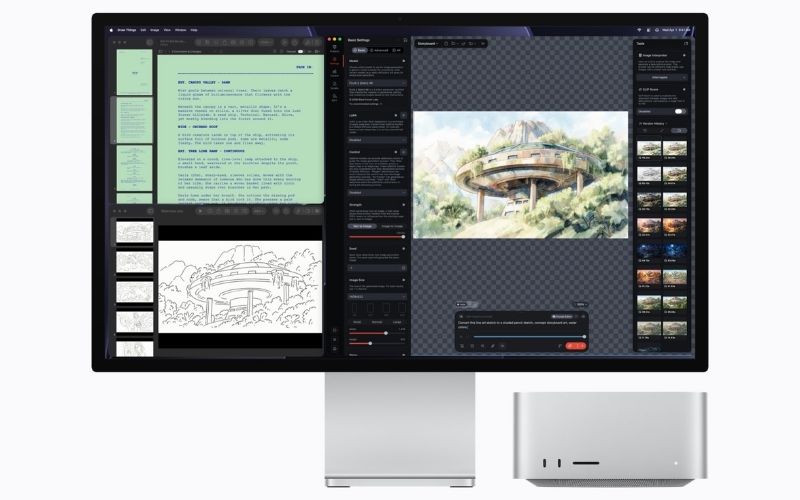
Fixed-function silicon handles the decode for H.264, HEVC, and ProRes, and Apple scales it by chip tier. One encode and decode pair on the M5 Pro. The M5 Max doubles that, and the Ultra doubles it again. Buying up a tier for the CPU cores and getting a second media engine thrown in is the single biggest change you can make to how long an export takes, and nothing in the marketing copy tells you that.
The M6 mini has 170 GB/s of memory bandwidth. Two high-resolution streams should be fine, but four is where I’d expect it to start struggling. The M5 Max jumps to 614 GB/s, so it has much more breathing room when the timeline gets busy. That difference matters once you’re stacking several streams instead of working with one at a time.
Cooling is easy to overlook. Run a 40-minute render and a small enclosure has to deal with sustained heat long after a quick benchmark finishes. Some specs matter less once the Mac sits in an edit bay. I wouldn’t pay Apple’s storage prices unless you need the space inside the machine. A Thunderbolt 5 drive can give you plenty of extra storage. Wi-Fi 7 and Bluetooth 6 won’t make much difference if the Mac stays connected to a wired setup.
Top picks
Best for 1080p and lightly graded 4K in Final Cut Pro: Apple Mac mini (M6)
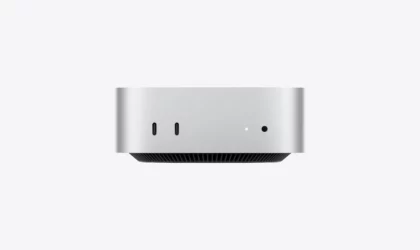
Picture a two-camera 4K interview—light grade, a lower third, wrapped before lunch. That’s a realistic afternoon for the M6 mini, and at $899 it’s the machine I’d stop deliberating over. For 1080p or a modestly graded 4K project in Final Cut, this is the cheapest Mac worth handing a working editor.
Memory tops out at 32 GB, and what you order is what you’re stuck with, since it’s soldered to the board. 16 GB is the standard configuration, which sounds fine until you’re stacking a couple of noise reduction nodes in Resolve and you’ve hit that ceiling way earlier than you’d expect.
On the networking side, 2.5 Gb Ethernet comes standard, which helps when you’re moving footage from a NAS.
Best for multicam 4K in Premiere Pro without a tower: Apple Mac mini (M5 Pro)
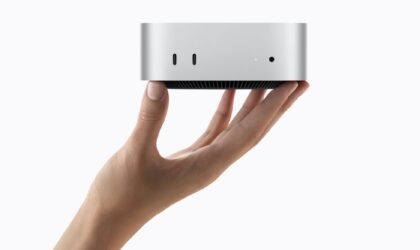
Apple Mac mini with M5 Pro
Same aluminum, different machine underneath. Up to an 18-core CPU, a 20-core GPU carrying Neural Accelerators in every core, 64GB of memory available for the first time in a mini, 307GB/s of bandwidth. Four-stream 4K multicam is where I’d draw the line, and inside that line the Mac mini with M5 Pro is the Premiere Pro desktop I’d buy at $1,699 instead of treating it as a placeholder. Apple also swaps in three Thunderbolt 5 ports, which RAID enclosures will notice.
Run a long export on the previous Pro-tier mini and the fans get loud, with clocks dropping once the workload keeps going. The compact enclosure leaves less room for cooling, so sustained workloads expose the difference between the two machines. If you’re exporting for hours at a time, the larger Studio makes more sense.
Best for Resolve color grading and Magic Mask: Apple Mac Studio (M5 Max)
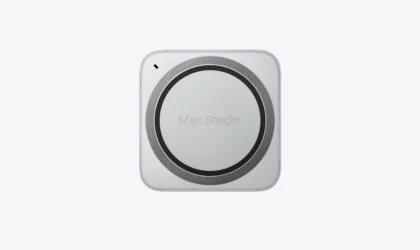
Apple Mac Studio with M5 Max
For 4K and 6K color grading in DaVinci Resolve Studio, the Mac Studio with M5 Max is the one I’d buy with my own money. Apple puts Magic Mask at up to 3x the M4 Max and up to 5.3x the M1 Max, and Magic Mask is the tool that turns a grade into a coffee break. The up-to-40-core GPU runs up to 50 percent quicker than last year’s part.
Everything else follows from wanting that GPU. An 18-core CPU, up to 128 GB of unified memory, 614 GB/s of bandwidth, and storage doubled in speed by a PCIe Gen 6 SSD. Six Thunderbolt 5 ports and 10 Gb Ethernet earn their keep on shared storage, though the port I’d miss most is the SD reader, since a card goes into the front of the machine instead of into the dongle you left at the shoot.
Pricing holds at $2,499 while the rest of the lineup climbs on memory costs. Apple Upgrade leases it from $48.99 a month across 36 months.
Best for 8K ProRes RAW and finishing work: Apple Mac Studio (M5 Ultra)

Apple Mac Studio with M5 Ultra
$5,499 answers one question. Whether the 8K ProRes RAW timeline plays. It does, up to 33 streams of 8K ProRes 422 at 30 fps, on a Media Engine carrying twice the encode and decode blocks of the M5 Max. Redshift scene rendering runs up to 1.7x the M3 Ultra and up to 4.7x the M1 Ultra.
A 36-core CPU, an 80-core GPU with Neural Accelerators, up to 512 GB of unified memory, 1.2 TB/s of bandwidth. For 8K ProRes RAW finishing, the Mac Studio with M5 Ultra ends the argument on memory ceiling alone, and the core counts are almost beside the point. Genlock over USB-C now syncs a display with camera capture, including iPhone 17 Pro. One scheduling note before you commit. The 512 GB configuration doesn’t reach customers until late October.
Best for cutting on location and docking at the desk: Apple MacBook Pro (14-inch)

Apple MacBook Pro (14-inch) with M5 Pro
If you need to cut away from your desk, the 14-inch MacBook Pro gives you a setup that can handle the trip and still work as your main machine at home. The base M5 Pro model pairs a 15-core CPU with a 16-core GPU, 24 GB of memory, and 1 TB of storage for around $2,100. It also delivers 25% more multicore performance than the M4 Pro. For 4K H.265 and ProRes work away from a desk, that’s the configuration I’d consider.
Move up to the base M5 Max at about $3,600, and you’re paying for the second encode and decode engine, which halves the long exports. An 18-core CPU, a 32-core GPU, 36 GB of memory, and 2 TB of storage.
Shooting 6K or 8K RAW on location makes the M5 Max MacBook Pro the cheapest route to that second media engine. Push to 64 GB and Apple forces a CPU upgrade, taking the total to about $4,100.
Setting up a Resolve and Premiere bay
I’d put the money into external storage before Apple’s internal SSD upgrades. A fast NVMe drive in a Thunderbolt 5 enclosure can deliver similar speeds without Apple’s per-terabyte premium. Keep a third of the boot drive free, too, so macOS has some working space. The 10 Gb Ethernet upgrade is harder to justify on its own. It becomes useful when the Mac connects to a 10 Gb switch and NAS, so there’s little point opening your wallet if the rest of the network still runs at 1 Gb or 2.5 Gb.
Premiere Pro can get awkward during a multicam session once the timeline starts getting busy. I’d leave playback at half resolution while making the rough cut, then bump it up when I need to inspect a shot. With 6K footage in Resolve, optimized media is worth setting up before the timeline becomes a slog, while render cache is more useful once you start grading.
The $150 nano-texture display makes sense if you edit near a window, where reflections can get annoying. I’d also spend the extra $20 on the 96 W power adapter for the faster charging.
Where the recommendation stops holding
Push either Mac mini configuration through an hour-long export and the clocks start sagging—something the Studio’s bigger enclosure doesn’t run into.
That 32 GB ceiling on the M6 mini is the harder wall, though. Heavy noise reduction or Fusion compositing just won’t fit, regardless of budget.
8K RAW is where I’d stop considering the cheaper configurations. Without proxies, playback gets rough, and 64 GB of memory gives you much more room for a long-form project.
The Mac Studio starts shipping September 22, while the 512 GB version is not due until late October.
Related: Best Windows laptop for video editing to start a YouTube channel


