
The California Public Utilities Commission (CPUC) approved the combination of Charter Communications and Cox Communications, an important step toward closing and the creation of the world’s largest cable operator.
The proposed $34.5 billion transaction could close sometime next week, establishing a combined company with about 70 million homes and businesses passed, and roughly 37 million customers.
There is minimal overlap between the two operators. The FCC approved the deal in February.
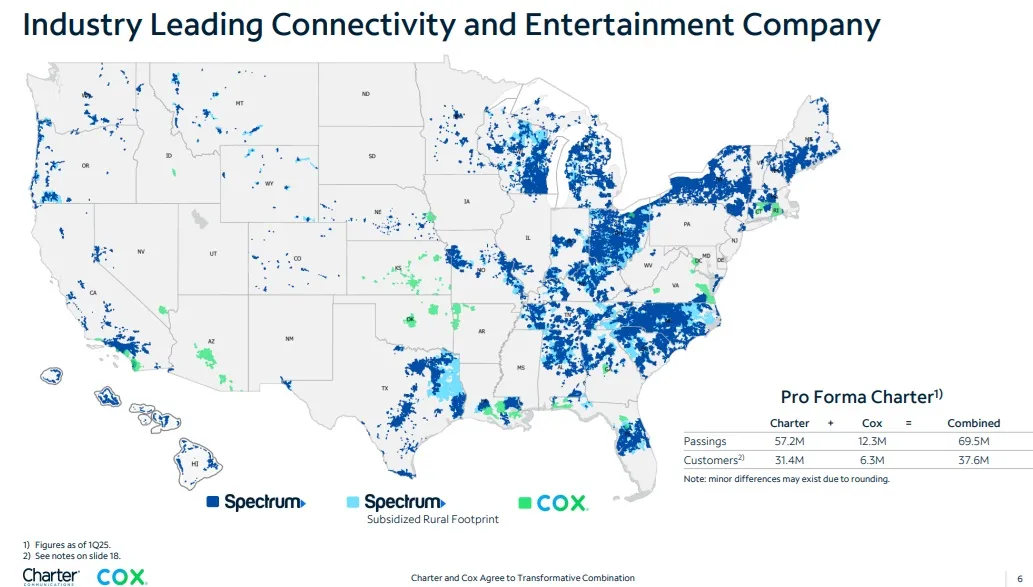
(Source: Charter-Cox merger presentation, May 16, 2025)
Per his analysis (registration required) of the latest numbers, MoffettNathanson analyst Craig Moffett recently noted that Cox will represent 18% of the new company’s revenue and 19% of its earnings before interest, taxes, depreciation and amortization (EBITDA), before synergies.
With the Charter-Cox deal nearing its close, speculation will soon turn toward a possible next chapter in the consolidation of the US cable industry, including the possibility of a future Charter-Comcast combo. In January, New Street Research policy analyst Blair Levin surmised that such a merger would face typical political headwinds, but posed a “material chance” of approval.
“With the closure of the Cox transaction, we expect an increase in investor speculation around a potential Charter-Comcast merger, especially after Comcast’s recent announcement that they are splitting the Cable and Media assets,” New Street Research analyst Vikash Harlalka said in a research note. “We continue to believe that a merger of the two Cable giants has industrial logic and would result in material cost synergies.”
Comcast Chairman and co-CEO Brian Roberts tossed some cold water on that idea in June, holding that investors should “absolutely not” think of a proposed split of Comcast’s cable and media assets as a step toward strategic transactions for either company over time. However, you’ll be hard pressed to find many industry watchers who are buying it.
Cox corporate name, Spectrum branding
While the combined company will eventually take on the Cox Communications name from a corporate standpoint, it will adopt Charter’s Spectrum branding, tap into Charter’s pricing and packaging, and be run by Charter’s current executive team, which is led today by CEO Chris Winfrey. Nick Jeffery, the exec who led Frontier Communications’ turnaround as CEO, is set to join Charter/Cox as COO on September 1.
Meanwhile, the combined company stands to benefit from Cox’s strong business services acumen.
The stamp from the CPUC arrives after months of negotiations between the operators and California regulators, and the final deal, as was the case with the Verizon-Frontier deal, had to thread the needle between California’s diversity, equity and inclusion (DEI) rules and the anti-DEI policies of the federal government. CPUC’s approval adopted settlement agreements between the companies and the California Public Advocates Office and California Emerging Technology Fund that included some clarifications and a handful of additional conditions.
Conditions aplenty
Compliance officers at the newly combined company will be on their toes after the deal closes. Per the CPUC agreement, the combined company must comply with a broad set of conditions, including:
-
New affordable broadband offerings for low-income Californians, including multiple California LifeLine service tiers and standalone broadband plans available for five years.
-
A $30 million investment in “digital inclusion initiatives” focused on areas such as broadband adoption, digital literacy training, community outreach and device access for underserved communities.
-
At least $275 million to upgrade the Cox/Charter networks in the state to support symmetrical 1 Gbit/s speeds across legacy service areas within three years. Charter has already said it expects to accelerate the deployment of DOCSIS 4.0 in the Cox footprint.
-
Five years of free broadband and Wi-Fi service for 50 eligible “community anchor institutions,” including schools, community centers and libraries.
-
Additional outreach and enrollment assistance to help eligible households access affordable broadband, plus $5 million toward Community Development Financial Institutions to provide capital to underserved small businesses in the state.
-
Expanded workforce development through the VetConnect program and “strengthened supplier diversity commitments.”
The agreement also includes other elements, such as automatic bill credits when outages last two hours or more, the honoring of “price for life” service agreements, the elimination of equipment exchange fees when customers upgrade or downgrade service or return rented equipment, and enhanced battery backup options and annual customer notices for residential wireline voice services.
The CPUC said it will create an enforcement and compliance program to oversee and enforce the above conditions.
Once the deal is closed, Spectrum will go headlong into the integration of the two companies and look to extend its pricing and packaging, including bundles that feature Spectrum Mobile, in the Cox territories. It’s also expected that Cox territories will soon get access to Charter’s refreshed video product, which is centered on the Xumo Stream Box for all new pay-TV subs and a platform that provides access to several ad-supported streaming apps, including Disney+ and Peacock, for no additional cost. Charter’s platform also lets video customers upgrade to the ad-free version of those supported apps.
It’s not immediately clear how network upgrades will proceed in the Cox territories.
Charter and Cox have been fairly aligned in their use of remote PHY for distributed access architecture (DAA) upgrades and the use of PON in greenfields and other new-build areas. However, there is a big difference on their selections of a virtual cable modem termination system (vCMTS). Charter’s multi-phase hybrid fiber/coax (HFC) network upgrade plan currently centers on Harmonic’s virtualization platform, while Cox has selected a platform from competing vendor Vecima Networks.


