Whether you’re processing financial data, managing e-commerce orders, or training machine learning (ML) models, efficiently coordinating complex processes is essential. Amazon Web Services (AWS) offers two services for workflow orchestration: Amazon Managed Workflows for Apache Airflow (Amazon MWAA) and AWS Step Functions.
This post explores how to select the right workflow orchestration service based on your specific use case requirements. We’ll examine key workflow characteristics, present real-world scenarios, and provide practical guidance to help you make an informed decision for your particular needs.
Understanding workflow orchestration requirements
Before exploring specific services, consider the key dimensions that influence workflow orchestration needs:
- Data statefulness: Does your workflow process independent units of work (stateless) or create dependencies where each step modifies data from previous steps (stateful)?
- Execution duration: Are your workflows short-lived (seconds to minutes) or long-running (hours to days)?
- Scheduling requirements: Do you need built-in time-based execution or rely primarily on event triggers?
- Recovery capabilities: How critical is the ability to restart from specific failure points rather than reprocessing entirely?
- Integration complexity: What systems, services, and data sources need to be coordinated?
- Security and access control: Do you need fine-grained permissions for different workflow components?
Let’s explore how these requirements map to real-world use cases and the appropriate orchestration solutions.
Use case: Enterprise data analytics pipeline
This scenario illustrates how Amazon MWAA handles complex, stateful data pipelines with built-in scheduling and granular recovery.
Business challenge
A global financial services company processes massive volumes of transaction data daily, requiring sophisticated data analytics capabilities. Their requirements include:
- Designed to process 5-10 TB of financial transaction data daily
- Running complex extract, transform, and load (ETL) jobs with multiple transformation stages
- Generating regulatory reports for compliance use cases
- Supporting both scheduled batch processing and event-driven workflows
- Capable of handling long-running jobs that can take up to 12 hours
- Ensuring data consistency and integrity throughout the pipeline
Workflow characteristics
- Data statefulness: Highly stateful workflows where each processing step modifies transaction data, creating dependencies throughout the pipeline
- Execution duration: Supports long-running processes extending 2-12 hours
- Scheduling needs: Mixed time-based and event-driven patterns
- Recovery requirements: Critical ability to resume from specific failure points
- Integration complexity: Orchestrates multiple AWS services and external systems
Solution: Amazon Managed Workflows for Apache Airflow (Amazon MWAA)
For this enterprise data analytics scenario, Amazon MWAA provides capabilities that align well with these requirements:
Stateful workflow management
MWAA excels at managing complex, stateful data pipelines where data consistency is critical. When processing terabytes of financial data, MWAA’s ability to resume from the last successful checkpoint helps prevent costly reprocessing and maintain data integrity.
The following code example demonstrates how to structure a complex financial ETL pipeline in MWAA:
This Directed Acyclic Graph (DAG) shows how to define task dependencies for parallel data extraction followed by sequential transformation and loading operations. The >> operator clearly defines the workflow dependencies. Transformation only begins after both extraction tasks complete successfully.
Built-in scheduling capabilities
MWAA includes native scheduling capabilities, making it straightforward to set up recurring workflows without additional services. The schedule_interval parameter in the DAG definition provides flexible scheduling options using cron syntax.
Granular recovery and resume control
During production incidents, operations teams can use the MWAA web interface to restart or bypass specific steps with a few clicks. This capability is important for stateful applications where restarting the entire workflow could compromise data consistency.
The MWAA web interface provides a visual representation of the workflow execution, allowing operators to:
Identify failed tasks – Examine task logs for troubleshooting – Clear the status of specific tasks – Restart execution from specific points
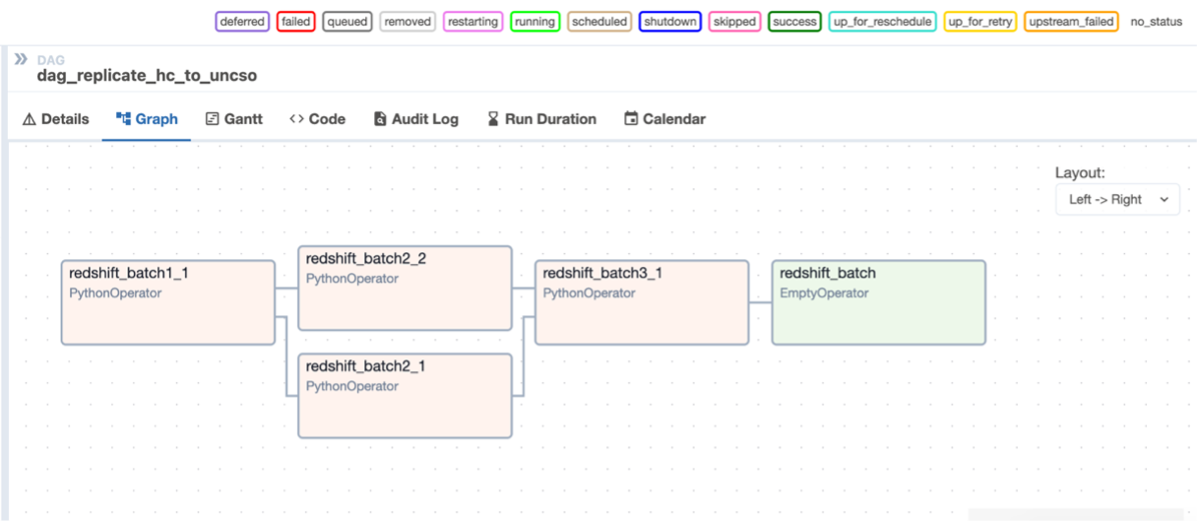
Figure 1: A Directed Acyclic Graph (DAG) in MWAA showing parallel execution ofAmazon Redshift Data APItasks. If any task fails, you can re-run specific tasks rather than restarting from the beginning.
Comprehensive monitoring and operational control
MWAA’s metadata server maintains comprehensive execution logs, enabling organizations to build operational dashboards for: – Real-time workflow monitoring – Task completion rate tracking – Pipeline execution pattern analysis – Optimization opportunity identification
Implementation considerations
- Infrastructure planning: While MWAA requires capacity planning, the automatic scaling capabilities effectively handle variable workloads by setting minimum and maximum worker counts.
- Security model: MWAA uses a shared execution role across DAGs, but you can implement additional security through resource-level policies and separate environments for different teams.
- Cost predictability: The worker-hour pricing model provides predictable costs for long-running jobs, making budget planning more straightforward.
Use case: Real-time serverless application orchestration
This scenario shows how AWS Step Functions handles event-driven, serverless workflows that need to scale automatically with unpredictable traffic.
Business challenge
An e-commerce platform needs to orchestrate real-time order processing workflows that can handle thousands of concurrent orders during peak shopping periods. Their requirements include:
- Designed for processing customer orders in real-time (targeting sub-second response times)
- Coordinating payment validation, inventory checks, and fulfillment
- Integrating with multiple AWS services (AWS Lambda, Amazon Simple Queue Service (Amazon SQS), Amazon Simple Notification Service (Amazon SNS), Amazon DynamoDB)
- Designed to handle traffic spikes during promotional events
- Implementing approval workflows for high-value orders
- Maintaining cost efficiency during variable load periods
Workflow characteristics
- Data statefulness: Primarily stateless processing where each customer order represents an independent transaction
- Execution duration: Supports rapid, real-time processing with sub-second to few-minute response times.
- Event-driven nature: Core architectural pattern where workflows are triggered by specific customer actions
- Integration requirements: Extensive coordination with AWS serverless services
- Scalability needs: Highly unpredictable traffic patterns requiring automatic scaling
Solution: AWS Step Functions
For this real-time e-commerce scenario, AWS Step Functions provides capabilities that align well with these requirements:
Serverless architecture and automatic scaling
Step Functions automatically scales to handle traffic spikes without infrastructure management. During peak shopping events like Black Friday, the service handles increased load without manual intervention.
Event-driven workflow execution
Step Functions is designed for order-triggered workflows that need immediate execution. The following JSON definition shows how to structure an e-commerce order processing workflow:
This Step Functions definition demonstrates several key capabilities: – The ValidatePayment state includes built-in retry logic with exponential backoff – The CheckInventory state uses parallel execution to simultaneously check multiple warehouses – Each Lambda function is called via its Amazon Resource Name (ARN), providing direct integration with AWS services
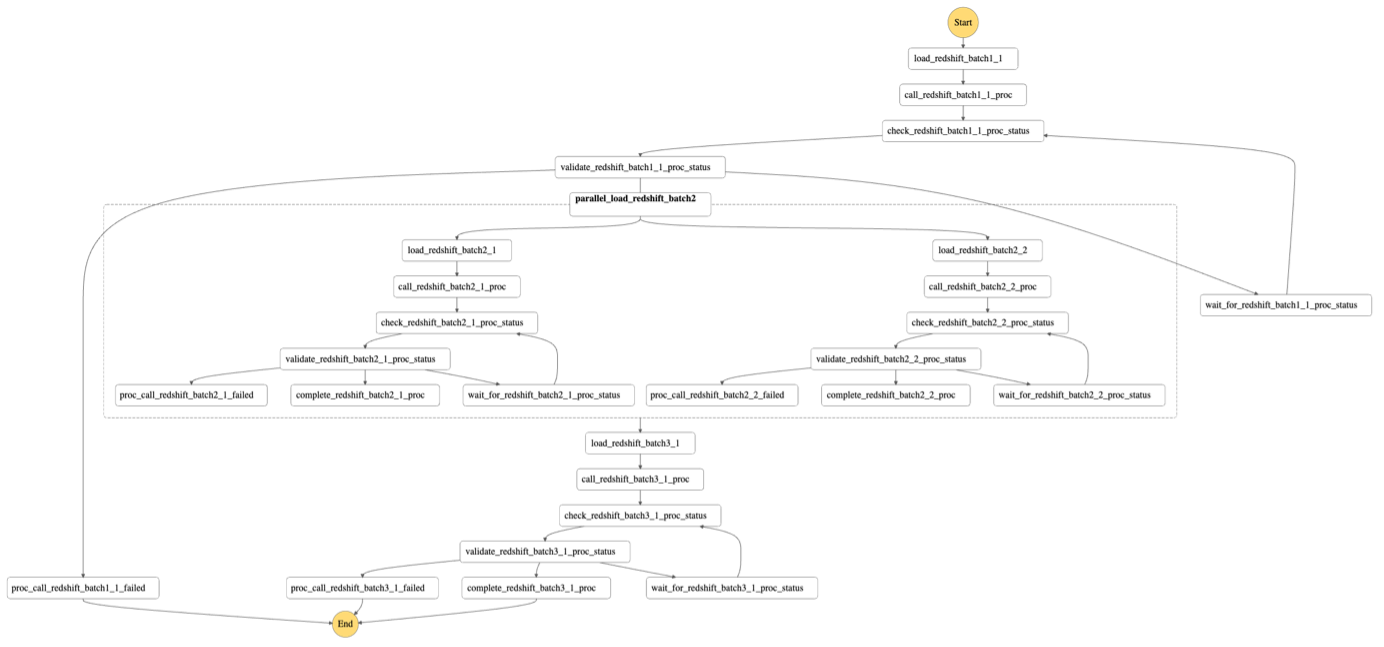
Figure 2: A complex workflow in AWS Step Functions, involving multiple stages of data processing. The parallel execution doesn’t allow resuming from a specific mid-execution step, but the branching structure provides automated error handling and recovery.
Native AWS service integration
Step Functions provides direct integration with Lambda functions, SQS queues, SNS topics, and DynamoDB, eliminating the need for custom connectors or additional infrastructure components.
Cost-effective pay-per-use model
The pay-per-execution pricing model aligns with variable order volumes, keeping costs minimal during slow periods while scaling automatically during busy times.
Human approval workflow support
Step Functions supports human approval steps, making it suitable for high-value order workflows that require manual review or approval processes.
Implementation considerations
- Error handling: Built-in retry mechanisms and error handling patterns help provide reliable order processing with configurable retry policies.
- Visual monitoring: The Step Functions console provides real-time visibility into order processing status, enabling quick identification of bottlenecks.
- Security model: Fine-grained AWS Identity and Access Management (IAM) roles per step so that payment processing functions have different permissions than inventory management functions.
Choosing the right workflow orchestration service
When selecting between Amazon MWAA and AWS Step Functions, consider these workflow characteristics:
Consider Amazon MWAA when your use case involves:
- Complex stateful data processing where workflows modify data state and require recovery mechanisms to maintain consistency
- Long-running batch jobs executing for hours or days where computational investment is substantial
- Built-in scheduling requirements where regular batch processing needs time-based orchestration
- Granular recovery needs where resuming from specific failure points is business-critical
- Complex task dependencies involving sophisticated relationships between workflow tasks
- Existing Apache Airflow expertise where teams have substantial investment in Apache Airflow knowledge
Consider AWS Step Functions when your use case involves:
- Event-driven serverless workflows triggered by external events requiring immediate response
- Stateless processing where each workflow execution operates independently
- Short to medium duration tasks completing within minutes to hours
- Heavy AWS service integration involving extensive coordination with Lambda functions and other AWS services
- Human approval workflows requiring manual intervention or decision-making
- Variable load patterns with unpredictable traffic requiring automatic scaling
Decision framework
To help guide your decision process, consider the following questions:
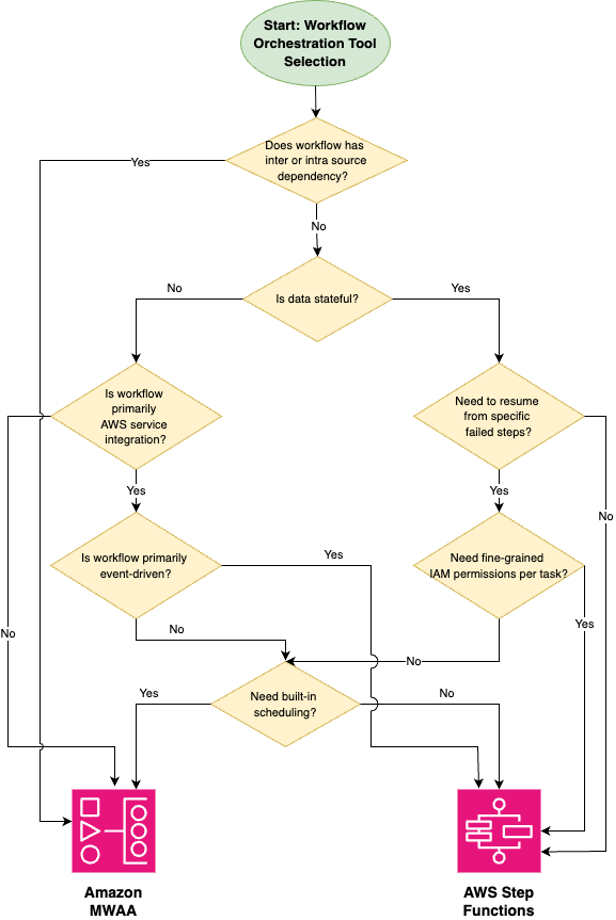
Figure 3: Decision tree guiding through key considerations for choosing between Amazon MWAA and AWS Step Functions based on workflow characteristics.
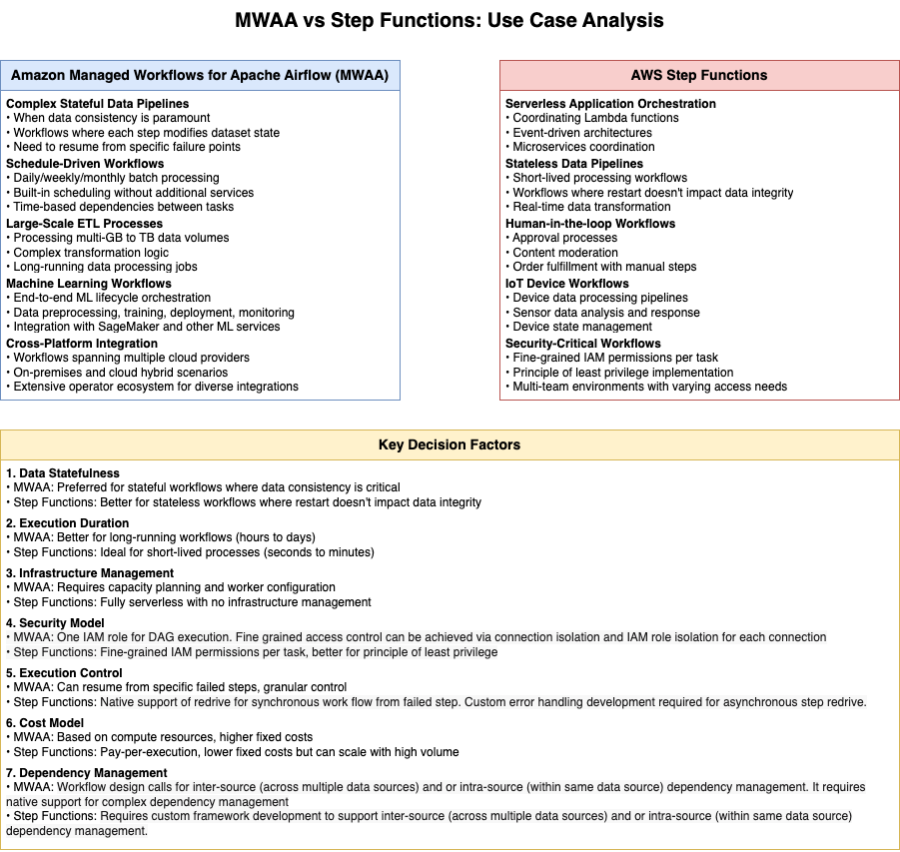
Figure 4: Comprehensive comparison between Amazon MWAA and AWS Step Functions, highlighting decision factors for choosing the right workflow orchestration service.
Conclusion
Both Amazon Managed Workflows for Apache Airflow and AWS Step Functions are workflow orchestration services, each designed to address specific use case requirements. By understanding your workflow characteristics and aligning them with the strengths of each service, you can make an informed decision that supports your business needs.
For complex, stateful workflows with long execution times and sophisticated recovery requirements, Amazon MWAA provides robust capabilities. For event-driven, serverless workflows with tight AWS integration and variable load patterns, AWS Step Functions is a strong fit.
Remember that these services are not mutually exclusive. Many organizations use both to address different workflow orchestration needs across their application portfolio. By focusing on your specific use case requirements, you can select the right tool for each job and build resilient, efficient workflow orchestration solutions on AWS.
If you have questions or feedback about choosing between these services, leave a comment.
About the authors


