70
Cisco Live 2026 signals the arrival of the agentic network, built around Cloud Control, AI-driven operations and security. But for managed connectivity providers, the real test remains simpler licensing, channel economics and monetizable value for SMB customers.
In sum – what to know
Agentic network – Cisco Live US 2026 centers on Cisco Cloud Control, AI agents, Live Protect, and Splunk observability.
Industry convergence – Just after Extreme Connect, both vendors landed on one playbook, one platform plus agentic AI, now competing on execution and price.
The SMB catch – Maravedis research shows the channel still decides on support, simple licensing, and margin, which neither vendor has resolved.
Cisco previewed its Cisco Live US lineup for analysts last week, and we were served with many significant announcements. The throughline is the shift from chatbots to agentic AI, with agents positioned as “digital coworkers” now deployed across data centers, campuses, and branches. Every action one of those agents takes, Cisco argues, is simultaneously a routing decision, a trust decision, and a telemetry event. That single idea is the lens through which almost everything comes to the show floor.
Here is what to expect and how it reads from Maravedis’s perspective, looking at managed connectivity and the SMB channel rather than the data center core. The “One Cisco” frame: three constraints, four outcomes.
Cisco’s pitch opens with three things it says are holding customers back as agentic AI scales: an infrastructure constraint (agents generate long, sustained load rather than the spiky demand of the chatbot era), a trust deficit (agents now collaborate with other agents and reach into systems), and a data gap (agents produce more telemetry than anyone is currently capturing). The answer is organized around four outcomes the company calls its one Cisco strategy: AI-ready data centers, future-proof workplaces, secure global connectivity, and digital resilience. Expect that four-part structure to anchor every keynote.
Cisco Cloud Control and agentic ops: the headline
The centerpiece is Cisco Cloud Control, a unified cross-domain platform that pulls networking, security, AI infrastructure, observability, and collaboration into a single sign-on destination with a shared data fabric. It enters controlled availability in the United States on June 2 for commercial customers, with the rest of the world to follow. Notably, Security Cloud Control folds into it, which Cisco described as “security cloud control” evolving into “security in cloud control.”
Inside the platform, watch for three pieces that matter beyond the demo:
– AI Canvas, a shared workspace where human operators and agents investigate and resolve issues together.
Agent Studio, which lets customers bring in third-party agents, build their own, and consume Cisco’s, an explicit nod to multi-vendor reality.
– App Builder, a workflow and app creation surface inside Cloud Control that is powered by OpenAI’s Codex. Cisco is framing Cloud Control as a “harness” for talking to your entire estate of switches, routers, and access points, much the way coding harnesses unlocked agentic development.
– Underneath sit purpose-built models (a domain-specific “deep network model,” a cybersecurity model called Foundation Sec) blended with frontier models, plus a network digital twin and Experience Metrics that, after debuting on wireless earlier in the year, now extend to wired.
Security: compensating controls without the reboot
The most operationally interesting security item is Live Protect (the detection side is “Live Detect”). It applies pinpoint compensating controls to a running switch or router to shield a known vulnerability without rebooting the device or updating its software. Cisco was clear that these are not WAF (web application firewall) or generic IPS (intrusion prevention system) rules, but very precise constraints, for example, blocking one software process from touching one file, with near-zero performance impact. It ships with Cisco software and is included with a supported contract, starting with on-campus smart switches.
Alongside it: post-quantum cryptography extending to SD-WAN (software-defined wide-area network) links, advanced firewall capabilities moving onto secure routers, and a set of agent-security moves including AI Defense, the integration of “Defense Claw” into Cisco Secure Client, and agent identity work built on the Asterix acquisition. The governing idea is a move from “can an agent access this” to “should it,” with just-in-time, just-enough access for agents.
Future-proof workplaces: what matters for the channel
This is where Cisco Live touches our world directly. The headline for anyone in managed connectivity is portfolio convergence. Cisco’s new devices are branded Cisco, not Meraki or Catalyst, and run one piece of hardware, one operating system, and a choice of operating model: the Meraki cloud dashboard, the on-premises Catalyst Center, or a hybrid of the two.
Hardware to expect includes a new 9550 fixed core campus smart switch with 400G (400 gigabit per second) uplinks, a highly scalable 8600 secure router for high-volume VPN (virtual private network) aggregation, new 8100/8200/8300 router variants, a low-power ruggedized router for utilities, and, for the wireless side, a premium outdoor Wi-Fi 7 (the latest Wi-Fi generation, also known as 802.11be) access point that Cisco says carries four times the capacity of the prior generation.
There is also a Cisco Multicloud Fabric for one-click connectivity across sites and clouds, a Webex meeting prep agent, and a third-generation Cisco Board Pro built on an Nvidia chipset that natively runs Webex, Microsoft Teams, Zoom, and Google.
Digital resilience and customer experience
On the Splunk side, expect the Cisco data fabric for telemetry at massive scale, federated search (bringing Splunk to the data rather than moving data into Splunk), a machine data lake, an AI toolkit, and agentic operations for both the SOC (security operations center) and SRE (site reliability engineering) functions. Observability for AI gets named pillars, including agent observability (via the Galileo acquisition), infrastructure observability for GPUs (graphics processing units, the chips that run AI workloads) and vector databases, and cost visibility that Cisco is branding “tokenomics.”
As a reminder, Splunk is a software platform for collecting, searching, and analyzing machine data, the logs and telemetry that servers, network devices, applications, and security tools generate constantly.
It’s used most heavily in two areas. The first is IT and infrastructure monitoring, where teams use it to troubleshoot outages and watch system health (the SRE -site reliability engineering function). The second is security, where it’s one of the leading SIEM (security information and event management) tools, meaning a security operations center uses it to detect threats and investigate incidents by correlating events across the whole environment.
Finally, Cisco IQ, the services layer that reached general availability on April 24, has signed more than 1,000 customers, covering millions of devices in roughly a month. Expect resilient-infrastructure services for the post-frontier-model era, a Quantum Ready Assessment, an on-premises mode, and peer benchmarking by vertical and geography.
An enterprise story, with a question underneath
Cisco is doubling down on the top of the market, the AI-ready data center and the large, agent-saturated enterprise estate. That is the right place for Cisco to plant a flag. But it is not the buying logic that governs the SMB and managed services market we mapped in our SMB study, Small Business Wi-Fi: The MSP Networking & Security Requirements, and the gap between the two is exactly what the connectivity channel should be watching for.
The study, drawn from 47 MSP (managed service provider) touchpoints across ten in-depth interviews and a 37-response survey, surfaced a different hierarchy of needs. Support quality was both the number-one vendor selection factor (cited by 100% of survey respondents) and the number-one pain point. Cloud management was treated as table stakes. And the single most repeated frustration with the premium incumbent was licensing complexity, the “licensing treadmill” that MSPs want gone.
Margin protection and genuine channel partnership, not raw feature depth, were the factors most likely to move an MSP from one vendor to another.
Hold the Cisco Live announcements against that, and three questions stand out:
- Does convergence simplify licensing, or add more layers? The one-hardware, one-OS (operating system), choice-of-operating-model design is genuinely attractive for MSPs who want cloud flexibility without lock-in. But the study is unambiguous that simple, predictable licensing with no equipment bricking on lapse is a make-or-break for this buyer. Agentic ops and Cloud Control add sophistication; the channel will judge whether they also add cost and complexity.
- Can agentic value reach the cloud-managed tier in a form MSPs can monetize? Experience Metrics, digital twins, and ambient agents that cut truck rolls map directly onto MSP unit economics. If those land in the Meraki-dashboard operating model and can be resold as a managed-services line item, that is a real opportunity. If they remain effectively an enterprise command-center feature, the mid-market MSP running 25 to 50 clients will not bite.
- Does the channel and margin model evolve? This is the decisive one. The study shows the SMB base rewards margin protection, deal registration, and channel discipline, precisely the terrain where value players win, and premium incumbents lose ground. None of the Cisco Live agenda speaks to that directly, and it is the variable that most determines whether any of this reaches the managed connectivity provider.
To Cisco’s credit, the multi-vendor and legacy-stack question was front of analysts’ minds on the call, including the question of parity between cloud-managed deployments and enterprise-grade Catalyst and Nexus. The answer pointed to Agent Studio, App Builder, and the converged portfolio as the extensibility story. That is the right architecture. The open question is commercial, not technical.
Cisco vs Extreme: two roads to the agentic network
Cisco Live lands only a few weeks after Extreme Connect 2026, which I covered in Orlando, and the two events rhyme. Both companies have arrived at the same destination, a single cloud-managed platform with agentic AI as the headline, but they get there from different starting points and at different speeds. On the AI question specifically, here is how they line up. (In the table below, GA means generally available, and MCP, the Model Context Protocol, is an open standard that lets AI agents connect to outside tools and data.)
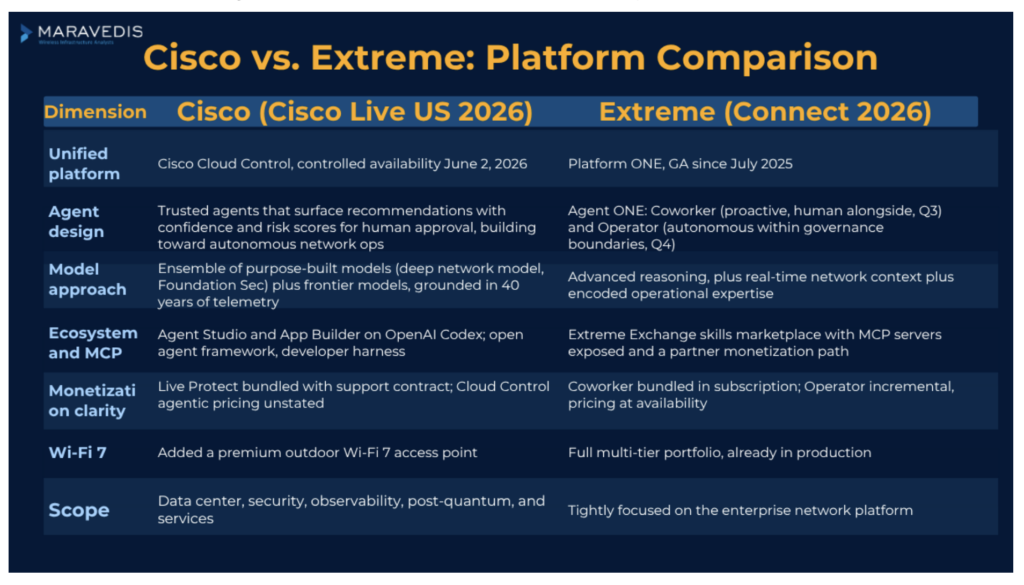
A few of these differences matter more than others.
Timing runs opposite to maturity. Platform ONE has been generally available since July 2025, roughly a year ahead of Cisco Cloud Control. But Extreme’s challenge, as I noted in that coverage, is adoption: a large, entitled base still running older tools. Cisco is earlier on the availability curve, yet it brings a far larger installed base and portfolio to migrate. Each is fighting a version of the same battle from opposite ends.
The agent design is strikingly parallel. Extreme’s Coworker-then-Operator path is almost a one-to-one match for Cisco’s trusted agents that ask for human sign-off today and aim at fully autonomous operations tomorrow. Both vendors went out of their way to argue that this is not a large language model bolted onto a dashboard, and both lean on the same recipe: domain reasoning, live network context, and encoded expertise. On architecture and ambition, they have converged almost completely.
Ecosystem strategy is where they diverge, and it matters for our channel. Extreme Exchange is an explicit AI skills marketplace, with MCP servers exposed and a path for MSP partners to build, package, and monetize proprietary skills. Cisco’s analog, Agent Studio plus App Builder, reads more like a developer harness for integrating third-party agents and building custom workflows than a partner revenue engine. Both embrace open agent frameworks. Only Extreme has, so far, explicitly drawn the partner-monetization line, and that is the more channel-native idea on paper.
Neither has answered the pricing-for-autonomy question. Extreme was candid that Operator will bear incremental costs and floated a token-limit “cell phone minutes” analogy, signaling that usage-based billing is still being worked out. Cisco was clearer about what is bundled than about how the agentic tier of Cloud Control will be priced. For the MSP buyer, our SMB study profiles, who reacts sharply to licensing surprises, this is the open question on both sides.
On trust, the two take different angles at the same wall. Cisco’s response to agentic risk is heavily security-flavored: agent identity via the Asterix acquisition, just-in-time access, Defense Claw, AI Defense, and a post-frontier-model threat surface. Extreme’s is more operational and change-management flavored. The sharpest reminder of how high the bar sits came not from a vendor but from a healthcare network operator who commented on my Extreme write-up, citing life-safety constraints and a reluctance to let autonomous AI operate on production networks without auditable, reproducible behavior. Both vendors have the right intent. Neither has the track record yet.
Bottom line
Expect Cisco Live US 2026 to be a confident, AI-infrastructure-forward show built around Cisco Cloud Control, agentic ops, Live Protect, and a converged Cisco-branded portfolio. Coming weeks after Extreme Connect, it confirms that the industry has settled on the same answer, one platform plus agentic AI, and is now competing on execution, ecosystem, and price rather than vision.
For data centers and large enterprises, Cisco holds a strong hand. For the managed connectivity and SMB channel, the interesting story is not on the keynote stage but in the fine print of licensing, operating model, and channel economics. That is where our SMB study, Small Business Wi-Fi: The MSP Networking & Security Requirements, says the market is actually decided. This year I followed the announcements from afar, though I would welcome the chance to cover Cisco Live in person next time around.


