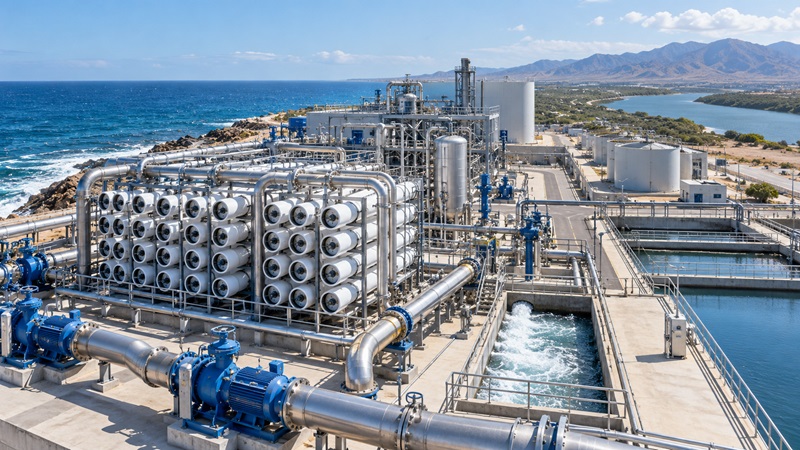
Reverse osmosis plants running on seawater have a combined installed capacity of about 30.6 million cubic metres a day worldwide. Plants running the same technology on brackish water account for another 17.8 million, according to a global assessment of desalination capacity published in the journal Desalination. That second figure is more than a third of all RO capacity on the planet, and it almost never appears in the coverage.
It should, because those two groups of plants do not have remotely the same energy footprint. The peer-reviewed range for seawater reverse osmosis is roughly 3 to 4 kilowatt-hours per cubic metre of product water. For brackish water reverse osmosis it is 0.5 to 2.5. Inland groundwater projects at the low end of the salinity range typically land near the bottom of that band.
Same membranes, same basic process, up to an eightfold difference in the electricity bill and the emissions that come with it.
Where the energy actually goes
The reason is osmotic pressure, and it is not a detail of engineering practice so much as a fact of physical chemistry. To push water across a semipermeable membrane against its own concentration gradient, you have to apply hydraulic pressure exceeding the osmotic pressure of the brine leaving the system. Osmotic pressure scales with salinity. So the saltier the feed, the harder the pumps work, and pump work is essentially the entire energy story in RO.
Seawater runs 32,000 to 45,000 ppm total dissolved solids. Getting fresh water out of it takes operating pressures in the range of 55 to 70 bar. Brackish water sits between roughly 1,000 and 10,000 ppm, and the same job is done at 8 to 16 bar.
That is where the eightfold gap comes from. Not from better equipment or a more advanced membrane. From starting with water that has less salt in it.
Researchers writing in ACS ES&T Engineering put the point about as plainly as it can be put: targeting lower-salinity waters is a simple and effective way to reduce the minimum energy a desalination process requires. It is the one lever in the whole system that works before you have built anything.
The efficiency story nobody tells
There is a second thing the standard coverage misses, and it cuts in the technology’s favour.
Early seawater RO plants were genuinely profligate. They discharged brine that was still at full operating pressure, throwing away most of the energy the pumps had just put into it. Modern plants recover that pressure and use it to pressurise incoming feed water, which is why seawater RO now sits in the 3 to 4 kWh range rather than the double digits.
The same ACS ES&T Engineering analysis notes that current thin-film composite membranes, combined with state-of-the-art energy recovery devices and pumps, allow seawater RO to operate within roughly a factor of two of the thermodynamic minimum energy required for the separation. There is not a great deal of headroom left. For a mature industrial process, running within 2x of the physical floor is close to remarkable, and it means the widely repeated claim that desalination is waiting on some efficiency breakthrough is mostly wrong. The breakthrough already happened, quietly, in the pressure exchangers.
Where the real headroom sits is in feedwater selection, and that is a planning decision rather than a technical one.
Three classes, not one technology
Part of why the public conversation flattens all this is that “reverse osmosis” gets used as though it names a single machine. It does not. It names a family, and the class is chosen by feed salinity before anything else gets sized — pump rating, pressure vessel specification, membrane selection, and the entire pretreatment train all shift with it.
For anyone who wants to see how sharply those lines are drawn in practice rather than in principle, equipment specifications are a useful place to look. Manufacturers split their catalogues along the same boundaries the physics does, and how RO systems are divided by feed salinity band tracks the pressure classes almost exactly: low-pressure units for municipal and treated groundwater feed, an intermediate class for brackish sources, and a separate high-pressure class with corrosion-resistant materials for true seawater.
The practical consequence matters more than it sounds. A plant specified into the wrong class does not waste energy once. It wastes it every hour for twenty or thirty years, and no amount of operational tuning recovers it. Seawater-class equipment installed on a brackish source is a permanent efficiency penalty baked into the capital decision.
The part that does not get easier
Honesty requires the counterweight, and it runs the other direction.
Lower salinity reduces the energy cost of separation. It does not reduce the brine problem, and in some respects it makes it worse. A coastal seawater plant discharges concentrate into the ocean, which raises real and well-documented questions about outfall design and benthic impact but at least offers somewhere to put it. An inland brackish plant has no such option. Its choices are evaporation ponds, deep well injection, or zero liquid discharge, and all three are expensive, land-hungry, or energy-intensive in their own right — which can claw back a meaningful share of the energy the low-pressure operation saved.
So brackish desalination is not simply the better answer. It is a different trade: cheaper separation, harder disposal. Which of the two dominates depends on geology, on how far the site is from a viable receiving environment, and on what the local regulator will permit.
What this changes
The useful shift is small and specific. When a carbon accounting exercise, a policy paper, or a news story assigns an energy figure to desalination, that figure is close to meaningless without the feedwater salinity attached to it. A megalitre from an inland brackish plant and a megalitre from a coastal seawater plant are not the same product, environmentally, even if they come out of chemically identical membranes.
The global capacity split makes this more than a technicality. The International Energy Agency’s tracking has put seawater at roughly 60 percent of installed desalination capacity and brackish sources at over 20 percent, and in the United States the balance has historically tilted much further toward brackish groundwater than most people assume — the UN’s World Ocean Assessment recorded seawater at only around 10 percent of US capacity in 2010, with brackish accounting for the large majority.
Water-stressed regions will keep building. The question worth arguing about is not whether desalination is too energy-hungry to be part of the answer. It is whether the plants going up over the next decade are being pointed at the least salty water available to them, or simply at the nearest ocean.


