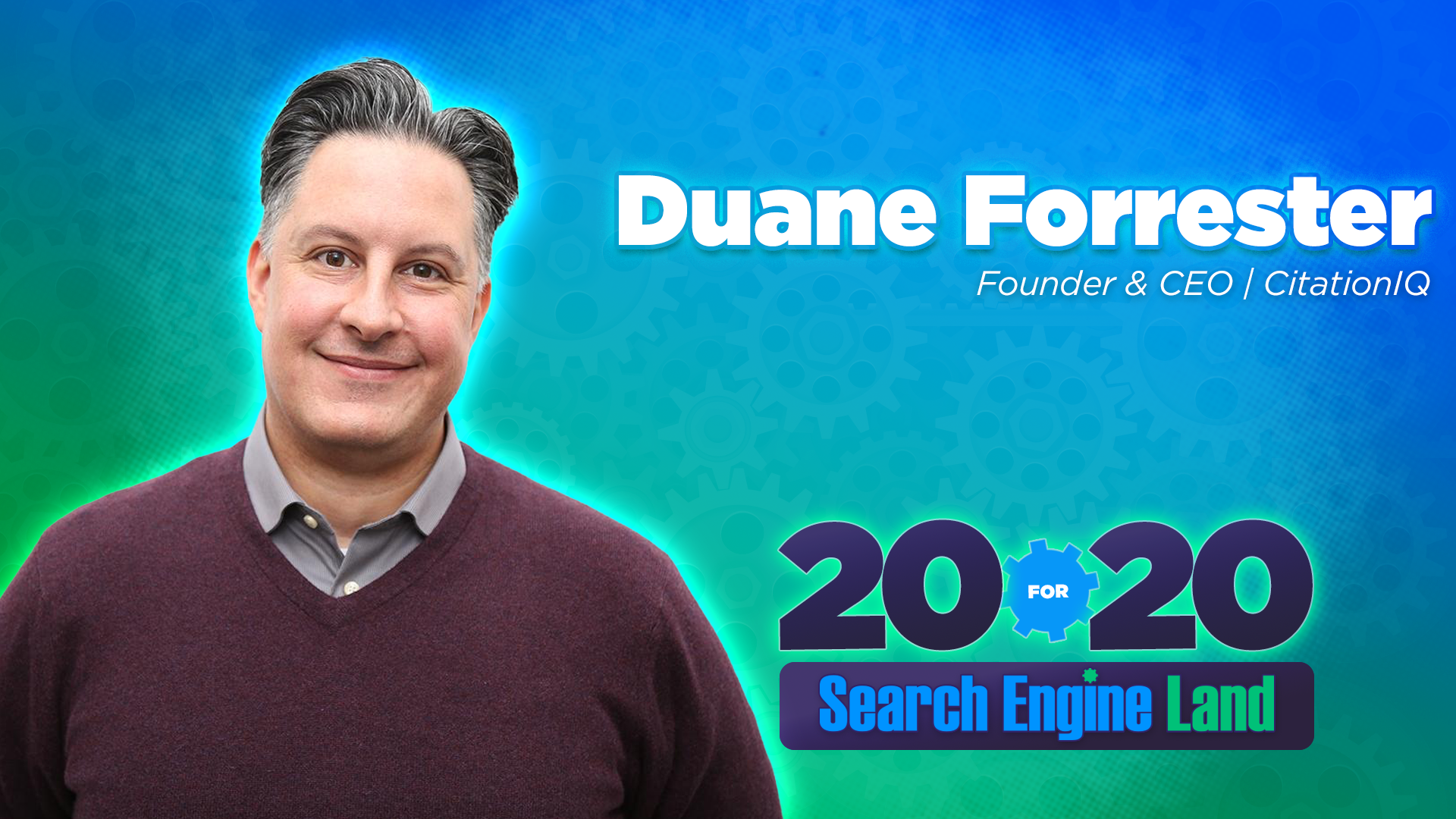
Duane Forrester has watched search evolve from the days of meta keyword stuffing and penny clicks through mobile, personalization, “(not provided),” AI, and LLMs.
After more than 25 years in the industry, including a decade at Microsoft, Forrester believes search is entering another foundational shift. To him, it feels a lot like the industry’s earliest days.
In our conversation for Search Engine Land’s 20th anniversary, Forrester reflected on the moments that shaped search, what he learned from working inside Bing, the career advice that changed how he works, and why SEOs need to become lifelong learners to survive what comes next.
Here are some highlights from our Search Engine Land 20 for 20 conversation.
SEO is back in the Wild West
Forrester started in SEO before Google existed. At the time, practitioners had little documentation, few tools, and almost no direct access to search engines.
Learning meant running experiments, reading code, and sharing discoveries with other SEOs in online communities and at conferences.
Today feels surprisingly familiar.
AI has created another period where the rules are being written in real time. The difference? Practitioners now have an overwhelming amount of research, documentation, and technology.
Keeping up with all of it? Forget it.
Anyone trying to stay at the absolute leading edge of AI is setting themselves up for frustration, Forrester said. Unless you work inside companies such as Google, Microsoft, OpenAI, or Anthropic, you probably can’t see the true leading edge anyway.
Instead, focus on making steady progress. Keep learning and keep the leading edge in sight.
Forrester said he feels more exhausted — and more excited — than at any other point in his career.
The SEO community was built on sharing
In search’s early years, communities such as WebmasterWorld served as a shared knowledge base.
People built reputations under usernames by answering questions, sharing discoveries, and helping each other understand a field that barely had a playbook.
Conferences brought that community together in person. Forrester remembers realizing there were other people who spoke the same strange language he did, and who were eager to trade ideas and help one another.
He said that spirit still exists, although the industry has become more insular in the AI era.
His advice is simple: participate. Publish what you’re learning. Go to meetups. Talk to people. Ask questions.
Forrester follows the same approach with his Substack. He uses it to document what he’s learning, which exposes him to more research, people, and ideas.
Working inside a search engine changed some SEO assumptions
One of Forrester’s biggest surprises after joining Microsoft was seeing how compartmentalized search engines are.
He recalled asking someone on the Bing Webmaster Tools team for backlink data. The employee responded by asking whether links actually affected rankings.
Forrester was stunned.
The employee wasn’t joking or trying to mislead him. Links simply weren’t part of his job. He didn’t have access to that part of the system.
That experience permanently changed how Forrester interpreted statements from search engine representatives. Working at Google or Microsoft doesn’t mean someone understands every part of search.
It also taught him another lesson: SEOs can obsess over tiny details that have little practical impact.
Today, Forrester focuses on the “big blocks” instead of the small ones. Or, as he puts it with a cooking analogy, stick with the “chunky onions.”
Search engines really do care about the user
Forrester also pushed back on the idea that search engines and SEOs are natural adversaries.
When Google tells SEOs to focus on users and their journeys, Forrester said that isn’t simply corporate misdirection.
Search engines are chasing the same customers marketers are.
That doesn’t mean Google will explain every ranking system or reveal proprietary information. It also doesn’t mean every Google employee can answer every SEO question.
But the underlying goal — satisfying the user — is real.
That’s also why Forrester believes SEOs need to move beyond labels such as “technical SEO” and “content SEO.” Technical excellence won’t save content that misses user intent. Likewise, great content can struggle if a site lacks the technical foundation needed to earn trust.
Modern search requires both.
‘(not provided)’ changed SEO in many ways
Few Google decisions still frustrate Forrester like the loss of keyword referral data.
He described “(not provided)” as a slap in the face to the SEO industry because it removed valuable data and forced businesses to make decisions with less information.
But it also had an unintended effect.
The data gap created demand for third-party SEO platforms. Forrester pointed to companies such as Semrush, Ahrefs, and Conductor as examples of tools that became increasingly important as marketers sought additional data sources.
In his view, that shift helped SEO grow beyond its “cottage industry” roots.
He still wants the data back.
The career lesson that changed everything
One of Forrester’s most important career moments came when a Microsoft manager told him he was underperforming.
Forrester thought he was about to lose his job.
Then he had lunch with longtime industry veteran Stephan Spencer.
Spencer helped him realize the problem wasn’t his ability. He was simply trying to keep too much work in his head.
Forrester built a system that broke projects into subprojects, tasks, deadlines, and individual work items.
Within months, his performance improved dramatically. By his annual review, he hadn’t lost his job. Instead, he earned a promotion and the largest bonus available.
He still organizes both his professional and personal projects using versions of that system.
The lesson is simple: when your workload becomes overwhelming, the answer isn’t always to work harder. Sometimes it’s to build a better system.
Search won’t disappear. It will become infrastructure
So what does Forrester think search will look like 20 years from now?
Agents.
Instead of manually researching a new coffee maker, we may tell a digital assistant what we need. It will research the options, apply what it knows about us, and return a shortlist — or eventually complete the purchase for us.
That doesn’t mean search disappears.
Forrester expects search to become an infrastructure layer beneath these experiences. It will supply the information agents need to understand and act on our requests.
Content will still matter. Trust may matter even more.
Brands and businesses need to demonstrate their trustworthiness to people and machines.
Despite all the technological change, Forrester believes the core job of search marketing will remain remarkably familiar.
Understand what someone wants at the moment they want it — and be the best answer.
The technology will change dramatically.
The mission probably won’t.


