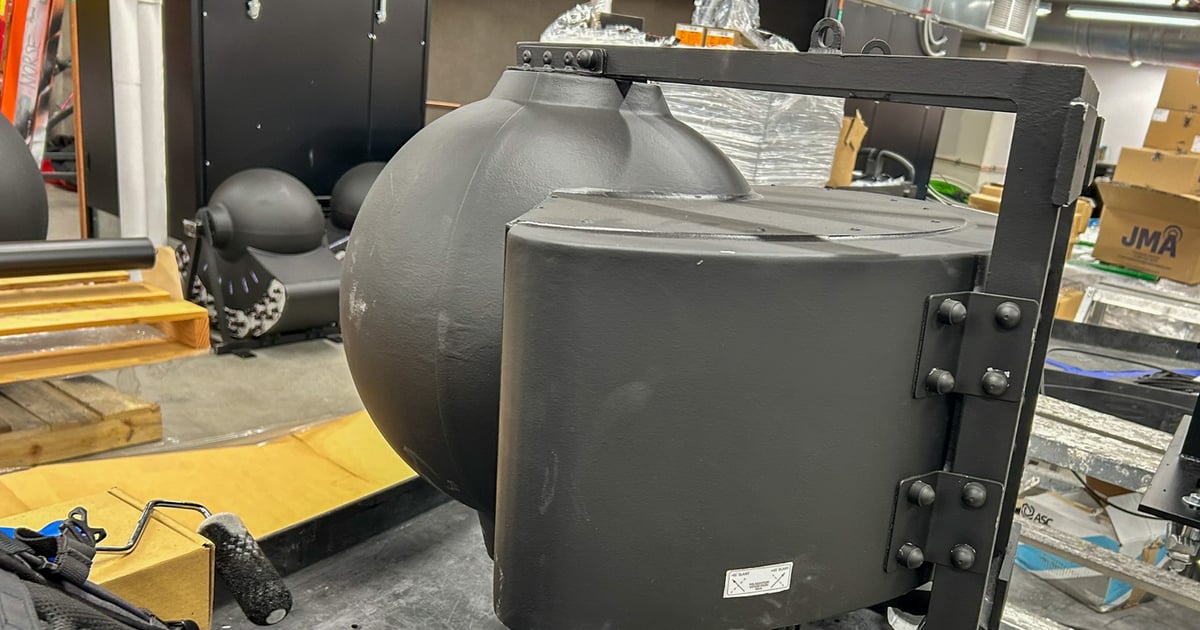
Lodged high in the steel skeleton of the AT&T Stadium, home to the Dallas Cowboys, are what appear to be several white balls, as if there have been some exuberant kicks by a trespassing soccer team. Closer inspection reveals they have a hard and shiny fiberglass exterior and are not there by accident. Built by a Californian company called MatSing, they are actually antennas, designed to blanket the stadium with a high-speed 5G signal for its many thousands of smartphone-addicted guests. As effective as it looks to some experts, the technology the antennas use is not the 5G or even 6G one that the industry’s big players have mainly tried to sell.
For years, Ericsson and Nokia have done their utmost to market a radio technology called massive MIMO. Standing for “multiple input, multiple output,” it relies on active antennas, stuffed with electronics, to create signal beams that can pinpoint users with the supposed accuracy of a Dak Prescott throw. Modern units feature dozens of transmit-receive modules (TRXs) to create an array of antenna elements. Multiple beams can be fired at smartphones with unprecedented control.
Unlike MatSing’s ball, these massive MIMO antennas are unmistakably flat and rectangular, hanging from masts like big white teeth. Gestating offspring that sound even more gargantuan (giga MIMO, ultra MIMO) are now at the center of conversations about 6G, due to arrive in 2030. Yet massive MIMO has been no unqualified industry success. It is expensive to buy and not cheap to run, voraciously gobbling power. Its performance has not always lived up to expectations. To the chagrin of Ericsson, take-up in some markets has been disappointing.
The MatSing ball that can be observed at some US stadiums is based on the completely different concept of passive antennas. Those make do without electrical components such as amplifiers and therefore require no direct external power source. But they were widely assumed to have been eclipsed by massive MIMO in more advanced 5G networks.
One problem seemed to be their inability to generate multiple beams in the way that massive MIMO does. “Originally, with a passive antenna, you had one beam,” said Earl Lum, the founder of analyst firm EJL Wireless Research. “But now CommScope and others are coming out with multibeam antennas.”
Skinny beams
The CommScope unit Lum refers to is today called Andrew. It competes against MatSing and was acquired by Amphenol as part of a $2.1 billion transaction announced in July 2024. Andrew has now developed the equivalent of a four-beam passive antenna that works just as well as massive MIMO but with more basic and lower-cost radio technology, according to Lum.
Where massive MIMO would generate beams digitally, conveying resources from baseband or radio units to the different submodules of an array, a passive antenna would traditionally take a more analog approach based on a radio frequency (RF) device known as a Butler matrix, explains Minya Gavrilovic, the general manager of Amphenol’s Andrew antennas business. “It’s a very complex passive RF matrix that can generate multiple beams out of the same antenna array,” he told Light Reading. “If you open the antenna, you have cabling, and then there’s this giant printed circuit board.”
Sadly, the unbreakable laws of physics mean beams typically degrade as they scan one way or the other. “If you scan a beam to the left, what tends to happen is the beam starts deforming a bit,” said Gavrilovic. “So, you don’t have four beams of the same shape and size.” That results in a loss of signal “gain” and worsening interference. It is not a problem uniquely faced by developers of passive multibeam antennas but one that can affect massive MIMO as well, insists Gavrilovic. “Physics is physics.”
A more recent innovation, however, relies on a metalens, the same type of optical lens technology used in MatSing’s balls. “Like a magnifying glass, it squeezes the beam into something very skinny,” said Gavrilovic. “The beauty about it is that I have a beam that I can now point anywhere on the lens, and I’m not having that degradation. It’s a symmetrical structure, so the gain doesn’t start dropping off.” The beams generated in this manner are also very “clean,” as he put it – so much so that Amphenol has begun to market the technology under the “CleanBeam” brand.
CleanBeam antennas illustrated on the company’s website look more cylindrical, like the heads of Lego men, than round. But the initial target market is also the stadium environment. “I can create a multibeam by putting these things behind a ball or a cylinder that is now concentrating the beam into something very tight with very good performance,” said Gavrilovic. “So, now I have identical beams in different sectors.”
The spherical lenses that feature in MatSing’s products are named Luneberg lenses after Rudolf Luneberg, the German mathematician and scientist who conceived the original design in the 1940s. But if the principles are the same, Amphenol has not just imitated its rival. “We’re very respectful of people’s IP,” said Gavrilovic. “So, I say we’re not doing the same thing as MatSing. We’re achieving it in a different way.” Amphenol’s cylindrical designs are now fully patented, he said, expressing confidence that his business will eventually be able to show “the highest performance in the market.”
Massive MIMO attack
The question screams out: If passive multibeam antennas are so good, why have Ericsson, Nokia and their network customers seemingly had so little to say about them? One possible explanation is simply that 5G’s biggest vendors stand to earn more from massive MIMO, in which they have also made considerable investments.
“It’s one of those things where they don’t make money selling 4T4R radios because they’re commoditized,” said Lum. “And the multibeam antennas from Amphenol and MatSing only need a 4T4R radio.” Those “T” and “R” references denote the number of transmitters and receivers in a unit. Massive MIMO comes in 32T32R and 64T64R configurations. For 6G, there is talk of going up to 256T256R.
Nokia, moreover, does not even have a business unit that makes passive antennas. Previously, it has instead teamed up with the likes of Amphenol in this area, and Gavrilovic evidently regards it as a prospective partner rather than a competitor. “Nokia has been a customer of ours for passive multibeam antennas,” he said. “They’re not an antenna company.”
The same cannot be said about Ericsson, which acquired Kathrein, a German antenna maker, for an undisclosed fee in 2019. What’s currently unclear is whether it has been trying to develop anything like CleanBeam or the MatSing ball. “Certainly, Ericsson has that capability,” said Gavrilovic. “I don’t know if they have solutions.”
With the big vendors actively pushing massive MIMO, operators might also have concluded that makers of passive multibeam antennas would represent an additional complication in the mix. “Honestly, a lot of it, I believe, is that it just seems easier,” said Gavrilovic on the appeal of massive MIMO. “You just plug it in, and it works.” Trials carried out on a limited basis are unlikely to have considered the performance differences in much detail, he said.
What’s more, other than ease of integration, massive MIMO has some obvious attractions over passive multibeam antennas. Its apparent ability to track users as they move around provides a technical flexibility that is “inarguable,” acknowledged the Amphenol executive.
But lofty expectations might also have led to some unhappiness after the technology was unleashed. Distributing beams across a big sector to cover numerous customers at the same time chews up resources. In some cases, it might not even be achievable. “When it has to connect to a high number of simultaneously connected customers, that becomes a real problem,” said Gavrilovic. It seems no accident that MatSing’s balls are preferred to massive MIMO in various US stadiums.
Passive aggressive
Unfortunately, real-world data comparing massive MIMO with passive multibeam antennas is sketchy. But Amphenol claims to have beaten a rival that was offering a massive MIMO product to a contract in Latin America after the customer saw the benefits of the alternative. “We did a big deployment of four-beam, 3.5GHz panels,” said Gavrilovic. “The carrier did a trial before with 64T64R, which was the highest-performing radio, and we still matched the same throughput they did, but our PRB was much lower.”
That PRB, which stands for physical resource block, is an efficiency metric used in radio planning. The lower the measurement, the better. “They decided we’re going to save a ton of money – this is a better solution – and they did a widespread macro deployment of four beams in a live environment with us,” said Gavrilovic.
As an analyst and technology expert, Lum is effusive about passive multibeam antennas and has been championing them over massive MIMO for several years as “the solution for increasing network capacity for the mobile operator.” He spies evidence that Verizon has already replaced some of Ericsson’s massive MIMO products with MatSing antennas. “The ultimate thing is to stick the MatSing beach balls everywhere,” he said. Outside the most densely populated areas, massive MIMO – in Lum’s opinion – will simply prove too expensive.
Rising energy costs might be a significant factor in today’s climate. “If people don’t think that power limitations are going to be a big deal, I think they’re being naïve,” said Gavrilovic. “And that’s where massive MIMO is not being evaluated enough today.” He likened a network loaded with that technology to a person forced to hold arms aloft and maintain the posture. As time passes, the trembling will only get worse.


