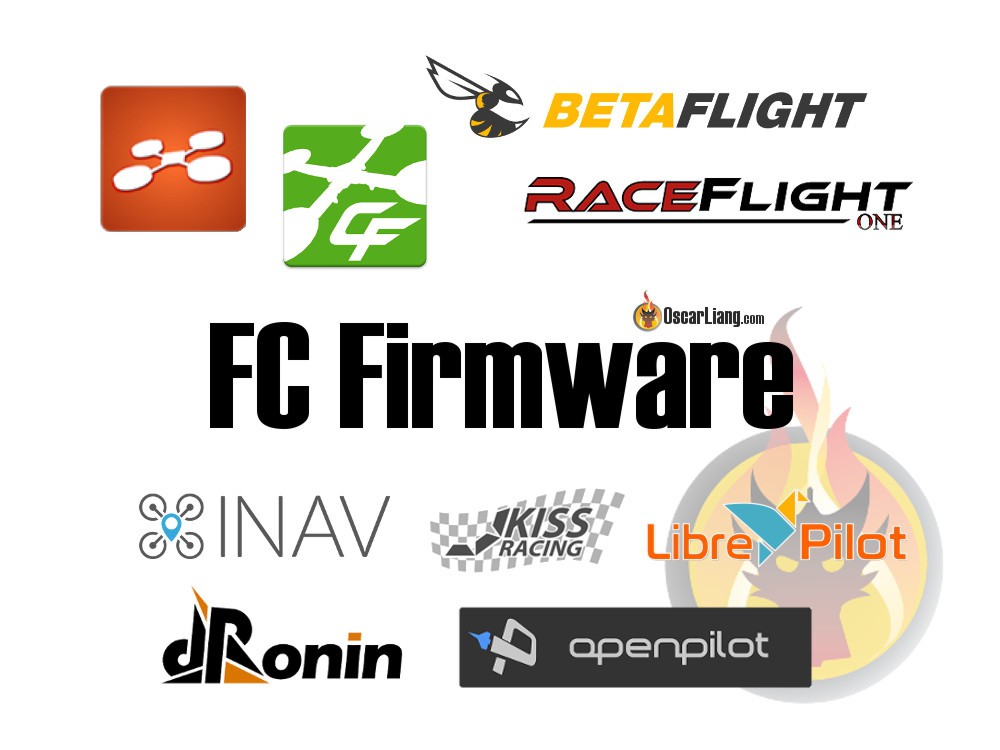
When building an FPV drone, most people spend a lot of time choosing motors, ESCs, video systems, and radio receivers, but there is another important decision to make: FC firmware. For most FPV pilots, the answer is simple: use Betaflight. However, Betaflight is not the only option. Depending on your application, there are alternatives such as INAV, ArduPilot, KISS, and EmuFlight. In this guide, I will explain the major FPV flight controller firmware options, their strengths and weaknesses, hardware compatibility, and how I decide which firmware to use.

What’s a Flight Controller?
A flight controller, or FC, is the electronic brain of an FPV drone. It uses sensors and algorithms to control and stabilise the aircraft. It receives data from the drone’s various sensors and continuously adjusts motor speeds to keep the aircraft stable and flying as intended.
You can learn more about the basics of FC in this buyer’s guide: https://oscarliang.com/flight-controller/
What’s FC Firmware?
Firmware is the software that runs on the flight controller. It reads data from the gyro and other sensors, processes your stick commands, calculates how much power each motor needs, handles failsafe behaviour, controls the OSD, communicates with peripherals, and performs many other tasks.
Different firmware projects prioritise different features, which is why there is no single FC firmware that is best for every aircraft.
Types of FC Firmware
There are many flight controller firmware options in the FPV hobby, but most are either obsolete or relatively niche. These are the main ones I think FPV pilots should know about today.
For freestyle and racing:
- Betaflight
- KISS
- Emuflight
For autonomous flying:
Betaflight
Betaflight is the default choice for FPV drones, and for good reason.
Betaflight is open-source flight controller firmware designed primarily for multirotor aircraft, including quadcopters. It is by far the most popular choice among FPV drone pilots and is known for its extensive feature set and performance-oriented design.
Betaflight offers an intuitive interface for tasks like PID tuning, OSD (On-Screen Display) configuration, and flight mode setup. It also supports a wide range of hardware, including F4, F7, and H7 flight controllers from many different manufacturers. One of its strengths is the active community and constant development, ensuring regular updates that introduce new features and improvements.
A Brief History of Betaflight
Betaflight originally started as an experimental branch of Cleanflight, designed to test more aggressive and cutting-edge flight-performance improvements—hence the name “Beta”.
Over time, it diverged significantly from Cleanflight and became a standalone project focused heavily on FPV racing and freestyle performance.
While Cleanflight has largely faded from mainstream use, Betaflight has grown into the industry standard for FPV multirotors.
Why Use Betaflight?
If you fly freestyle or racing FPV drones, Betaflight is the go-to firmware thanks to its excellent flight performance, tuning options, and continuous development.
It is also a very good choice for long-range FPV, especially now that GPS Rescue has improved considerably.
Whether you are a beginner or an experienced pilot, Betaflight provides almost everything you need to get the most out of a modern FPV drone.
Downsides of Betaflight
Despite its extensive feature set, Betaflight can still have a fairly steep learning curve for beginners.
There are many menus, parameters, and advanced options, and it is easy to become overwhelmed when you are just starting out.
However, because Betaflight is so widely used, there is also a huge amount of documentation, tutorials, presets, and community support available.
If you are serious about FPV freestyle or racing, Betaflight should usually be your first choice.
Ready to get started? Here is my Betaflight setup tutorial: https://oscarliang.com/betaflight-firmware-setup/
KISS
KISS is proprietary flight controller firmware developed by Flyduino. It has long been popular among old-school freestyle pilots because of its simple interface and reputation for excellent flight feel.
KISS stands for: Keep It Simple, Stupid
That philosophy is reflected in the way the firmware is designed.
KISS generally has a good reputation among its users and is relatively straightforward to configure. However, it offers less customisation and fewer advanced features than something like Betaflight.
For beginners, I do not normally recommend KISS as a first firmware. While it can be easy to configure, the smaller user community means there are fewer tutorials and fewer people available to help when something goes wrong.
Another major limitation is hardware compatibility. KISS firmware is designed specifically for flight controllers from FETtec and Flyduino. You cannot simply flash it onto a typical Betaflight flight controller from another manufacturer. KISS-compatible hardware also tends to be more expensive than comparable Betaflight hardware because of the smaller ecosystem and independent development. You may also come across related or derivative firmware projects such as KISS Ultra and FETtec Alpha, which retain similar philosophies and features.
You can find KISS flight controllers here:
Emuflight
EmuFlight is a branch of Betaflight that took a different approach to areas such as filtering and flight feel.
Without going too deeply into the development history, EmuFlight was partly the result of differing ideas among developers about how filtering and control should be handled. Many EmuFlight users describe it as having a unique stick feel compared with Betaflight, although I personally do not have enough experience with it to make a strong comparison.
Because it originated from the Betaflight ecosystem, the interface and general configuration style will feel familiar to Betaflight users. Some pilots try EmuFlight when they cannot get Betaflight to feel exactly the way they want.
The main downside is that EmuFlight has a much smaller user base, less documentation, and more limited modern hardware support than Betaflight. For most pilots, I would recommend starting with Betaflight before experimenting with EmuFlight.
INAV
INAV is geared much more towards GPS navigation and autonomous flight.
Apart from multirotors, INAV can also be used with:
- fixed-wing aircraft
- flying wings
- RC cars and rovers
- other navigation-focused models
It offers advanced GPS features such as:
- waypoint navigation
- Return to Home
- altitude hold
- position hold
- automated launch
- navigation-assisted flight
INAV is open source and is continuously updated by a community of developers.
Like Betaflight, INAV originated from Cleanflight, so the two projects still share some similarities. Even the Configurator interface feels somewhat familiar, which makes INAV relatively easy for Betaflight users to pick up.
Flight Performance
INAV is not as popular for freestyle or racing as Betaflight. Its primary focus is navigation rather than maximum acro performance, so multirotor flight performance is generally not as heavily optimised for freestyle. That said, the gap has narrowed significantly over the years.
Hardware Support
There are flight controllers designed specifically for INAV, but many Betaflight flight controllers are also compatible.
However, you should always check official firmware support before buying or flashing a board. Just because a flight controller supports Betaflight does not automatically mean it supports INAV.
If you are interested in UAV-style flying, long-range navigation, or fixed-wing aircraft, INAV is definitely worth exploring.
ArduPilot
ArduPilot is probably the most advanced open-source autopilot software suite available to hobbyists.
It is something of a jack of all trades, supporting a wide variety of vehicles, including quadcopters, planes, rovers, ground vehicles, even RC submarines.
ArduPilot is known for its huge feature set and extensive customisation options. It supports both autonomous and manual control modes, GPS waypoint navigation, and various sensors like barometers and magnetometers.
Its biggest downside is complexity.
Of all the firmware options mentioned in this guide, ArduPilot probably has the steepest learning curve.
It is also not a popular choice for FPV racing or freestyle because its priorities are very different from Betaflight. It focuses much more heavily on navigation, autonomous control, and robotics rather than pure acro performance.
Honourable Mentions
The following firmware projects are either outdated, discontinued, or relatively niche today, but they played an important role in the development of modern FPV flight control.
MultiWii
MultiWii was released around 2010 and was one of the first popular flight controller firmware projects in the DIY multirotor community.
It inspired many of the FPV firmware projects that followed.
The firmware originally used sensors from Nintendo Wii accessories together with Arduino hardware, for multirotors, which is where the name MultiWii came from.
Development has effectively stopped, with the last updates dating back 2015, so it is no longer a practical option for modern FPV builds.
Baseflight
Baseflight was one of the first widely used 32-bit flight controller firmware projects, appearing around 2012 and based on the older 8-bit MultiWii codebase.
Development largely stopped around 2014.
Despite controversies surrounding its original developer, TimeCop, Baseflight played an important role in the evolution of the firmware used by modern FPV drones.
Cleanflight
Cleanflight was released in 2014 as open-source flight controller firmware based on Baseflight by Dominic Clifton.
It quickly became extremely popular in the FPV drone community.
However, after Betaflight and INAV emerged in 2015, Cleanflight development slowed considerably, and most FPV pilots eventually moved to Betaflight because of its stronger flight performance, more advanced features, and more active development.
Butterflight
Butterflight was a Betaflight fork that aims to bring a renewed focus on FPV drone flight performance and cutting edge features.
Around 2018, some of its major differences included alternative gyro filtering and support for specific VTX-control features.
However, active development stopped around 2019.
OpenPilot
OpenPilot was one of the earliest major open-source flight control projects for multirotors and contributed significantly to the development of modern flight-control systems.
The project was discontinued around 2015 and was eventually succeeded by LibrePilot.
LibrePilot
LibrePilot is a fork of OpenPilot and was aimed at research and development across a wide range of applications, including robotics.
However, active development has largely stopped since around 2016, making it unsuitable for most modern FPV builds.
TauLabs
TauLabs was another fork of OpenPilot, focused mainly on autopilot, UAV research, and development.
The project targeted professionals, researchers, and students, offering an entry-level platform with fast and easy setup/configuration for any group that needs UAVs in their research.
However, development stopped around 2015, so it is mainly of historical interest today.
dRonin
dRonin was also derived from OpenPilot and focused primarily on FPV drone racing and acrobatic performance.
Its development team worked on improving racing and freestyle flight characteristics, but active development stopped around 2018–2019.
FlightOne FalcoX
FlightOne was originally called RaceFlight and began as a fork of Betaflight/Cleanflight before eventually being rewritten as closed-source firmware.
Its later firmware variant, FalcoX, became popular among some racing and freestyle pilots because of its simple configuration and direct stick feel. One unusual advantage was that much of the setup could be completed directly through the OSD rather than requiring a computer.
However, FlightOne is now widely considered abandoned or dead by the FPV community, with official development, product support, and communication largely stopped around 2022.
ArduPilot vs Betaflight vs INAV for FPV Drones
The 3 most important firmware options for FPV pilots today are Betaflight, INAV, and ArduPilot. Each focuses on a different part of the RC and UAV world.
Freestyle and Racing
For freestyle and racing, Betaflight is the clear industry standard.
INAV can fly multirotors quite well, but it does not offer the same level of performance optimisation and tuning focus for aggressive FPV flying.
ArduPilot is generally the least suitable of the three for this application.
User Friendliness
ArduPilot is the most complex and generally requires more knowledge to configure correctly.
Betaflight and INAV are easier to learn, with more modern and intuitive Configurator interfaces.
There are also far more FPV-specific tutorials, guides, and community resources available for Betaflight and INAV.
Hardware Support
Betaflight has the widest hardware support by far. Almost every mainstream FPV flight controller is designed primarily with Betaflight in mind.
INAV comes next. Some FCs are designed specifically for INAV, while many Betaflight FCs are also compatible.
ArduPilot is more selective about supported hardware and may not work with some popular FPV-oriented boards.
Cinematography and Long Range
INAV and ArduPilot are excellent for navigation-heavy cinematic and long-range applications because they provide advanced GPS-assisted flight modes.
Betaflight offers features such as GPS Rescue and Position Hold, but navigation is not its primary focus.
That said, Betaflight remains extremely popular for long-range and cinematic FPV because of its excellent manual flight performance.
Navigation and Autonomous Flight
ArduPilot is the strongest option for autonomous navigation.
INAV follows closely and offers many useful GPS-assisted features in a more accessible package.
Betaflight’s GPS Rescue is very useful as a recovery feature, but Betaflight is still much less focused on fully autonomous operation.
Airplanes
Both ArduPilot and INAV offer excellent fixed-wing support.
INAV is particularly popular among FPV fixed-wing pilots because its interface is relatively easy to learn, especially for people already familiar with Betaflight.
Betaflight also supports fixed-wing aircraft, but its functionality is less mature.
Boats and Rovers
ArduPilot is the strongest option for rovers and boats, with a very extensive feature set.
INAV can also handle some of these applications but does not offer the same depth of functionality.
VTOL
For VTOL aircraft, ArduPilot is the most capable option.
INAV also supports VTOL configurations, but ArduPilot offers considerably more mature functionality for these complex aircraft.
Conclusion
The best flight controller software depends entirely on what you want your aircraft to do.
For FPV racing and freestyle, Betaflight is the obvious choice. Its excellent flight performance, huge hardware ecosystem, and massive community make it difficult to beat.
If you need advanced GPS features, autonomous navigation, or support for other types of aircraft and vehicles, then INAV and ArduPilot become much more attractive.
INAV provides an excellent compromise between advanced navigation features and ease of use. Its interface is familiar to Betaflight users, and it offers good hardware support.
ArduPilot is considerably more powerful in terms of autonomous flight and vehicle support, but its complexity makes it harder to learn.
For beginners flying FPV drones, I highly recommend starting with Betaflight as your first FC firmware. It has the widest choice of compatible hardware and by far the largest amount of tutorials, documentation, presets, and community support.
However, if you are more interested in autonomous flying, GPS navigation, or fixed-wing aircraft, INAV may be the more suitable starting point because it offers many advanced features while remaining relatively approachable.
Edit History
- May 2017 – article created
- June 2021 – updated
- Mar 2023 – updated, shortened URL
- Aug 2026 – updated


