I am rowing in the flat water west of Diamond Creek when an eddy sucks the raft into the upriver current. In a half second, the river wrenches the oar out of my hand and sends me spinning. The power of the Colorado doesn’t give me a chance to fight.
I am pushing an eighteen-foot-long gear boat loaded with the shit necessary to take twenty-four people through the Grand Canyon for sixteen days. Literally the shit. I am rowing the boat with the groovers—the portable bathrooms for the trip—and the boat is getting heavier by the day. By now, near the end of our trip, it is so overloaded and pluggy that it takes me several strokes to start the boat moving in the direction I want. But even in the slow water, the current is so forceful that it can grab the elephantine boat and throw it halfway across the river.
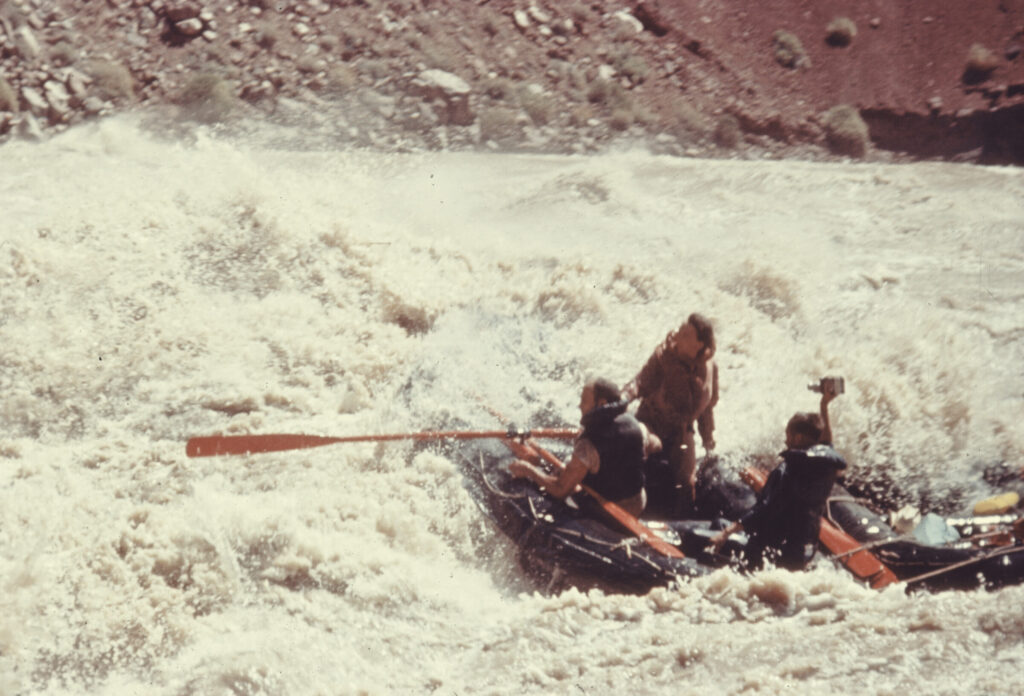
Over the course of its 1,450 miles, the Colorado River drops eight feet per mile, more than almost any major river in the world. It is fast and steep, and here in the compression of the Grand Canyon, there is so much water in the channel that sometimes the eddy lines are bigger than the waves. They boil up around us.
A river is a heavy thing. One cubic foot of water weighs sixty-two and a half pounds. It’s muscly and fast-twitch and its force compounds with movement. Here, the shore is a dark, slanted rib of metamorphic rock, shot with lighter mica and quartz. The blood-colored basement rock is the oldest geologic formation in the canyon, diamond-hard remnants of an ancient world, some of it nearly two billion years old. Those thick-skinned rock walls are so steep and solid that there are no beaches here, just big swirly boils where the current hits the shore.
In the eddy, I shake out my arms and get ready to fight my way into the current. I watch a branch get sucked down in the boil and come up twenty yards downstream. As I put my back into every push of the oars, holding my angle against the river, I imagine swimming through the current. Imagine what it would do to my body. That’s because this is approximately where Georgie White started swimming the river in 1945.
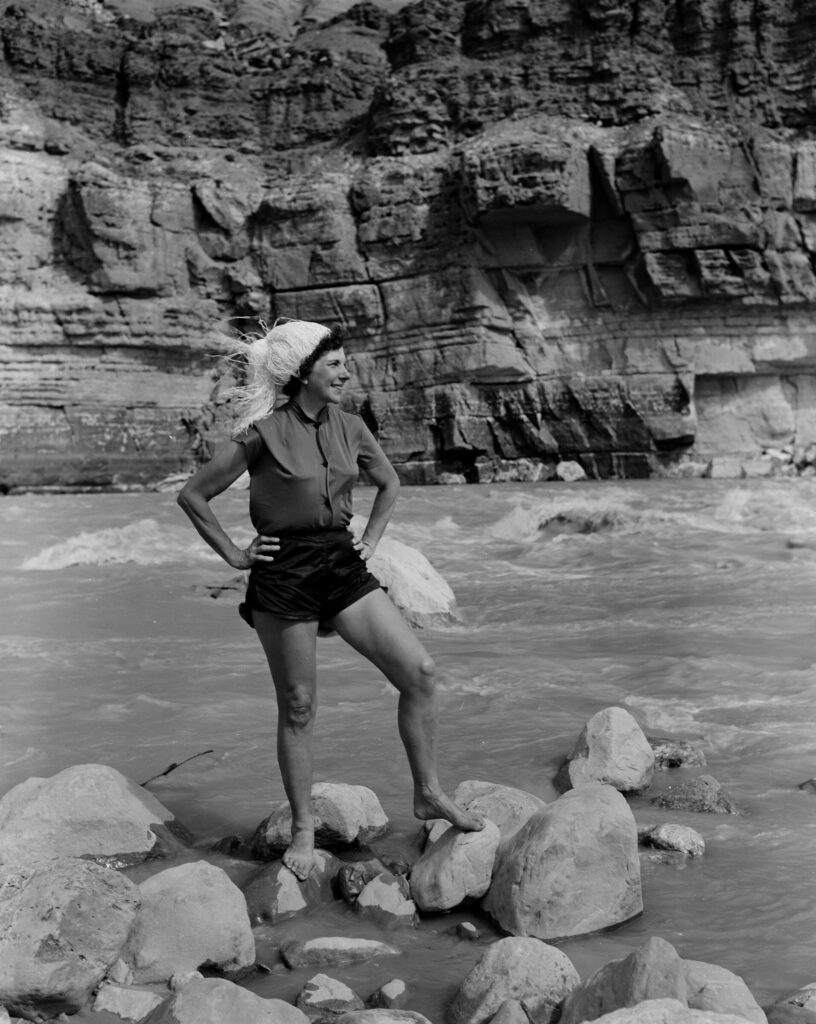
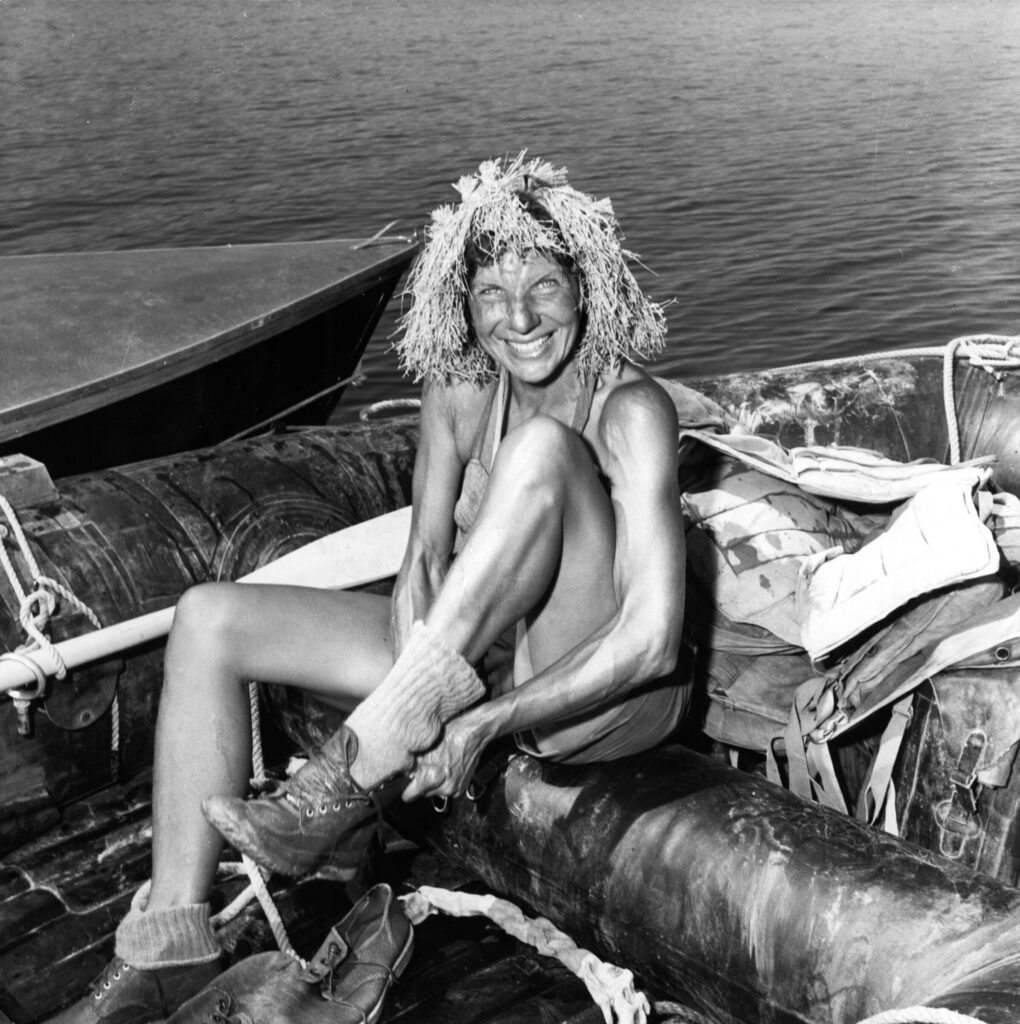
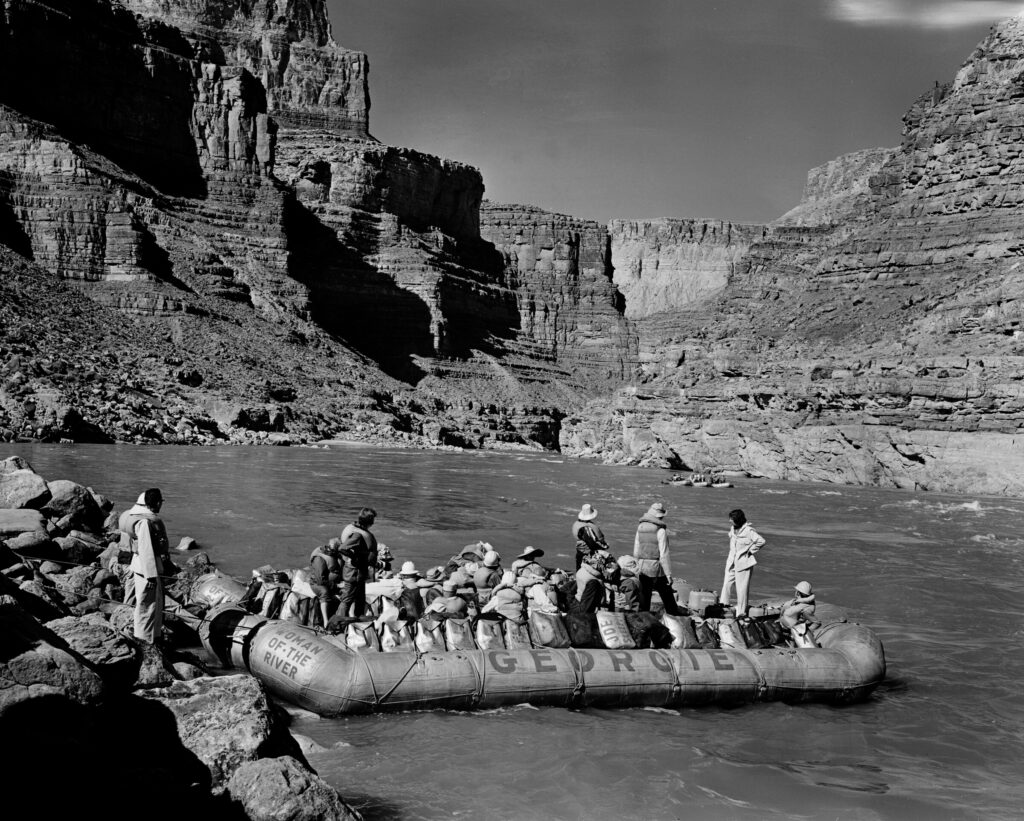
Georgie was the first female Grand Canyon guide. She was one of the first and only people running the river for years, and she was the only woman guiding for decades. For a while, she had brought more people down the river than anyone else on earth, and she kept bringing people down until she was nearly eighty. Even when the river and the river-running world changed. Even when her body started to break down. She’s one of my heroes.
One day in June, a month after VE Day, Georgie and her buddy Harry Aleson jumped in the river here, planning to swim into the mouth of Lake Mead. “When we reached the river we stared in disbelief,” she wrote in her memoir, Women of the River. “The current hurtled at breakneck speed downriver, creating huge waves that crashed headlong into giant rocks.”
I’m sure they had some idea that the river was running high. Harry had spent years in the nearby canyons. But, unlike now, when we have data on the flows of almost any river in the country, they only had a few points of reference, including a gauge at Lees Ferry, which was installed in 1921.
Maybe it was better that they didn’t know much about the conditions so they couldn’t overthink them. Plus, at that point, they were committed. To get there, they’d hiked nineteen miles down the Diamond Creek access road in the blistering sun. They were wearing sneakers and shorts and carrying life jackets. They each had a backpack stuffed with a double-lidded malt can that held a camera, a thin jacket, candy, powdered coffee, and soup. In Peach Springs, back on the highway, they’d asked the local sheriff to ship some clothes to Boulder City, Nevada, where they were planning to hike out, so they’d have something besides swimsuits to wear on the other side.
Georgie had spent minimal time on the river. Very few people had. The core of the Grand Canyon was one of the last places in the western US to be mapped. The United States Geological Survey didn’t map the canyon until 1923. By the time she and Harry decided to swim, only a few dozen people had been down the canyon in boats.
Georgie and Harry had spent the previous fall hiking through nearby canyons with little food and water. They were both comfortable with the exhaustion that comes from long days in the desert, where many of the plants and animals could kill you, and where the weather can switch at any second. Georgie claimed that she’d learned to swim in the frigid waters of Lake Michigan, so she wasn’t worried about cold or exhaustion, but they were wholly unprepared for the swollen river. They couldn’t have known what the waves would do to their bodies, how the river would rip them from shore and hurl them downstream.
From the banks they watched the melee of waves and whirlpools and listened to the roar of the river on the rocks. The air held the heavy smell of rotting plants. There were dead things in the water. Their plan had been to swim until they got tired and then stop for a while on a beach, but they quickly realized that they’d be at the mercy of the current. The river was in control.
That’s the first thing you learn about running rivers. The average human weighs about as much as three feet of water. You are nothing against its force. Fighting the river is futile, so you have to learn to work with the flow. You’re committed.
Eventually, Harry got up his courage and waded in. The current immediately grabbed him and knocked him over. He disappeared downstream, his hat trailing behind him, and there was nothing Georgie could do but follow.
She was sucked into the water and washing-machined in the massive eddy line. She tried to pinch her nose closed, but the river ripped her hand away. She kept trying to get above water to breathe, to look for Harry, or to find a slow piece of water where they could wash themselves to shore and rest, but she was hurled between waves and lashed by floating driftwood. It was all she could do to try to keep her face up.
If you’ve ever been pummeled by recirculating white water, you might know that feeling. Underwater, getting whitewashed, it seems like you’ll never surface. You’re trying to find glimmers of light, trying to figure out which way is up. Fighting for air as your lungs come closer and closer to popping. The best thing to do is relax, but nothing feels more impossible.
Eventually, Georgie and Harry washed up on the same small beach, freezing and exhausted. They failed to make a fire, and their supplies were soaked, but they sucked on hard candies to gain a few calories and shivered their way through the night. In the morning they made cold instant coffee with chunky river water and then threw themselves back into the morass. There was no escape out of the steep-walled canyon besides downstream. The second day they made it twenty-seven miles over nine grueling hours of floating. On the third day, after getting stuck in a driftwood logjam at the top of Lake Mead, they floated to Harry’s camp at Quartermaster Canyon, where they gorged on food he’d stashed, before they hiked another twenty miles and caught a Greyhound in their bathing suits. They’d been near death. They still had water in their lungs. But as they flagged down the bus, Georgie was already thinking about doing it again.
Seventy years after Georgie’s swim, a decade before I’d ever hear her name, I jumped into a different stretch of whitewater in a similar way. Just my body, a life jacket, the river. I was eighteen, a rookie river guide in northern Maine, trying to figure out the rush and flow of water and how to move within it.
That summer, my first on my own, I was objectively bad at guiding. I was awkward and often nervous. But I loved the connection and buzz from being outside. And like Georgie, I wanted to see what the river would do to me.
I’d come to the Kennebec River with no previous knowledge, just looking for a summer job that would let me be outside. I was surprised at how much it grabbed me. I loved the ragtag river society where we dogpiled into tents and tumble-down houses. I loved learning the physics of paddling. I loved the river itself, bank full and restless, white with roil and the new kinetics of spring. I could watch it pool for hours, a moving puzzle of force.
The Kennebec cuts through a gray-veined granite gorge. Its water is a specific northern color: leaden blue where it’s deep and fast, tannic in the shallows. In my memory the sky is always slightly gray in the gorge, and the whitewater is gnashing at sharp rock, rushing past eddies, training up into roller-coaster waves. Bigger, I’m sure, in my recollection.
Later, after I’d learned other, wilder rivers, I’d understand that the dam release and the deep channel made the white water there uncomplicated. But back then, it felt like a whole world compressed. I was the youngest guide on the river that summer, and I desperately wanted to have some kind of power.
So one morning after the river came up, I tightened my life jacket and jumped into the river at the boat ramp below a dam. The second I was sucked away from shore, I fought to keep my head above water. Years later, the thing I remember most is the feeling of waves lifting me up and then letting me go as my body moved downstream. The more I got that sense of motion, the more I wanted it. Sometimes I wonder if it might have been different if I’d put myself on another path at eighteen, or whether that ache was always in me, waiting.
Georgie had her own ache when she first came to the canyon. She said part of why she went down to the river was because she didn’t care about living.
Her daughter Sommona had been killed in a bike crash the previous spring, her second marriage was on the rocks, and she was spiraling. She said she couldn’t feel anything.
She’d met Harry Aleson at a house party that same summer. He was showing some of his photos of the red rock canyons around the Grand. The scenery sparked something in her, and she asked if she could come with him the next time he went back.
Harry was searching, too. “He didn’t think much, he just acted,” says river historian Renny Russell, who wrote a book about Aleson. Harry had been gassed in World War I and was living off his disability pensions. He’d set up an isolated camp at Quartermaster Canyon, where the Colorado flows into the eastern edge of Lake Mead, and from there he was trying to make a living exploring canyons and guiding people. He was a bit of an unlikely explorer—he had serious stomach problems to the point that he only ate baby food—but so was Georgie.
Harry had an agenda that spring. He wanted companions for a harebrained hike across the arid, spiny Colorado strip. Georgie was foolhardy enough to say yes. The two spent the fall after Sommona’s death hiking around Lake Mead. Georgie looked upstream at the gush of the Colorado and wanted to see more of the river. They decided to swim.
That first swim switched something in Georgie. Back home in Los Angeles, she wrote letters to Harry outlining the ways she wanted to understand the river. It was all she could think about, which might have been because nothing else was going well. She was grieving Sommona, coping with her husband James “Whitey” White’s alcoholism, and bored with her work as an office temp. She kept imagining the river in her mind, obsessing over the parts they hadn’t yet seen: the feeling of river and rock, the texture of water.
Time is excellent at erasing physical pain. It expunges cold and discomfort. Georgie said that as summer turned into fall, she and Harry talked less about the agony of the swim and more about the good parts. “I was also beginning to wonder what it would be like to cover twice the distance we had swum that first summer. After all, there was a lot more river to explore,” she wrote.
By the spring of 1946, she’d sold Harry on the idea of another swim. The river was lower that year, but Harry wrote that the rapids were just as bad as the year before. They had initially attempted to build a driftwood raft, but they couldn’t get it over the massive eddy lines. The tiny rubber boat they’d packed quickly sank. Mostly they swam, using the wrist-lock technique they’d invented the previous spring, where they clutched each other’s forearms as they floated. Georgie said that on the second swim she could relax more and try to just let the river take her.
They’d slipped into the water unnoticed on the first swim, but the second time they spotted planes circling them above Lake Mead. Harry finally admitted to Georgie that he’d been scared and told some friends in Las Vegas about their plan, in case anything happened to them. When the pair didn’t come out of the canyon on time, the friends alerted the authorities. By the time rescuers hit the lake, Georgie and Harry had already made the papers. TWO DROWNED IN GRAND CANYON, the Boulder City News headline read.
It escalated from there. Someone called Georgie’s mother in LA and told her that they’d found her daughter’s body in the river.
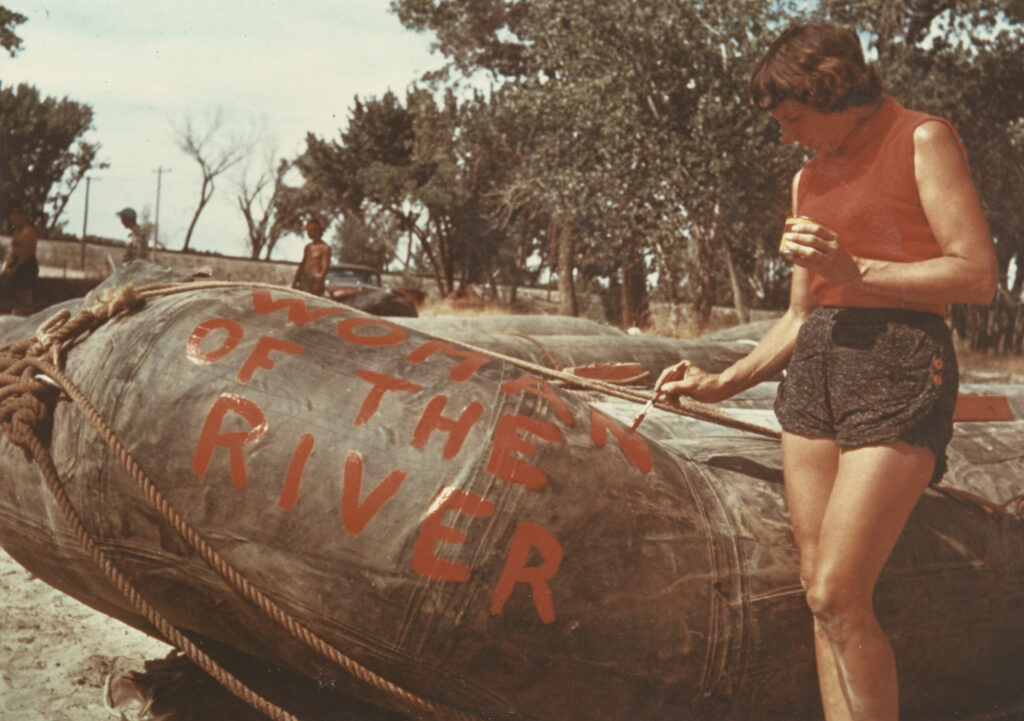
Tamor DeRoss was unfazed or perhaps used to hearing outlandish stories about her daughter’s escapades. “My mother had great faith in me, however, so she simply hung up and forgot the whole incident,” Georgie said.
Her mother might have not cared about the gossip, but a growing curiosity around recreational river running caused the story to spread, even after they turned up exhausted but unscathed. The Boulder City newspaper ran photos of them on a rescue raft barely afloat, Georgie grinning huge. It was the first of her many brushes with the media.
Harry was exhausted by the swim. He swore he’d never do it again, and he turned his attention to finding other ways to bring tourists into canyon country. But Georgie was exhilarated. “I learned more about water and the Colorado River on those two trips than I could probably have learned in ten years any other way,” she said.
Today much of the river’s mystery is gone. More than twenty thousand people raft through the Grand Canyon each year, the majority of them on commercial trips. You can watch videos of all the rapids. You can page through river maps that outline every curve and sandbar. You can ask internet forums what to cook and how bad the bugs will be.
Back then, the only resource was a 1923 USGS map of the canyon, which filled the gaps left by the 1869 John Wesley Powell expedition. Georgie and Harry might have gotten their hands on a copy of Ellsworth Kolb’s 1914 book, Through the Grand Canyon from Wyoming to Mexico, but at that point no one had done what they’d attempted to do.
Georgie couldn’t have known it then, but they were floating through a landscape at the forefront of the American public land movement. Their second swim—which had appeared to be a publicity stunt from the outside—pissed off the authorities in Grand Canyon National Park, who were starting to reckon with increased river traffic and potential danger. The age of unconstrained exploration was ending.
In the previous decade, between 1928 and 1937, twelve people died boating in the Grand Canyon. River historian Otis “Dock” Marston called that period the tragic era, and it had a big impact on Grand Canyon National Park superintendent Miner Tillotson, who had started the job in 1927 open to the idea of boating in the canyon. He quickly changed his stance when two park employees, Glen Sturdevant and Fred Johnson, drowned in Horn Creek Rapid, in 1929, after the canoe they were using for an exploratory trip swamped and flipped.
Tillotson was nervous about what could happen on the river, and Georgie’s float got under his skin. In 1946, he wrote to the director of the National Park Service, asking for more regulation and other ways to make sure that they could control the flow of boaters. He cited the park’s responsibility if rafters were to hurt themselves or die and the permit systems in places like Mount Rainier National Park and Grand Teton National Park.
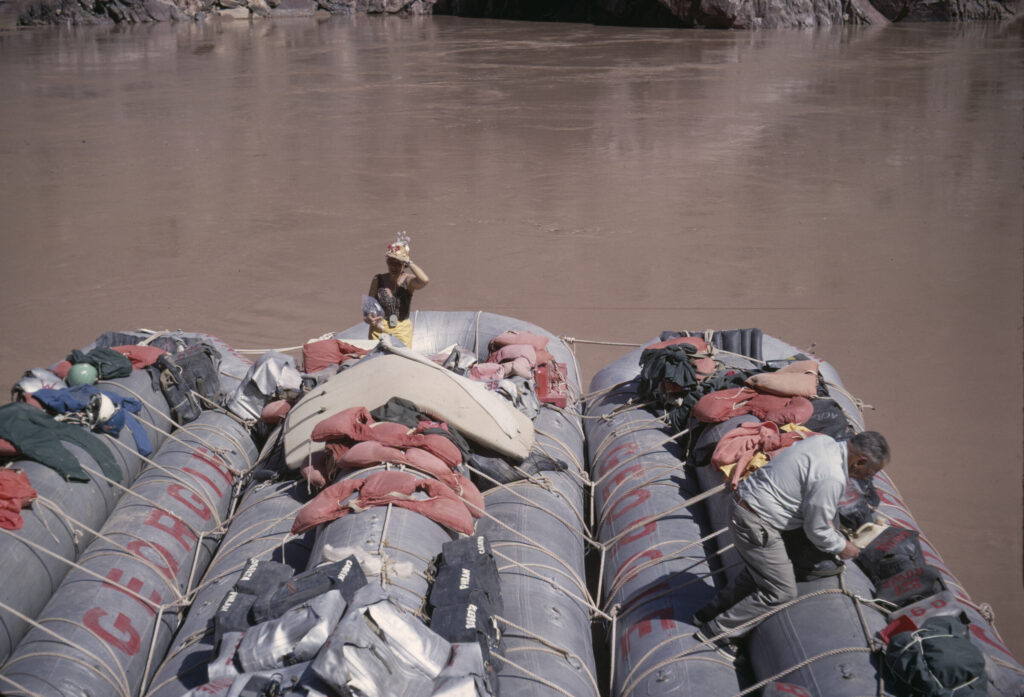
By the end of the year, acting National Park Service Director Hillory Tolson sent out a memo to all the national parks, outlining how Georgie and Harry had violated “section 2.54 of the General Rules and Regulations, which prohibit the placing of any privately owned boat, canoe, raft, or other floating craft upon the waters of any park or monument without a permit from the superintendent.” He gave the parks power to regulate rafting and set a permitting system in motion. It fundamentally changed how we access public lands in the US.
Regulation can kill part of the romance of being outside, but the move toward permitting ultimately helped limit overuse and abuse. In the years following Georgie and Harry’s swim, river running exploded from a risky niche experience to a vacation cliché. The place needed some protection, but government oversight also felt like it sucked away some of the exploratory magic.
Those early days of river running, when Georgie was swimming into the unknown, make me jealous because they feel so wild.
You can’t just jump in the river anymore. These days, passage through the Grand Canyon is highly regulated, expensive, or hard to get, in part because of those constraints set in place by Tillotson and the culture that grew up around river running.
I had neither money nor a permit, so the dirtbag in me—who learned to be scrappy from my time as a guide, and who still tries to sneak around the system whenever I can—started scheming.
I decided I’d try to be a swamper, the equivalent of an unpaid river intern, which is often a first step for guides trying to get into the canyon. In February, when the trip was starting to turn in my head, I’d run into a Grand Canyon guide I knew in a coffee shop in Silverton, Colorado. John Shocklee walked in the door layered up against the cold, his dog waiting patiently outside.
We talked about snowpack and how the ski season was shaping up so far, and then I steered the conversation toward summer. “I’m trying to get down the Grand. Do you know anyone who might need help?” I’d asked, as he leaned on our table, waiting for his mug to get filled.
Two days later he called me. “Are you free in August?” he’d asked. And then he disappeared back into the vapor of winter for months. I was hopeful that I’d scored a spot on one of his trips, but I wasn’t sure.
But, like Georgie must have done when she first met Harry Aleson, I set my heart on a half-formed idea, trusting that it would happen. “I think I’ll be gone in August,” I found myself telling people, “I think.” In late July, Shocklee called again. “Can you be in Flagstaff on August 2?” he asked. “We’ll rig that day, then head to the river the next.”
Can you row? he texted a few days later. And what’s your last name?
After I texted back (YES! Hansman), I realized I neglected to ask how long the trip was, but I didn’t want to seem high-maintenance when it felt like my tie was tenuous, so on August 1, I threw my river gear in the back of my car and drove across the Navajo Nation toward Flagstaff in the silvery afternoon light of a summer monsoon, still unsure of what I was getting into. In the morning, I met the seven other members of the crew: four guides, two baggage boaters, and another swamper. We loaded six rafts with the mountain of gear and food we needed for sixteen days on the river. That night I slept on the floor of the boathouse, restless with anticipation.
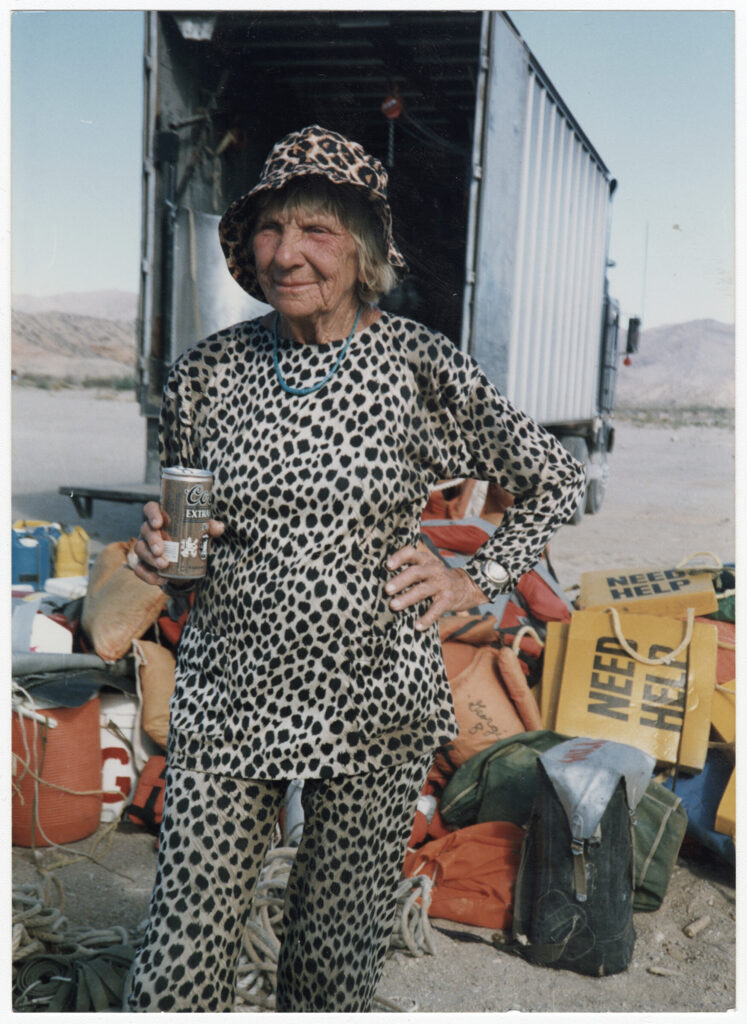
Shocklee works for OARS Grand Canyon Dories, a company with a long history of human-powered boat trips and conservation, thanks to its founders George Wendt and Martin Litton, who began running commercial trips in 1969 and ’70 respectively. The company’s boathouse walls are spackled with decades of raft guide detritus. It’s a history lesson told through snapshots, Christmas cards, news clippings, and broken boat parts. You can track fashion and facial hair, and you can learn stories. I walked along the wall, trying to identify faces in old photos. Georgie ran a different, competitive rafting company, but she’s part of the legacy, so there are photos of her, including one from her notorious eightieth birthday party, where hundreds of guides showed up. There’s a portrait of her when she’s old and etched with wrinkles, staring down the cameraperson, fire in her steady blue eyes, a can of Coors in her hand. She looks both ageless and ancient, and at that point she probably was. Georgie was about my age, mid-thirties, when she came to the river, and she guided the river into her eighties, hauling motors and running boats until cancer decimated her strength and shrank her to skin and bones—a change she outwardly blamed on the tightening park service regulations, which wouldn’t let her drink those Coors all day. The photos on the wall tell pieces of the story, and the next day I’d be loading boats at Lees Ferry, getting ready to be a part of it, too.
Adapted from Fierce Country: The Untold Story of Three Women Who Ignited America’s Love for the Wild (Hanover Square, June 2026).


