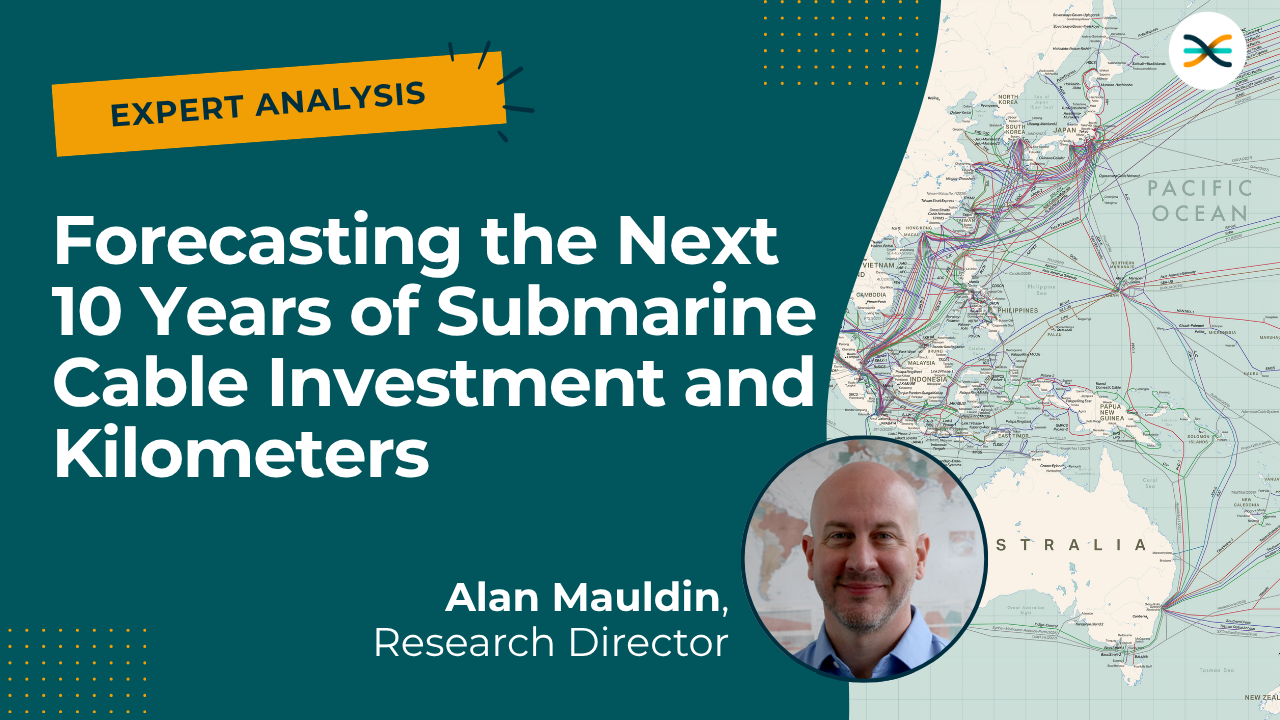
If you’ve followed our work at TeleGeography for any length of time, you know we spend a lot of time tracking what’s happening on the ocean floor. We map the cables, monitor bandwidth deployments, and track bandwidth price trends.
And now we’re tracking future cable activity with our new submarine cable forecasts.
Forecasting new and soon-to-be-retired submarine cables is notoriously challenging—yet as the backbone of intercontinental communications, countless industries need to make plans based on what’s happening under the sea at any given time.
Last year, along with Mike Constable of Infra-Analytics, we first released a report entitled The Future of Submarine Cable Maintenance: Trends, Challenges, and Strategies. This study was an in-depth look at current challenges facing the marine maintenance industry. A key aspect of this analysis was understanding how many cables are going to be in the water in the future.
But we didn’t want to just write one report and leave it at that. We’ve refined and expanded the forecasting model from this study to create new data and analysis in our Transport Networks Research Service. These forecasts cover 10 years and will be updated quarterly for these datasets:
- Number of new and retired cables for major routes
- Investment for major routes
- New and retired cable kilometers by region
Let’s take a look at a few high-level findings from the latest version of our submarine cable forecasts.
New cables
-
New cables are forecasted to be deployed on all of the routes covered in our forecasts. The largest number of new cables are forecasted on the trans-Atlantic, trans-Pacific, and intra-Asia routes. Between 2026 and 2035, these routes will see an average of more than one cable added per year.
- Taking into account the retirement of cables along with the launch of new cables, many routes are expected see a net increase in active cables on over the next 10 years.
- For the intra-Asian route, the numbers of active cables will more than double from 14 to 19 from 2025 to 2035. On the other hand, the forecast model suggests that the total number of cables on the East South America-U.S. route will remain stable during this period as new cable activates are balanced out by retirements.
Investment
- Our model suggests this investment in new submarine cables will average $5 billion annually from 2026-2035. The intra-Asian route alone will account for $11 billion in investment during this period.
Kilometers
- The forecasts are based on major geographic regions, roughly corresponding to major maintenance zone boundaries. In some cases, the zones were disaggregated to provide greater visibility into regional changes.
-
New cables will account for over 1,010,000 kilometers from 2026-2035.
-
The Northeast Atlantic, Northeast Pacific, Northwest Pacific, and Southwest Pacific regions will see the introduction of more than 100,000 new cable kilometers during this period.
- Over 450,000 kilometers of older submarine cables may be retired from 2026-2035.
Get more submarine cable forecast data and analysis
These findings are just scratching the surface of our research. TeleGeography’s Transport Networks Research Service data and analysis platform is the telecom industry’s gold-standard for comprehensive, unbiased intelligence on the global submarine cable ecosystem. It’s where you’ll find cable forecast data like this, as well as forecasts of international bandwidth supply, demand, prices, and revenues. 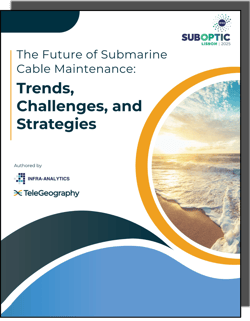
You can also download The Future of Submarine Cable Maintenance: Trends, Challenges, and Strategies report for an in-depth look at forecasting new cables, faults, the demand for repair vessels, and the evolving regulatory and geopolitical macro-environment the will continue to shape the submarine cable ecosystem.


