5
Major telcos in France have agreed a deal to split SFR, the country’s second-biggest operator, between Bouygues Telecom, Orange, and Iliad. The transaction boosts their commercial scale, investment capacity, and sovereignty ambitions, but it has to get past regulatory approval and union consultation.
In sum – what to know:
Bouygues – will take 42% of SFR assets, including its enterprise unit, 6.4m consumer customers, and key network assets, expanding its footprint.
Iliad – will get 31% of SFR assets, worth €6.2bn, and add 8m subscribers, taking its French base to 31m; it will also gain 50 MHz of spectrum.
Orange – will acquire 27% of SFR assets, worth €5.6bn, and add 5m mobile and fixed customers, and boost its spectrum holdings by 47 MHz.
As telegraphed, the French telecoms sector has agreed among itself to shrink from four to three operators. Bouygues Telecom, Orange, and Free-Iliad Group have signed with Altice France to acquire its SFR operations. The deal values SFR at €20.35 billion, and sees the parties take different assets. Broadly, Bouygues will take 42 percent of the value, including its enterprise business; Iliad will take 31 percent, including most of its budget-end base, plus a chunk of spectrum; and Orange will take 27 percent, including some more premium subscribers, and spectrum as well.
The move is waiting on regulatory approval, which could take up to a year. But there is a precedent across the channel in the UK, where the regulator permitted Vodafone’s merger with Three in June (as VodafoneThree), and is now reviewing the former’s $4.3 billion takeover of it, agreed by the pair in May. And given the region’s focus on digital sovereignty, requiring local companies with deep-enough pockets to build and scale cloud and network infrastructure, the sense is the consortium deal to make richer French telcos will be green-lit within 12 months.
The press statements from all three make repeated references to sovereignty, and the interests of France’s economic competitiveness. The regulator will ask, at the same time, whether the price of telecoms services will go up, as a consequence – and how much it needs the telco sector to be able to reverse its shrinking service margins, in order to make good on the region’s new promise of control, innovation, and autonomy. Iliad’s role in the deal is crucial, perhaps, on the grounds it remains the ‘challenger’ brand in French telecoms, and avows to remain so.
Reacting to the news, Kester Mann, director of consumer and enterprise connectivity at CCS Insight, commented: “It is a deal that paves the way for the greatest shake-up in the French telecom sector since the arrival of disruptive fourth mobile operator Iliad in 2012. The agreement appears a successful outcome for all parties. Bouygues, Orange, and Iliad each gain important new assets in their pursuit of greater scale, while eliminating a major rival will reduce the competitive intensity of the market.”
He added: “For SFR parent Altice, it ends months of speculation surrounding its heavy debt burden. The biggest challenge now is to convince competition authorities that the deal will bring positive outcomes to the French market. Several years ago, this would have felt like a herculean task. But the regulatory tide has steadily been turning favour of consolidation in Europe following recent deals approved in the UK and Spain. Although a lengthy probe is likely, it is surely odds-on to get the green light.”
In an interview with RCR about the proposed deal in April, Diana Gorelik, principal analyst at Omdia, reflected: “It would reduce near-term pricing pressure in one of Europe’s most competitive markets. But the impact on competition and investment would depend heavily on regulatory safeguards…. The proposed split creates both opportunities and risks for potential acquirers. The main advantage is flexibility: operators can selectively acquire B2B, B2C, or specific assets that best align with their strategic priorities, rather than inheriting a fully integrated operator.”
She warned: “Separating SFR also introduces the risk of operational fragmentation, particularly where coordination between network, wholesale, and retail functions is critical. This could result in [problems] across service quality, enterprise SLAs, cost allocation, IT integration, while increasing dependence on transitional service arrangements… An additional drawback is that certain assets, including fiber infrastructure, are not included in the transaction, meaning acquiring operators would remain dependent on SFR/Altice through wholesale and service agreements.”
Some of that appears to have been dealt with, as follows…
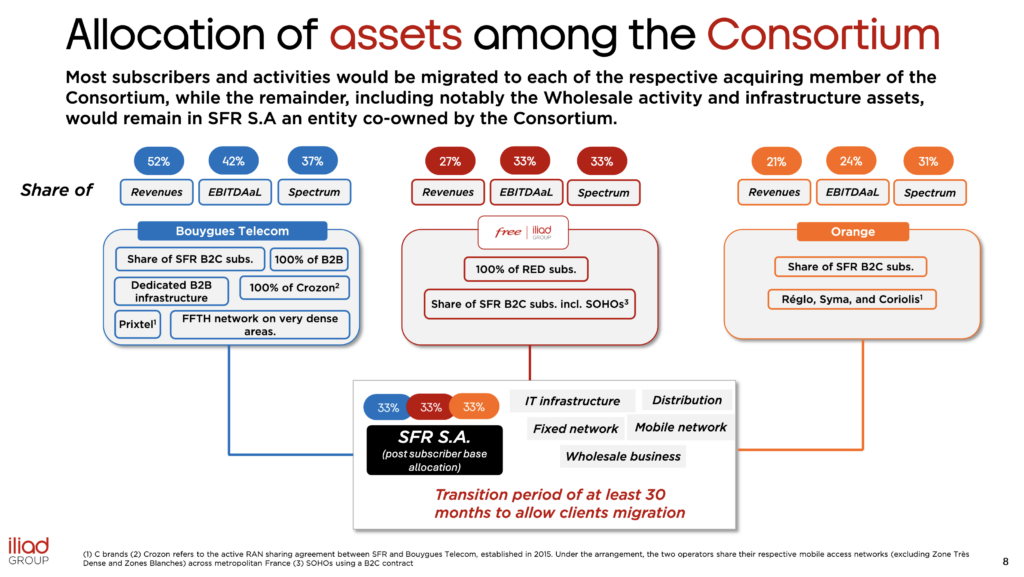
Bouygues Telecom, Orange, and Free-Iliad Group have signed with Altice France to acquire SFR, France’s second-largest operator. The deal values SFR at €20.35 billion, and excludes its shareholdings in XP Fibre, Ultraedge, and Altice Technical Services, plus its overseas operations. As it stands, the split between consortium members, related to the value of assets taken by each, remains as it was when they approached Altice France in April: Bouygues Telecom will take 42 percent, Iliad will take 31 percent, and Orange will take 27 percent.
Bouygues Telecom, currently the third biggest operator in Europe behind Orange and SFR, reckons its share will be worth 52 percent (€4.1 billion) of SFR’s reported sales in 2025, and 42 percent (€1 billion) of its profits (EBITDAaL). Notably, it is to get SFR’s enterprise unit, SFR Business, which delivered around €1.2 billion in sales in 2025, plus part of its consumer base, comprising 3.8 million mobile customers and 2.6 million fixed customers. The mobile count includes 0.5 million customers with Prixtel, the local MVNO piggybacking on SFR.
Bouygues’ bits
It will also take charge of SFR’s part of its shared network with SFR in “less dense areas” (under their Crozon sharing agreement), plus its share of the “horizontal” fiber-to-the-home (FTTH) network in certain “very dense” areas (under their Faber deal). The deal will increase its fixed base by nearly 50 percent; its consumer mobile base will see “significant expansion”; its enterprise offer will expand to cover small-to-large sized enterprises, and make it a “strong challenger” to cover digital-change services, including private 5G, cloud computing, cybersecurity, and AI services.
It expects the deal to make it about €1 billion per year better off in operating profit and investment efficiency (EBITDA minus capital spending), with most of the savings from sharing networks, IT systems, and operations. It expects to reach about 70 percent of these savings by 2032, and all of them by 2034. But the integration will also be expensive, it said – costing €3.5-€4 billion in total, mainly in the first five years. The deal values the purchase at about seven times the profit it will generate after savings. It will initially fund it with a bank loan to be refinanced with bonds.
Iliad’s spoils
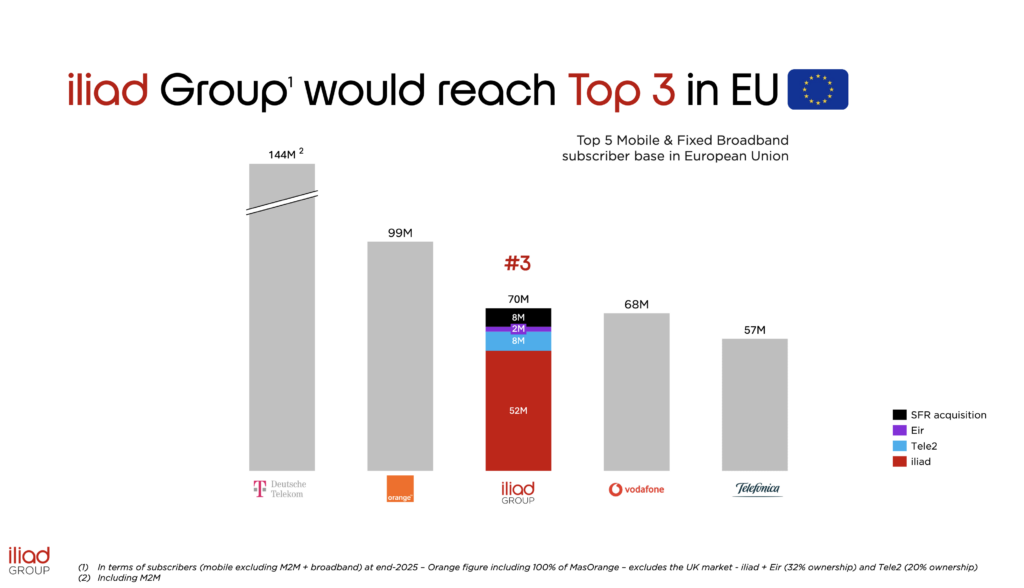
Meanwhile, Iliad said its part of the consortium takeover of SFR assets will be worth €6.2 billion. It will gain eight million subscribers, including six million subscribers to SFR’s low-cost digital-only RED, plus 1.6 million consumer customers and 0.4 (“very-small”) business customers; the deal would take it to nearly 31 million subscribers in France, it said. It will also take 50 MHz of new spectrum across several bands. It reckons it will generate €2 billion in additional revenues and €0.9 billion in additional free cash flow, including more than €0.5 billion in synergies.
Iliad suggested it will be the third largest telco in Europe, based on subscriber numbers.
Iliad provided fewer hard financial metrics about synergies and such, focusing instead on strategic benefits. Its only concrete figure is its existing €4 billion investment plan to develop data centers and sovereign cloud infrastructure. It said the deal will allow it to accelerate spending in key areas such as fiber, mobile, cloud, and AI infrastructure. It does not quantify any additional synergies or profit impact, but frames the transaction in broader terms, suggesting it will enhance its competitiveness and innovation as a challenger in European telecoms.
Orange’s segments
Orange said its share of the total enterprise value would be €5.6 billion. Its new assets will include four million mobile customers (an 18 percent increase in its base in France) and one million fixed broadband customers (an eight percent increase), including all of SFR’s premium prepaid customer base, as well as all customers of the Coriolis, Syma, and Réglo brands – which collectively delivered about €1.7 billion in revenue in 2025 and €0.6 billion in EBITDAaL. It will also gain an additional 47 MHz of spectrum, taking its total holdings in France to 221 MHz.
Orange is more candid – probably somewhere between Bouygues’s deal economics and Iliad’’s fluffy strategy narrative. Orange expects its new assets to generate €0.5 billion per year in synergies once integrated (five years after closing). These will come mainly from network and infrastructure optimization (about 60 percent), with the rest from rationalizing IT and support (20 percent) and distribution (20 percent). It also breaks down the synergy mix, suggesting 80 percent will come from operating cost savings and 20 percent from capital expenditure reductions.
It expects €1.3 billion in total integration costs over five years. Once complete, the acquired assets should contribute around €0.9 billion annually in EBITDAaL. The deal is financed through debt, which it thinks will remain at a stable level, about twice its operating earnings, even after the acquisition.
Regulator’s say
The transaction remains subject to union sign-off and regulatory approvals. The latter may yet prove to be an obstacle. The consortium has opened a consultation period with the relevant employee representative bodies. A proper deal is expected in the second half of 2026, and could close in the second half of 2027, the group said.
The trio observe the new market dynamics, where new growth is increasingly from “superfast broadband, cloud computing, “one-stop-shop comms”, cybersecurity, digital services, and “the rise of AI [and] expansion of private 5G”. As such, they argue that consolidation is necessary to “boost the capacity for investment in French digital infrastructure over the long term”, and to ensure operators can “scale up and boost their investment capabilities” to build more “sovereign and high-performing digital… services and infrastructure in France”.
Sovereignty cards
Indeed, the sovereignty theme runs through the narrative, with the aim of keeping assets “in the hands of long-standing French industrial players with a strong presence in France”. They all stress that competition will be preserved in a “highly competitive ecosystem”, even as operators gain scale, and that customer outcomes will be protected through “a smooth, controlled transition with service continuity” and “a straightforward and transparent migration, with no service interruptions”. The market is framed as capital-intensive and infrastructure-driven, where consolidation is positioned as essential to sustaining investment, innovation, and sovereign control.
They all place emphasis on customer protection, operational continuity, and workforce stability across a complex multi-year integration. They also note the scale and sensitivity of the integration, stating that success depends on “the women and men who know the networks, systems, customers and local areas”. The consortium will guarantee “employment for all the staff” until the beginning of 2029, they said.
Edward Bouygues, chairman at Bouygues Telecom and deputy chief at the Bouygues Group, talked about “placing its core businesses on a long-term growth path and contributing to France’s digital sovereignty”.
Christel Heydemann, chief executive at Orange, said: “France needs operators capable of investing massively and sustainably in infrastructure and digital services… This means the promise of access to the best networks, best-in-class customer service, and innovative digital services designed to meet their everyday needs.”
Thomas Reynaud, chief executive at the Iliad Group, said: “TIt is a sector that constantly needs to invest more in networks, cybersecurity, cloud services and AI, and as such it needs solid market players. At the same time, digital sovereignty can’t be decreed – it has to be financed.”


