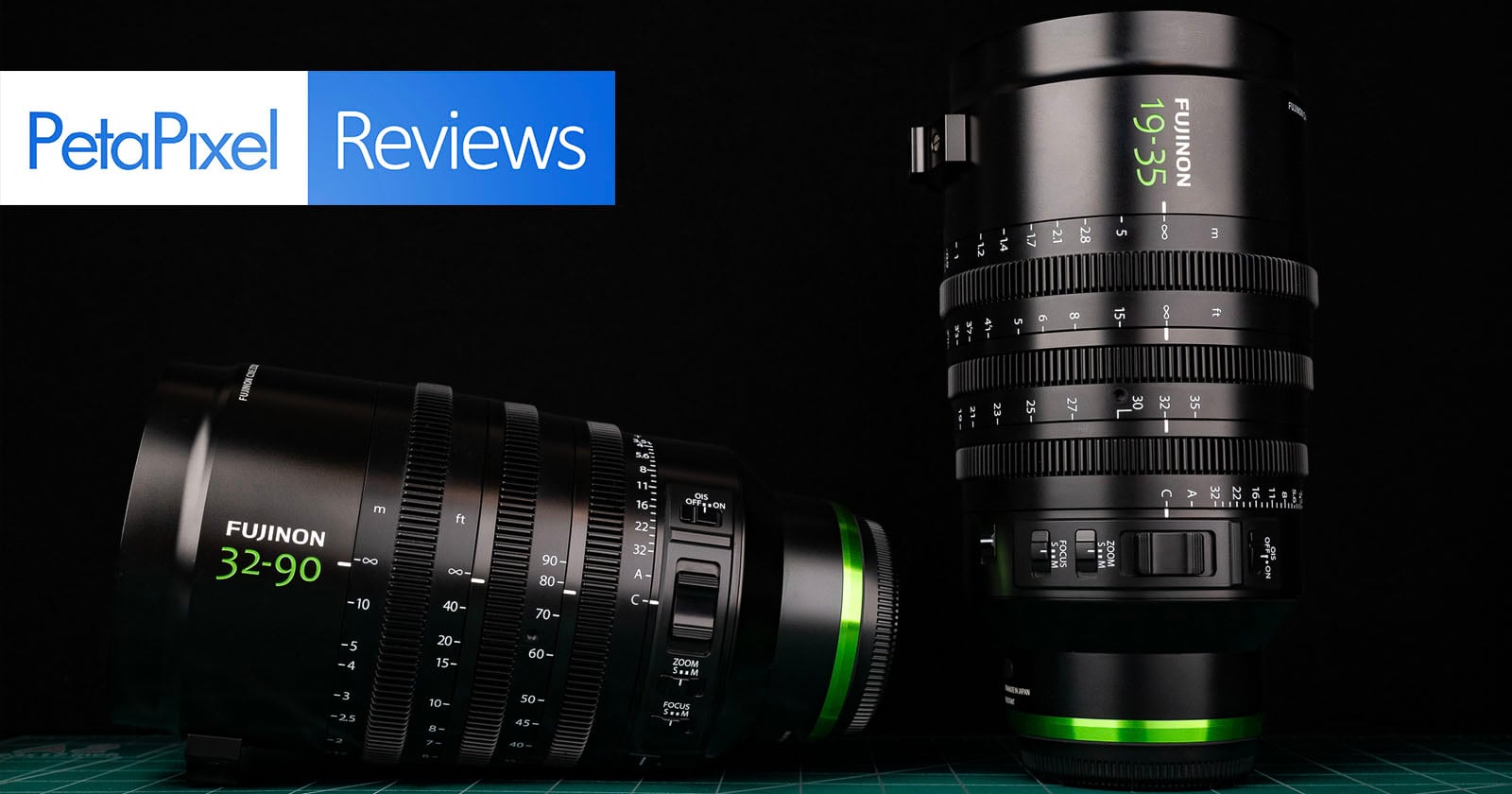
Several months ago I was in Alaska shooting a documentary (which will be released one day, I swear!) on the Fujifilm Eterna 55 camera, and finding suitable lenses was one of my biggest struggles.
If you are already invested in or are looking at a Fujifilm Eterna 55, these lenses are absolute necessities and relatively affordable considering what they offer.
Pros
- Outstanding manual focus response, while still offering autofocus
- Lovely bokeh
- Minimal breathing
- Affordable for their class
- Stabilized
Cons
- Only available for GF-Mount cameras
- Inconsistent focus performance while zooming
- Large and heavy
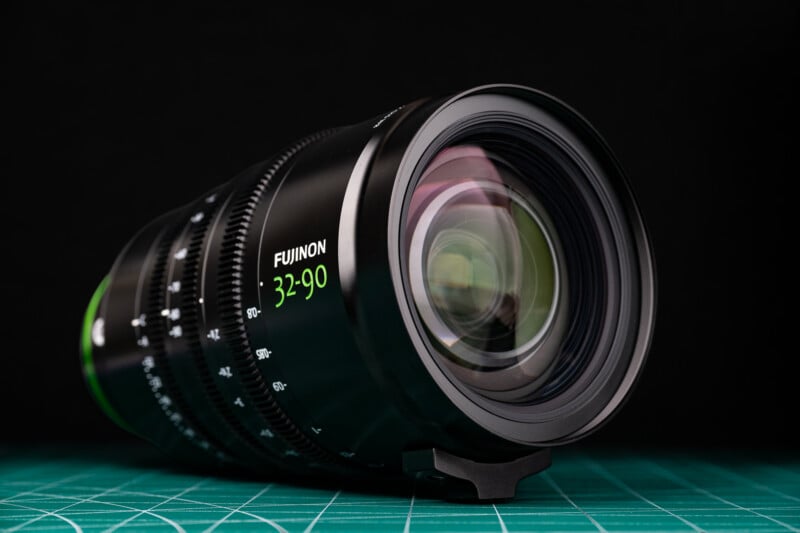
The Fujinon Cine Zoom GF series of lenses would have addressed most of my headaches if they were available then. Well, now not only is the 32-90mm T3.5 standard zoom available, but I was also able to test the new 19-35mm T3.5 ultra-wide zoom ($5,995 each). These lenses could single-handedly make the Eterna 55 a much more compelling camera if they can deliver the goods. So, do they?
What makes these lenses so special? First off, the mount. These are GF-Mount only lenses, which means the only cinema camera currently available that they will mount to is the Eterna 55. That camera has a very large and uniquely tall sensor, so relatively few lenses will cover it. These zooms will, even when recording the full 44x33mm area in Open Gate. Giving an equivalent field of view and depth of field of a 15-28mm f/2.8 and 24-70mm f/2.8, these GF lenses will cover a huge range of use cases. Also, while these look like standard cinema zoom lenses, they have all the latest technology we see in Fujifilm’s photo lenses, including autofocus, optical stabilization, and weather sealing.
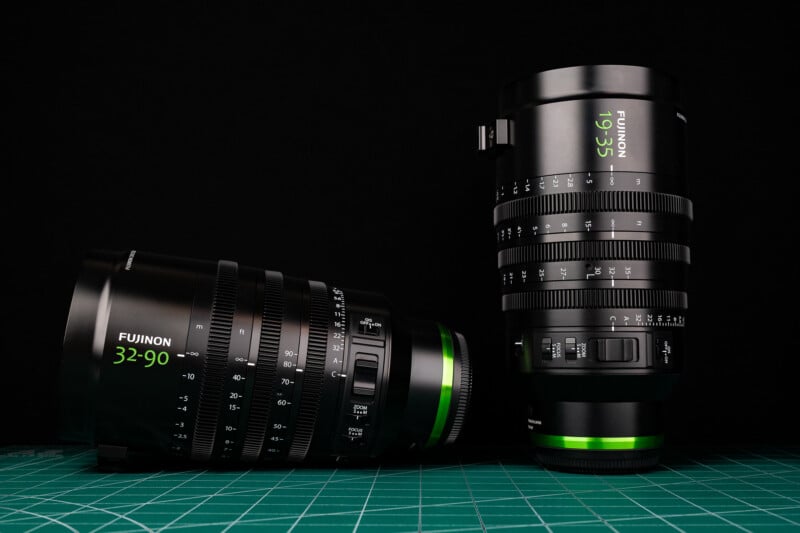
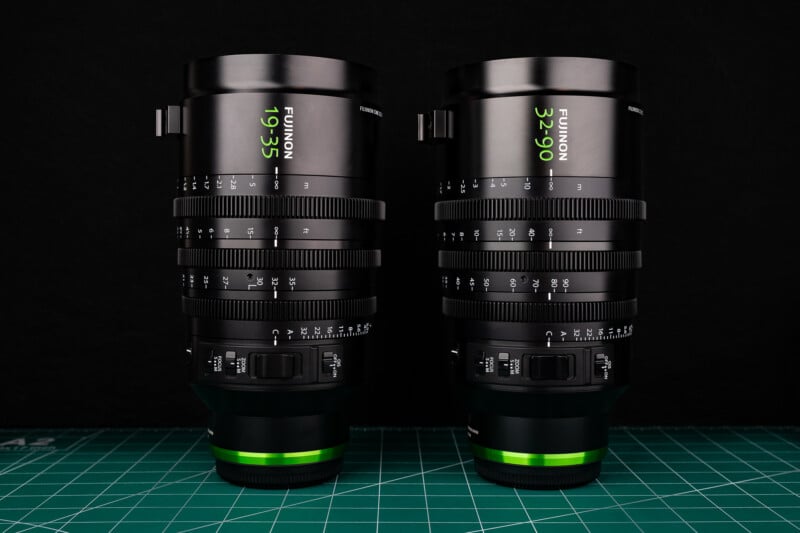
Importantly, these are matched lenses with nearly identical weight (2,100 grams for the 19-35mm and 2,115 grams for the 32-90mm) and design. If used in a rig, the lenses can be easily swapped without readjusting tools like the follow focus module.
Fujinon GF 19-35mm and 32-90mm T3.5 Review: How Do They Feel?
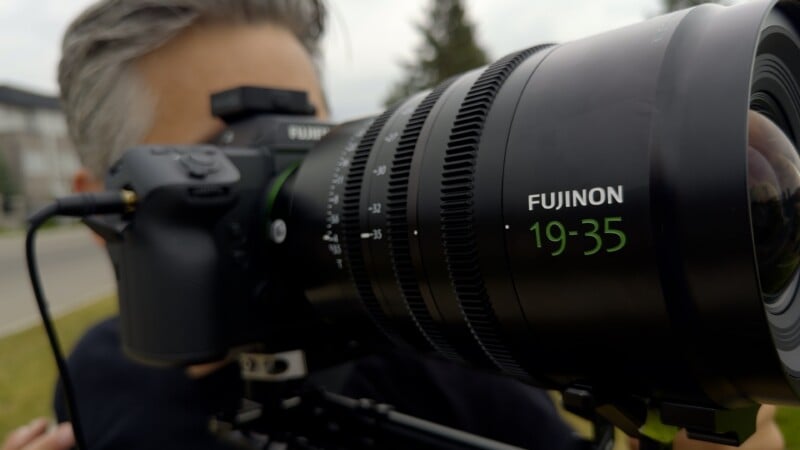
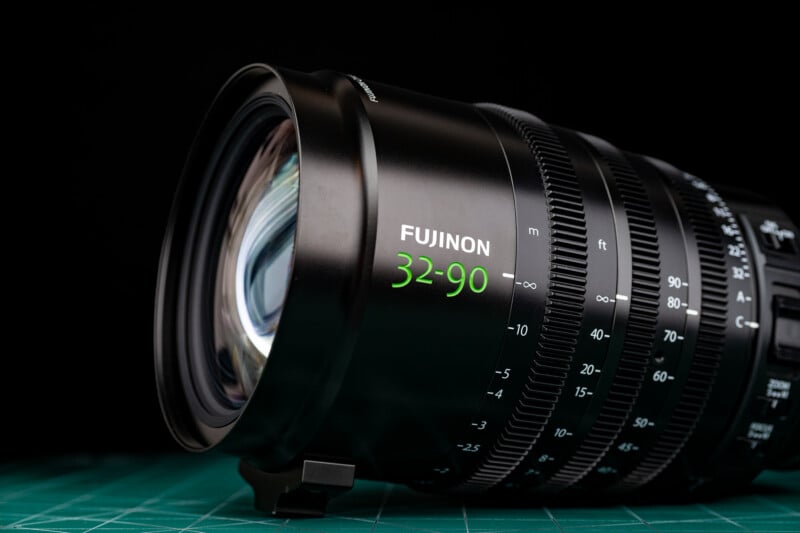
The design is exactly what you’d expect from a Fujinon cinema lens. We have geared iris, zoom, and focus rings. There is also an included but detachable lever for the zoom ring. I like that the aperture can be set to automatic or locked so it can be controlled from the camera body. The front element has a very large 111mm filter diameter, so you’ll need a substantial matte box to cover it. At the bottom of the lens is a 3/8 mount for directly mounting a lens support.
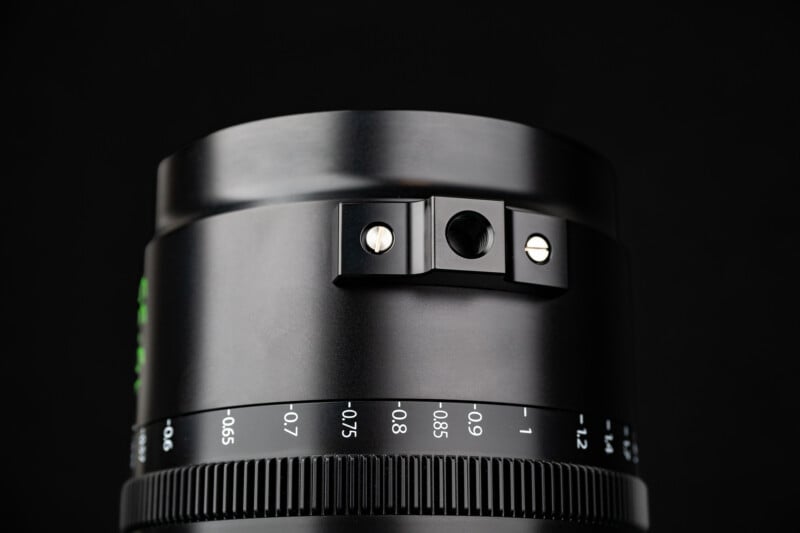
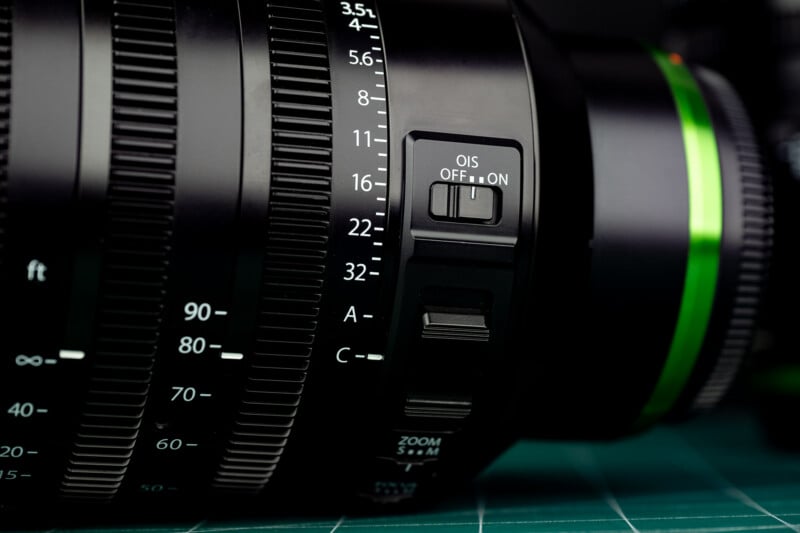
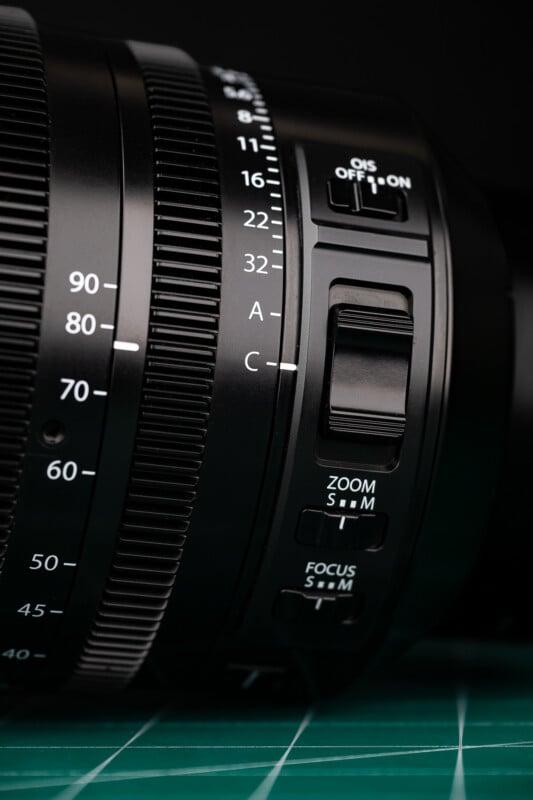
There are several toggle switches on the barrel, starting with one to enable OIS (optical image stabilization). This is especially important for Eterna 55 users, as that body does not offer in-body image stabilization (IBIS). There is a large zoom rocker which allows servo zooming of the lens without attaching a motor. More on that in a bit. Sitting just below is the option to have either the zoom or focus function in “M” mode, or by manually twisting the lens, or in “S” for servo, which enables autofocus, or the aforementioned servo zoom rocker. Confusingly, when either of the switches is set to “S,” it ignores the current settings on the lens itself. I found this quite jarring when a quick look at the physical dials did not
represent what the camera was actually recording.
Fujinon GF 19-35mm and 32-90mm T3.5 Review: How Do They Shoot?
The first thing I wanted to test was the performance of the manual focus ring, as historically autofocusing cinema lenses have had a sloppy, sluggish feel that makes pulling focus very difficult. On the Cine Zooms GF lenses, though, it felt so much like a mechanically coupled lens that PetaPixel‘s Chris Niccolls was initially unaware that this was focus-by-wire. Alongside the recently released Sigma Cine AF zooms, this indicates that modern linear motors are able to overcome the previous limitations of focus-by-wire lenses, provided they are designed to handle it.
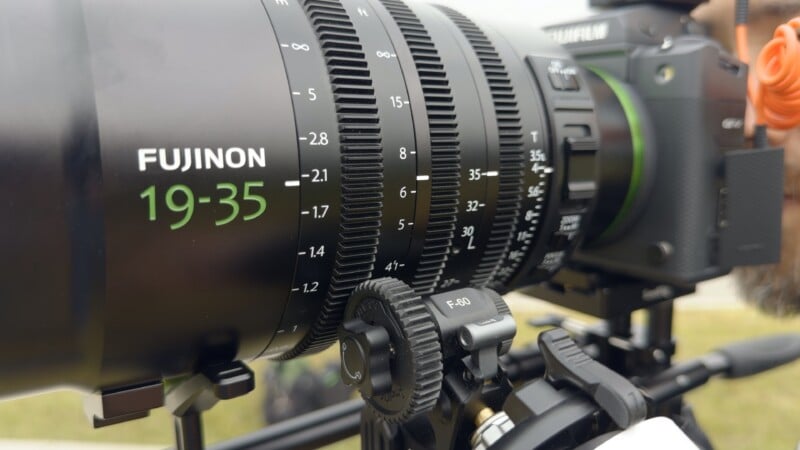
In terms of breathing (which is where the field of view changes when focus is shifted dramatically), I was very pleased with the results. The 19-35mm exhibits some very minor breathing with extreme focus pulls, but the 32-90mm showed barely any perceptible change. This is incredibly impressive.
Flare is also worth testing on cinema lenses, and many cinematographers prefer a bit of contrast loss and ghosting when bright light sources hit the front element. These Fujinon lenses hit a middle ground in terms of flare characteristics, which I found very pleasing. There is certainly a loss of contrast around bright light sources and small instances of ghosting, but only enough to add a bit of character, never enough to distract from a shot.
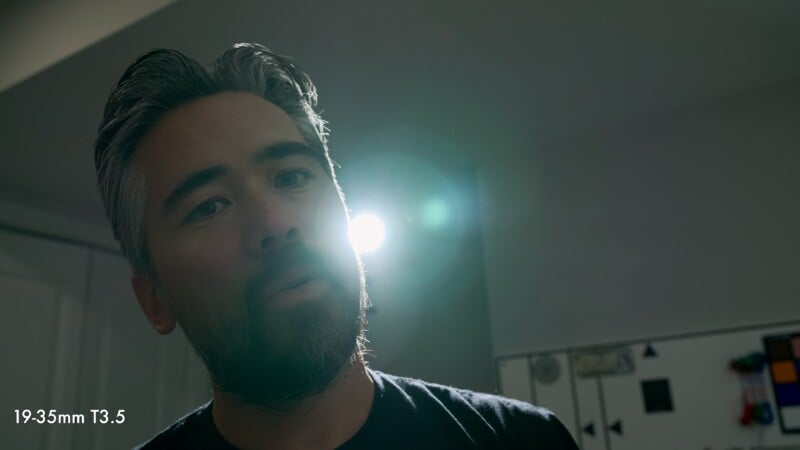
Bokeh on both of these lenses is simply excellent. There is a similar smooth rendition of specular highlights, with a minor soap bubble effect and almost no onion rings. More importantly, backgrounds and foregrounds dissolve in a lovely abstraction which looks great when pulling focus.

In terms of sharpness, I wanted to test these lenses at full resolution on the GFX100 II stills camera. While currently the Eterna 55 can only capture the full area of the sensor in 4K, future camera models will certainly improve on this, so I wanted to see how well they resolved in 102 megapixel photo mode.
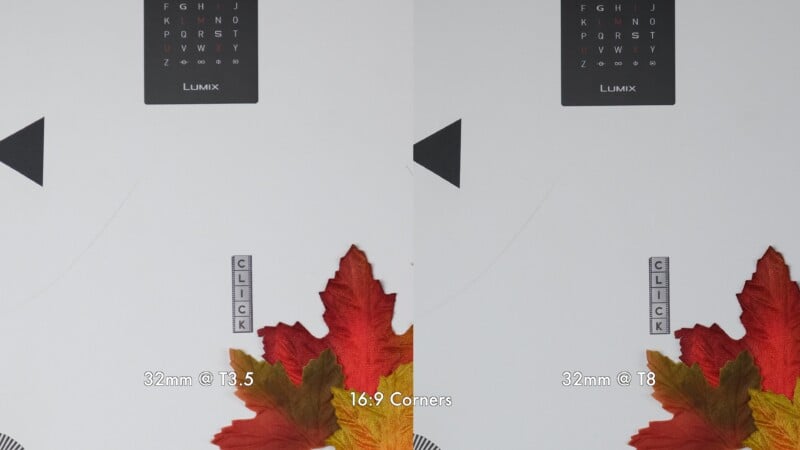
The performance was nearly identical despite the lens and focal length tested. The center of the image is quite sharp wide open, but does benefit slightly when stopping down, though I think this would only be noticeable with 8K recording. Stopped down to T8, the image is tack sharp even when shooting high-resolution photos. At the extreme edges of the 4:3 aspect ratio Open Gate frame, there is a distinct softness to the image; however, stopping down again gives excellent results.
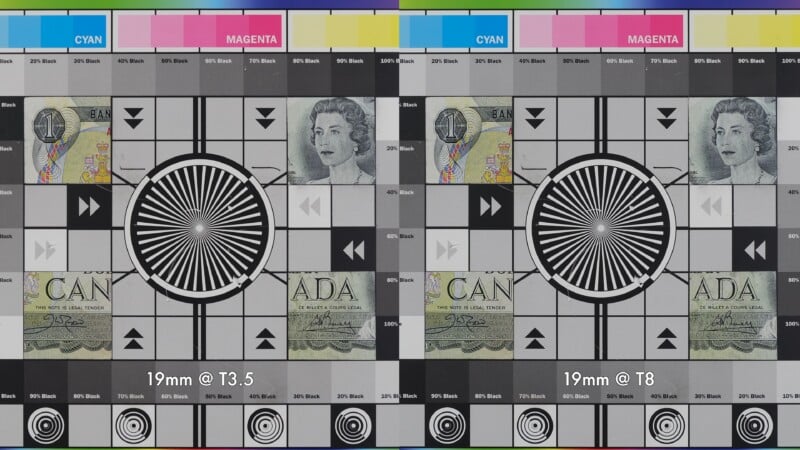
I also wanted to look at the corners in a 16:9 frame, and there they fare slightly better wide open, but still benefit when stopping down. Basically, I think you can shoot these lenses wide open at any focal length for 4K recording and be rewarded with solid results. However, in future models which may offer 8K or higher open-gate recording, stopping down will be beneficial to capture the maximum amount of detail, especially in the corners.
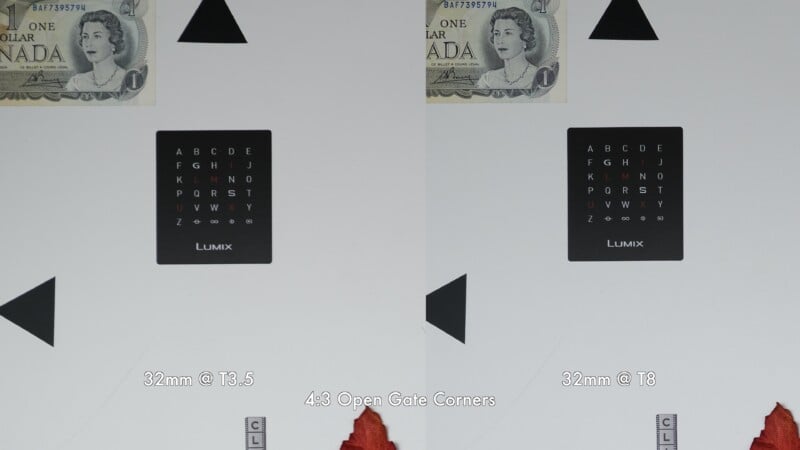
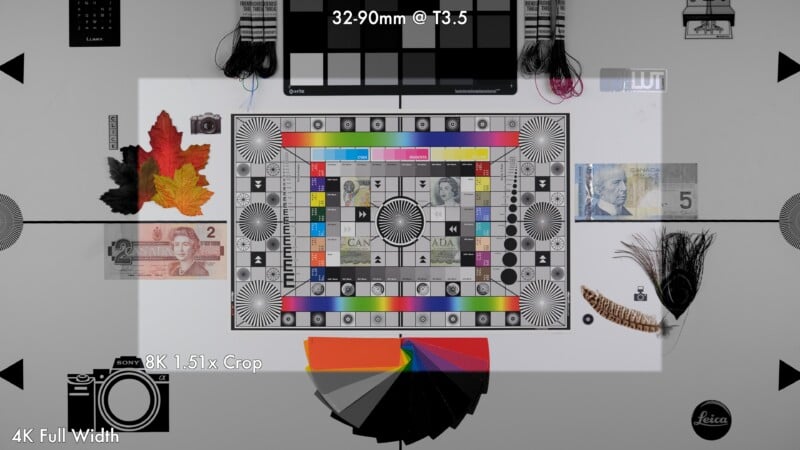
It’s also worth noting that the current Eterna 55 and GFX 100 II have a significant 1.51x crop factor when recording 8K, and the image quality in this portion of both lenses is excellent.
The last topic worth touching on for image quality is whether or not these lenses are parfocal, meaning the focus does not shift when zooming the lenses. What Fujifilm seems to be doing here is electronically adjusting the focus while the lens zooms to keep your subject in focus. Unfortunately, it is not quite responsive enough to keep the subject sharp while the lens is zooming. This means a zoom mid-shot may go out of focus, even when focus has been correctly set, but return to focus at the end of the zoom. Essentially, videographers and cinematographers can reframe between shots without worrying about focus shift, but I would recommend against zooming mid-shot. This seriously impacts the usability of the servo zoom functionality, unfortunately.

The Eterna 55 Makes A Lot More Sense Now
When shooting with Fujifilm’s first cinema camera, selecting lenses was a real struggle. I could use GF mount photographic lenses which fully covered the sensor but had dismal manual focus handling, or use cinema lenses that could rarely cover that enormous sensor. The Fujinon Cine Zoom GF models address this concern and do so with lens designs capable of creating truly lovely images.
More importantly, these show Fujifilm’s dedication to cinema cameras moving forward. If the company was just testing the water with the Eterna 55, there’s no way they would go to the cost and expense of developing a pair of state-of-the-art lenses like these. I’m just hoping we’ll see a telephoto zoom shortly to complete a GF-mount cinema lens trinity.

Are There Alternatives?
No. Nothing else on the market will cover the enormous sensor of the GFX and Eterna 55 camera while still offering autofocus, stabilization, weather sealing, and professional manual controls as well. Luckily, despite completely cornering this market, Fujifilm isn’t asking for a huge investment for either of these lenses: $5,999.99 is pretty reasonable given the performance, especially considering what even full-frame or Super 35 cinema zooms can cost.
Should You Buy Them?
Yes. If you are already invested in or are looking at a Fujifilm Eterna 55, these lenses are absolute necessities and relatively affordable considering what they offer. If you are a cinematographer planning to use GFX bodies for their large sensor aesthetic, these will also make your life much easier. The optical performance also shows these should be relatively future-proof as Fujifilm’s cinema experiment progresses.
Affiliate Disclosure PetaPixel articles may include affiliate links; we may earn a commission if you buy through one.


