Helicon is using robots for carbon fiber parts production. Source: Helicon
Advanced composites offer strength and stiffness at low weight, but manufacturing them at scale remains slow, labor-intensive, and difficult to automate. Helicon Industries is building automated manufacturing systems designed to bring composites into high-volume production, starting with carbon fiber.
The Los Angeles-based startup has emerged from stealth with $16 million in seed funding, led by AlleyCorp. Helicon aims to cut composite manufacturing lead times from six months or more down to two weeks.
Co-founder went from autonomous systems to automated manufacturing
Edmundo Sanz-Gadea, co-founder and chief technology officer of Helicon, built rockets and drones in his youth in Madrid. That led to a high school internship at the European Space Agency in Paris, followed by studies in aerospace at TU Delft in the Netherlands.

Edmundo Sanz-Gadea. CTO of Helicon
“Traditional aerospace felt like squeezing out that last 1% of efficiency from already highly optimized systems. If you look at things like jet engine design or commercial aircraft aerodynamics, they’re already pretty close to optimal,” Sanz-Gadea told The Robot Report. “I got very interested in the new wave of robotics and autonomous systems. So I spent a year on a Formula Student self-driving team, where students design and build race cars and compete all around the world.”
“TU Delft and MIT combined forces,” he recalled. “We were doing most of the hardware in Delft and a lot of the autonomous algorithms at MIT. I was bridging the two sides. There were 10 of us working full time, managing a team of more than 100 part-time engineers.”
“It was a great experience, eye-opening toward autonomy and working in a fast-paced team,” said Sanz-Gadea. “We were lucky to have sponsors like Google, Uber, and Volkswagen.”
He then worked at a startup in the Netherlands on autonomous drones for infrastructure inspections, followed by a year at ETH Zurich. Sanz-Gadea developed a diffusion policy to enable an ANYbotics quadruped to do robot-to-human handovers before founding Helicon.
Sanz-Gadea started Helicon with co-founder and CEO Alex Niehaus around a shared vision of building a new generation of highly automated manufacturing for composites.
Autonomous factories take on a defense challenge
Why did Helicon choose to start with carbon fiber manufacturing?
“Composite manufacturing is still a very manual process, it’s difficult to automate, especially the manipulation of flexible materials like carbon-fiber textiles,” explained Sanz-Gadea. “That’s compounded by the heavy regulation around manned aviation and defense programs.”
“Traditionally, you start with a mold for the part you want to make and place the carbon-fiber material into it,” he added. “Depending on the process, the material may already contain the resin, as with prepreg, or the resin can be introduced afterward through processes such as vacuum infusion or resin transfer molding.”
That labor-intensive approach has worked for the primes like Lockheed or Boeing, because production volumes are low and the cost of each part is high, Sanz-Gadea said. But a new generation of companies in drones, robotics, and aerospace is looking to build much larger volumes without giving up the performance advantages of composites.
“The mindset is changing from building a small number of extremely optimized systems to building good systems at much larger scale,” said Sanz-Gadea. “You see that very clearly with drones, but it’s happening across robotics and other industries too. The challenge is figuring out how to manufacture lightweight, high-performance structures in the hundreds of thousands rather than the hundreds.”
“Most companies are still buying flat carbon-fiber sheets from overseas, cutting them to shape, and assembling them with fasteners,” said Sanz-Gadea. “It’s a very inefficient way to build a structure, it creates a lot of assembly work, and it makes it much harder to manufacture competitively at scale in the U.S.”
 Register now and help us celebrate 20 years of RoboBusiness!
Helicon preps for mass production
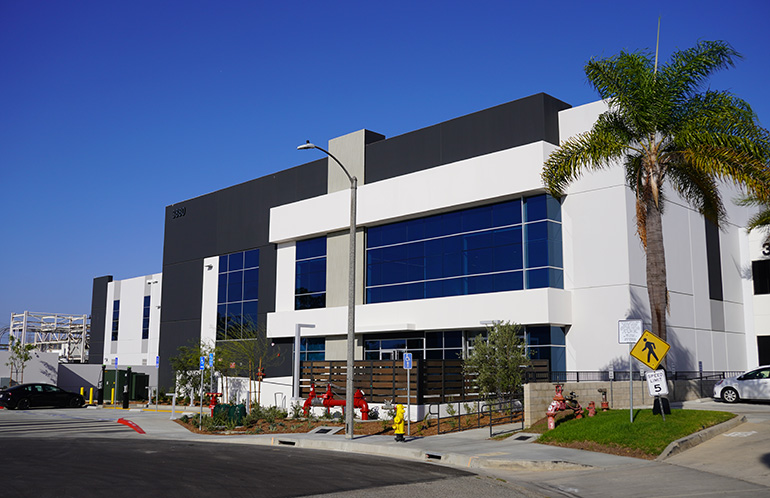
Helicon is gearing up for production as it moves to a 36,000 sq. ft. (3,344.5 sq. m) space in Torrance, Calif. From the materials it uses to the equipment and processes on the factory floor, the company is building everything around automation and high-volume production, Sanz-Gadea noted.
“We are focused on ease of automation and on high-volume manufacturing methods,” he said. “The goal is to use processes that can be automated much more easily and run with much faster cycle times — under 15 minutes, compared with hours for traditional layup and autoclave processes.”
“The materials and processes we’re using are also much easier to automate,” said Sanz-Gadea. “You can design the process so a robot can reliably pick the material, place it, remove the finished part, and then handle downstream steps like trimming and quality control.”
“There’s a lot of demand,” he said. “The challenge companies face is they can typically do a certain number of prototypes in-house — small production runs of 10 to 100 units manually — but when they win a contract for thousands, they can’t hire enough people.”
“For robotics, we don’t need massive industrial arms,” Sanz-Gadea said. “The important part is designing the whole cell around repeatability and speed.”
The company is also working closely with multiple material suppliers to support production at much larger volumes. “There’s not really a shortage of carbon fiber itself,” said Sanz-Gadea. “The bottleneck is the ability to turn that material into finished parts at scale domestically.”

Sanz-Gadea sees customer base for composites beyond aerospace
Helicon is working toward the certifications needed to serve demanding aerospace and defense programs, while also seeing interest from robotics, logistics, maritime, and other industries where lightweight, high-performance structures matter.
“Most robotic systems today are made from aluminum, and our materials offer higher stiffness at 40% lower weight,” he said. “That translates into longer battery life, smaller actuators, or higher payload capacity. We see a big opportunity as robotics moves toward larger-scale production across humanoids and mobile robots.”
The stiffness-to-weight ratio of carbon fiber is significantly better than that of metals and plastics, but manufacturing it at scale is still difficult.
“Composites today are a bit like metals before modern industrialization,” said Sanz-Gadea. “The material properties are exceptional, but the manufacturing infrastructure has not caught up. Steel only became transformative once companies like Carnegie and Bethlehem Steel figured out how to produce it reliably and at massive scale.”
“Carbon fiber has already proven itself in elite applications like Formula 1, fighter jets, and spacecraft,” he explained. “The challenge now is bringing those same performance advantages into products made in much larger volumes. That’s what we’re focused on.”
Helicon vision draws funding to scale

Source: Helicon
Sanz-Gadea and co-founder and CEO Alex Niehaus started Helicon around a broader goal of “reindustrializing the West.” The company began in London, where they focused on developing the technology, building supplier relationships, and establishing relationships with prospective customers.
They later spent time in San Francisco meeting investors, customers, and other people across the advanced manufacturing ecosystem, before choosing Los Angeles as the base for Helicon’s manufacturing operations.
“A lot of the early work was about building the right relationships around the company,” Sanz-Gadea said. “We spent time with customers, material suppliers, manufacturers, and people across aerospace, defense, robotics, and advanced manufacturing to understand where the strongest needs were.”
Helicon initially raised capital from angel investors before bringing in institutional investors. The oversubscribed round allowed the founders to be selective about the partners they brought onto the cap table.
Sanz-Gadea said Brannon Jones, a principal on AlleyCorp’s deep-tech team, stood out because of his background in SpaceX and advanced manufacturing. “He understood what we were trying to build immediately,” Sanz-Gadea said. “He flew from New York to San Francisco the next day to meet us.”
Now, Helicon is building out its manufacturing capabilities in Los Angeles and hiring across mechanical and structural engineering, software, robotics, manufacturing, and operations.
“The ambition is much bigger than making one type of carbon-fiber part,” Sanz-Gadea said. “We want to build the manufacturing capacity to produce advanced composites at a real industrial scale.”
The post Helicon brings automation to high-volume composites manufacturing appeared first on The Robot Report.


