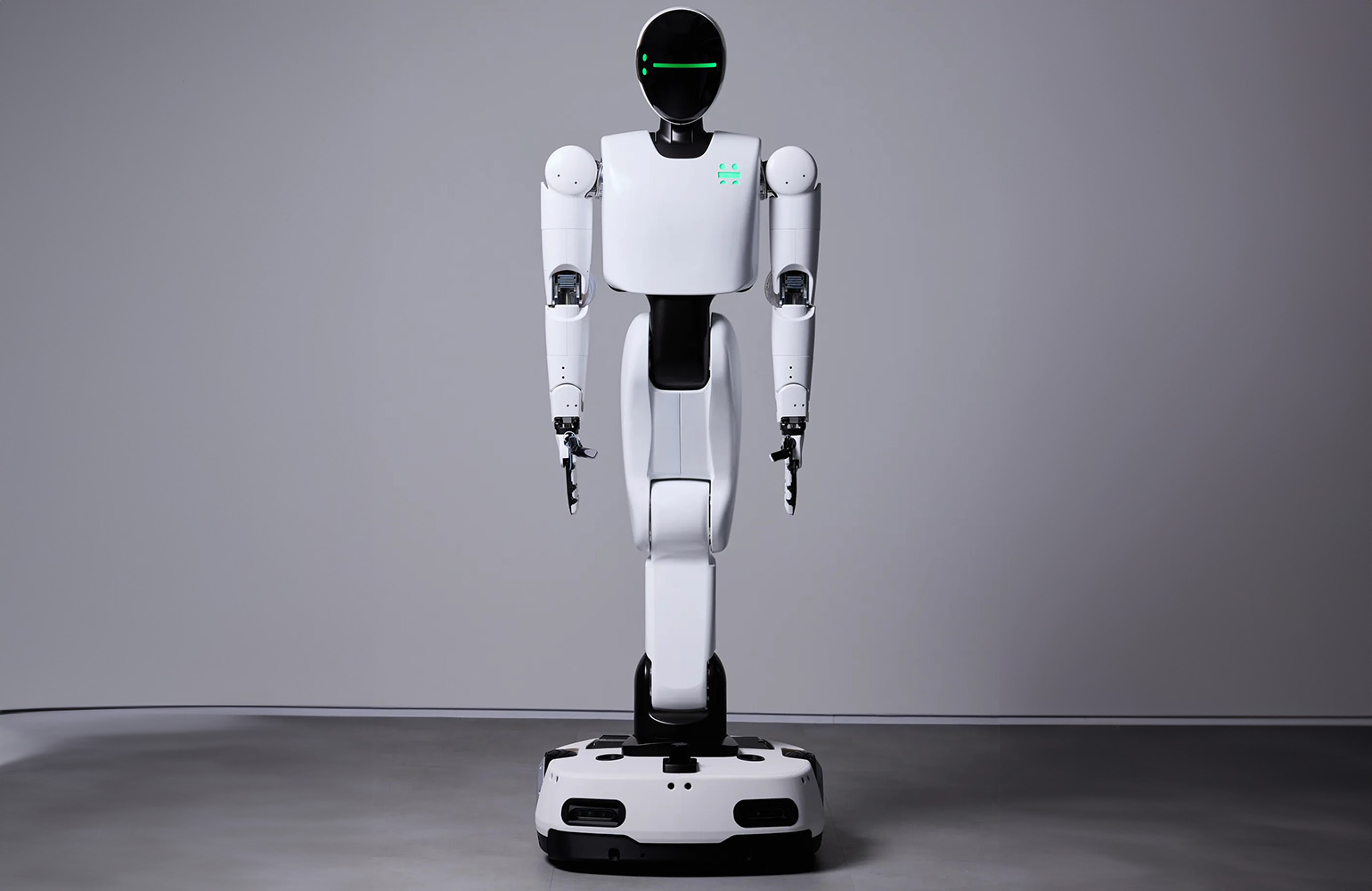
Holiday Robotics said its robot FRIDAY reduces the burden of repetitive physical work. | Source: Holiday Robotics
Holiday Robotics this month raised $105 million in Series A funding. The Seoul, South Korea-based company is building a wheeled humanoid for industrial work.
Humanoid robots have made progress in mobility, interaction, and demonstrations, observed Holiday Robotics. However, for humanoids to work in manufacturing, they need the reliability to safely work alongside people and take on repetitive physical tasks, said the company.
A real factory imposes constraints that never show up in a controlled demo, it said. These include things like contact, timing, repeatability, safety, recovery, and operational fit. The robot has to work inside the environment as it already exists, not ask the environment to change around it.
Holiday’s FRIDAY semi-humanoid features a wheel-based mobile base, a upper body that for dexterous manipulation, and hot-swappable batteries to keep it going across a full shift.
The company designed safety from the hardware up. FRIDAY has lightweight hands with low inertia, fully back-drivable hand and arm joints, and 360° perception with multiple cameras and lidar sensors to eliminate blind spots. Holiday said it sees safe operation around people as a requirement, not a feature.
Holiday says reliability starts with the hands
For a humanoid on a factory floor, walking is not enough. Value is created through their hands, according to Holiday Robotics. Hands grasp parts, place components, adjust positions, sense contact, recover from small variations, and repeat precise movements thousands of times.
Hands handle the physical details that make industrial work difficult to automate: friction, weight, alignment, compliance, surface changes, and uncertainty, said Holiday. The company claimed that it built FRIDAY around high-dexterity robotic hands.
The hands include tactile sensing and force-aware control that lets the robot feel contact and adapt to it. “FRIDAY has 64 degrees of freedom, 40 of which are dedicated to its hands — a direct measure of where we put our engineering focus,” Holiday asserted.
FRIDAY is built on a full stack
Holiday Robotics said it hopes to build on the progress of vision-language models VLMs) in helping robots interpret what needs to be done. Interpreting a task and reliably performing it are different problems, the company acknowledged.
When perception maps directly to action from end to end, rich behaviors can emerge straight from data, it said. However, it can be difficult to isolate why a specific motion failed, fix it without retraining the whole task, or apply that behavior to a new task, said Holiday.
To increase reliability, the company said it is taking a vision-language-skill (VLS) approach. Each skill is built and validated on its own, and complex tasks are composed by retrieving and orchestrating the right skills.
“VLS reaches its full potential when hardware, simulation, learning, and deployment evolve together,” said Holiday Robotics. “This is why Holiday develops the full-stack in-house. FRIDAY is where VLS meets the real world.”
Complementing FRIDAY is Holiday Sim, where the company’s robots, their skills, and their environment are reproduced to be tested, broken, and hardened before deployment.
The Holiday Lab is intended to create and improve skills. It turns demonstrations, simulation rollouts, and real-world failures into reusable skills. The lab then learns, orchestrates, and continuously improves them to solve increasingly complex tasks on FRIDAY, said Holiday Robotics.
The final piece, OASys, will make robots easy to deploy while carrying real-world experience back into the system, the company said.
Holiday Robotics takes a field-first approach
Holiday Robotics said it is starting to deploy its robots where work is repetitive, the need is clear, and the value of automation can actually be measured. The company said it will earn generality through use rather than claim it in advance.
Holiday said its current focus is manufacturing and industrial automation, including for automotive, semiconductor, and logistics environments. It is conducting private proofs of concept with industrial partners.
With the funding, Holiday said it plans to grow its research and engineering teams, strengthen manufacturing readiness, and keep advancing the full-stack systems for FRIDAY. The company is also planning to grow its team in the U.S. and in Korea.
 Save the date for RoboBusiness 2026
The post Holiday Robotics raises $105M for its FRIDAY wheeled humanoid appeared first on The Robot Report.


