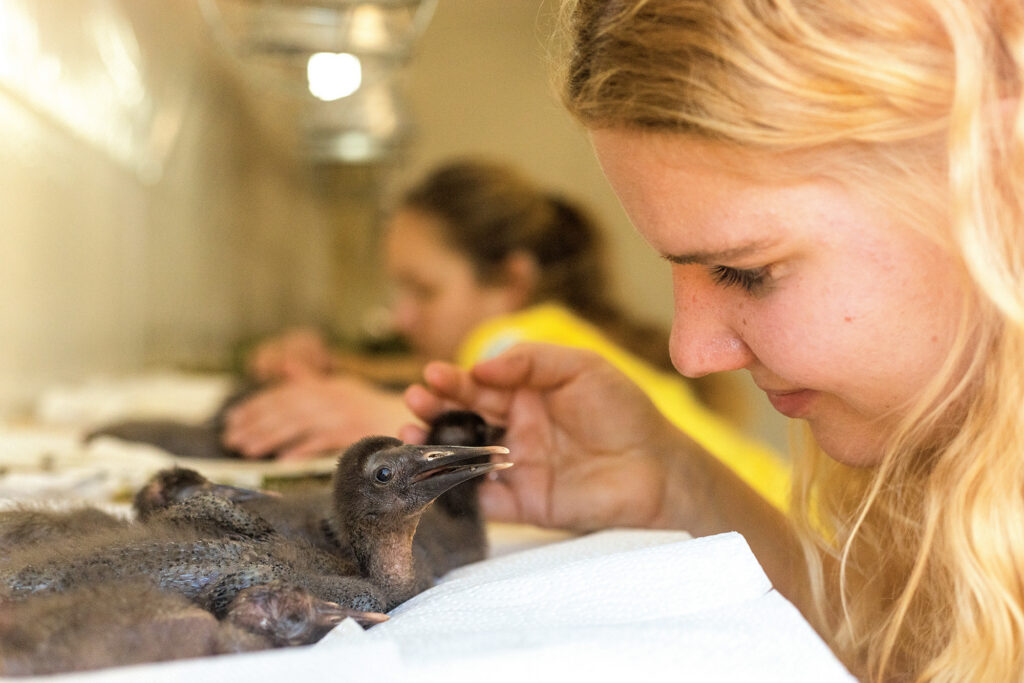
Just a few meters from an aviary in southern Austria, where the mountains are rough but the valleys lush and expansive, Barbara Steininger got nervous. At twenty-five, Steininger was about to become a foster mom. Not an everyday occurrence, she said, “especially if your fosterlings are birds.”
Moments later, a Wildlife Park Rosegg zookeeper placed two featherless chicks in Steininger’s warm hands. Her freckled face lit up. Two down, thirty-three more to go.
From that chilly day in April 2023, Steininger and her colleague, twenty-eight-year-old Helena Wehner, would be the chicks’ sole caregivers. It’s much like being a mom to a human: Cuddles are as essential as words of encouragement and adoration, all delivered in baby speak. Eight times a day, they’ll hand-feed them. “Just that it’s not breast milk or formula,” Wehner said, but a mix of shredded beef hearts and mice.
Such devotion isn’t afforded to just any bird, but to some of the last of the northern bald ibises. Already one of the rarest birds, shifting climate patterns have rendered their original migratory route unviable.
These thirty-five chicks were chosen to establish a new route, one that will help save their species from extinction. The singular connection they will form with Steininger and Wehner is a vital component. In just a few months, the human-bird bond needs to be so strong the fledged ibises will fly alongside their foster moms, who will ride in a tiny, ultralight aircraft, as they travel from their summer habitat in Central Europe to a winter refuge along the warmer coast of the Atlantic.
The endeavor demands courage. Over twenty-five hundred miles, birds and humans will need to dodge rugged peaks and high-voltage power lines, while weathering extreme heat, storms, and wildfires. The birds, of course, are unaware of their role in this dangerous mission. The humans, for their part, are spurred by the motto they’ve adopted. “Northern Bald Ibis,” their bright yellow t-shirts read, “A reason for hope.”
Once, the northern bald ibis was abundant. As a representation of the afterlife, ancient Egyptians drew the bird, with its distinct, mohawk-like head feathers, on the tombs of pharaohs. The Old Testament describes how, upon disembarking the ark, Noah released them as messengers of fertility and new beginnings.
Today, however, destruction of their habitat and hunting have left just a few hundred individuals scattered across the world. In Central Europe, the last of the wild ibises was likely served some three centuries ago along with a side of boiled potatoes and gravy, a specialty at the time. Since then, the confines of zoological collections have been their sole habitat on the continent.
That is, until Johannes Fritz, a spirited biologist, began reintroducing zoo-born ibis chicks to the wild. Since the beginning of the twenty-first century, Team “Waldrapp” (German for northern bald ibis) has lifted the Central European population from zero to two hundred seventy-seven, making it one of the world’s shining conservation success stories.
Most wild ibises now nest and raise their offspring in the craggy cliffs of the eastern Alps. Sometime between September and October, colder temperatures and lack of critters and bugs signal the birds it’s time to migrate south to their winter refuge in a protected lagoon in Tuscany.
Not in the winter of 2022-23, though. That fall, the team had been monitoring the birds’ movements via GPS trackers, eagerly waiting to see them take off and head south. But temperatures remained warm and food abundant. September came and went, as did October. The team began to worry. Since Fritz started working with the birds almost two decades ago, they’ve delayed their migration by an entire month, on average. This was the longest they’d ever stayed north of the Alps.
In early November, temperatures dropped abruptly. The birds took off. From their colonies across Germany, Austria, and Switzerland, they traced the valleys of the Rhine and Salzach rivers south through the Alps. When just a few more peaks separated them from the flatlands of Italy, they turned around. “They tried several times, but each time they aborted and flew back to lower-lying areas,” Fritz said. Team Waldrapp watched the ibis struggle as small blips on their screens, until they seemingly gave up.
Fritz hypothesizes seasonally weaker thermal lifts might not have allowed them to soar over the peaks, but whatever the reason, the birds were now caught in an icy death trap. Social animals, they huddled together for much-needed warmth, but in the frosty soil, their long, curved beaks no longer found any food.
Traditional conservationists see their role as passive stewards. They keep their distance and let nature take its path, even if that means none of the ibises survive the winter. Fritz argued nothing about the situation was, in fact, natural. “I always thought that climate change would eventually affect the birds—just not that it would happen this soon,” he said.
What the earth is experiencing today, scientists say, is a sixth mass extinction. The previous five were due to natural phenomena, such as the asteroid that wiped out almost all dinosaurs. The only group of dinosaurs that survived had feathers, wings, and beaks—species we’ve come to categorize as birds.
Their lives, like those of all animals we know today, are defined by the climate. Migratory birds, for example, lay their eggs in time so they’ll find worms or snails to feed their young once temperatures rise. When it gets cold, the chicks have grown strong enough to swap their home base for another habitat, timing their journey so food there, too, will be abundant upon their arrival.
Ever-growing global emissions, however, have thrown nature’s clock out of sync. Many species can no longer find the food they need at the time and locations they used to. Then there are other changes, too, ones we might not fully understand—like a seasonal shift in thermodynamics that would have helped the birds soar over the Alps if they’d arrived earlier.
Already, every eighth bird species is on the precipice of extinction. Soon, we might only view them in natural history museums, next to the skeletons of the dinosaurs they survived sixty-five million years ago. This “biological annihilation” will hit humans in ways that threaten our own species’ survival, too, as a new study by Stanford and the National Autonomous University of Mexico shows. When passenger pigeons went extinct, for example, acorns became more widely available for other creatures, which led to an increase in the population of white-footed mice—the main carriers of Lyme disease. Since then, cases in humans have grown, too.
The future appears bleak, but it isn’t set in stone. For millions of species to survive, it’s imperative humans cut carbon and other greenhouse gas emissions. At the moment, though, they keep rising. And while in November 2023, at the COP28 United Nations climate summit, two hundred countries agreed to transition away from fossil fuels, experts say whether they follow through will depend on citizens holding their governments accountable.
In the meantime, Fritz argues, humans might need to take a “more extreme, more radical” approach to save threatened species like ibises. “The old ideas of how we should approach conservation, they won’t match the challenges we’re facing today.”
In late autumn 2022, the team embarked on a rescue mission. With tasty mealworms as lure, they trapped the ravenous birds in crates and chauffeured them over the mountains. As soon as the birds had settled in their Tuscan winter habitat, Team Waldrapp began working on next year’s contingency plan.
The migratory route they’d established was no longer feasible, and a private coach service, they conceded, wasn’t a long-term option, either. But along Spain’s Atlantic coast, another group of conservationists had recently established a sedentary population of ibises. If they could get migratory birds there, they’d not only bypass the Alps, but allow the birds to link with their maritime peers.
The downsides were as obvious as the upsides. The new route would be three times as long as the previous one, roughly the same distance as from New York to Las Vegas. It’d take a minimum of six weeks, across a terrain they’d never seen.
In July 2023, at their final training camp next to a small landing strip for gliders in southern Germany, the team was upbeat. After weeks of love and care, the birds had turned into curious and playful youngsters with shiny plumage, each with its own personality. They still enjoyed being hand-fed by Steininger and Wehner, but had also grown skilled at pecking worms and snails off the meadows, and when they flew around the undulating hills, they always kept an eye on their landbound foster moms. Now, it was time to get Steininger and Wehner up in the air, too.
While the two women put on yellow t-shirts—a visual aid that helps the birds identify their moms, even from great distance—Fritz pushed his ultralight aircraft onto the meadow that served as a runway.
At fifty-seven, and now with a team he feels responsible for, safety has become a primary concern. That wasn’t quite the case when he started, as he readily admits.
A high-school dropout, Fritz began studying biology in his mid-twenties and later landed a PhD position at Austria’s Konrad Lorenz Research Center, where he hand-raised goslings and raven chicks, taught them to open boxes, and observed how they pass their skills to their peers. Working closely with animals was exactly what he’d dreamed as a little boy growing up on a small mountain farm.
Then, in 1997, the research center received its first northern bald ibis chicks from a Vienna zoo. The ibises had been a favorite among zoo visitors, who were able to walk straight through their aviary, gaze at the artificial rock formations where chicks screamed from their nests, and watch them pick bugs off the ground. (A famous game show host, Peter Rapp, became their patron, not least because his last name is also found in “Waldrapp”)

At the Konrad Lorenz Research Center in Grünau im Almtal, however, the ibises were a source of frustration. Nowhere near as smart as ravens, not even close to geese, teaching them skills was tricky. Fritz, however, was enamored. Even today, he points to their charisma and explains they’re so gregarious, affectionate, and curious, they’ll eagerly poke their long beaks into his ear.
After the first summer at the research center, where they were kept in the open, the birds suddenly vanished. The scientists were puzzled, but as the weeks passed, reports of sightings of large birds with long beaks, yellow eyes, and black mohawks trickled in from across Europe. To Fritz, it was clear the ibises had tried to migrate, their instinct to fly south unabated by hundreds of years of zoological confinement. Their only issue: “They didn’t know where south was,” Fritz recalled. Some were even spotted as far north as the Netherlands, and east in Russia.
A simple cage would do the trick for next year’s research subject, the center’s biologists reasoned. But Fritz, singleminded and entrepreneurial, hatched other ideas. If the birds didn’t know where to go, why not show them?
Inspired by the 1996 Hollywood movie Fly Away Home, in which Jeff Daniels and a young Anna Paquin teach orphaned Canada geese how to migrate, he came up with a plan: He’d brave his flight sickness, learn to fly a small aircraft, and guide the ibises south.
Initially, the distances they covered were humble, the learning curve steep. The aircraft had to be engineered to fly at no more than twenty-five miles per hour. “Luckily, whenever the motor stopped working, we were somewhere we could still land,” Fritz said, laughing with relief.
Once, his team—including his then-wife and two sons—watched helplessly as he crashed into a cornfield. Though they found the aircraft destroyed, Fritz was unharmed and unfazed. His first response: “We need to get this fixed immediately.”
In 2004, after three years of trial and error, he successfully guided his first flock over the mighty Alps and all the way to a nature reserve in Tuscany. He kept going, steadily growing the number of wild ibises. The birds prospered.
At the landing strip in southern Germany, the team ordered a group of keen bird watchers to position themselves near the hangar, farther from where the ibises would take off, so as not to disturb them. Strict rules ensured the project came first, including that only the foster moms were allowed near the birds, a way to keep their bond with the ibises strong.
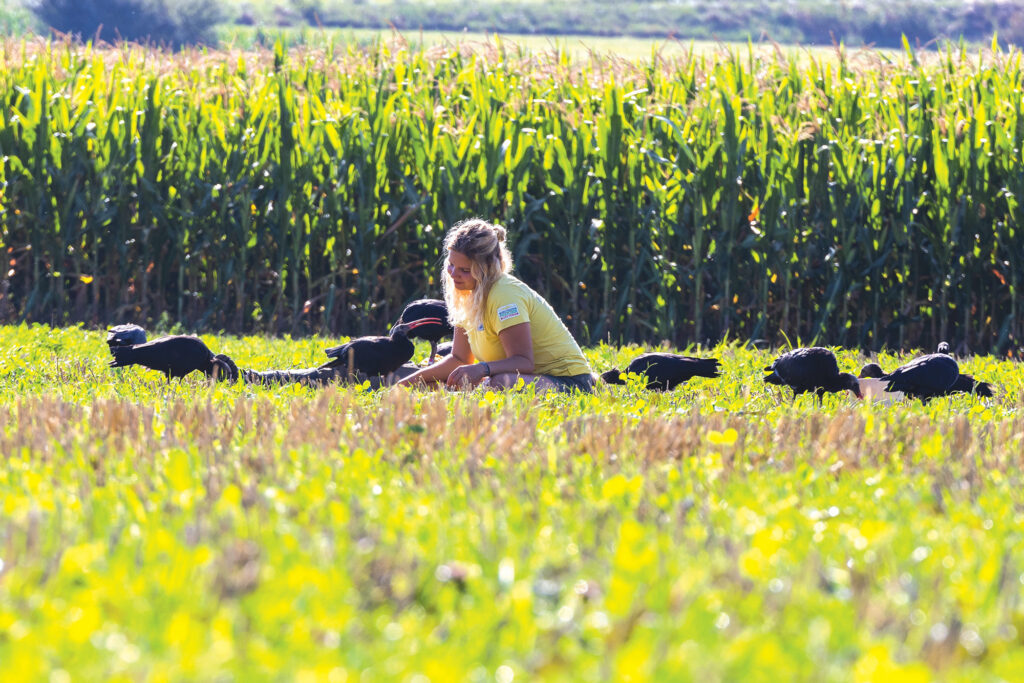
Through the high, dewy grass, Steininger and Wehner dashed toward the landing strip, their blonde ponytails bouncing while they yelled, “Come, come, ibis,” in German. The flock flew low and landed around their moms on the field.
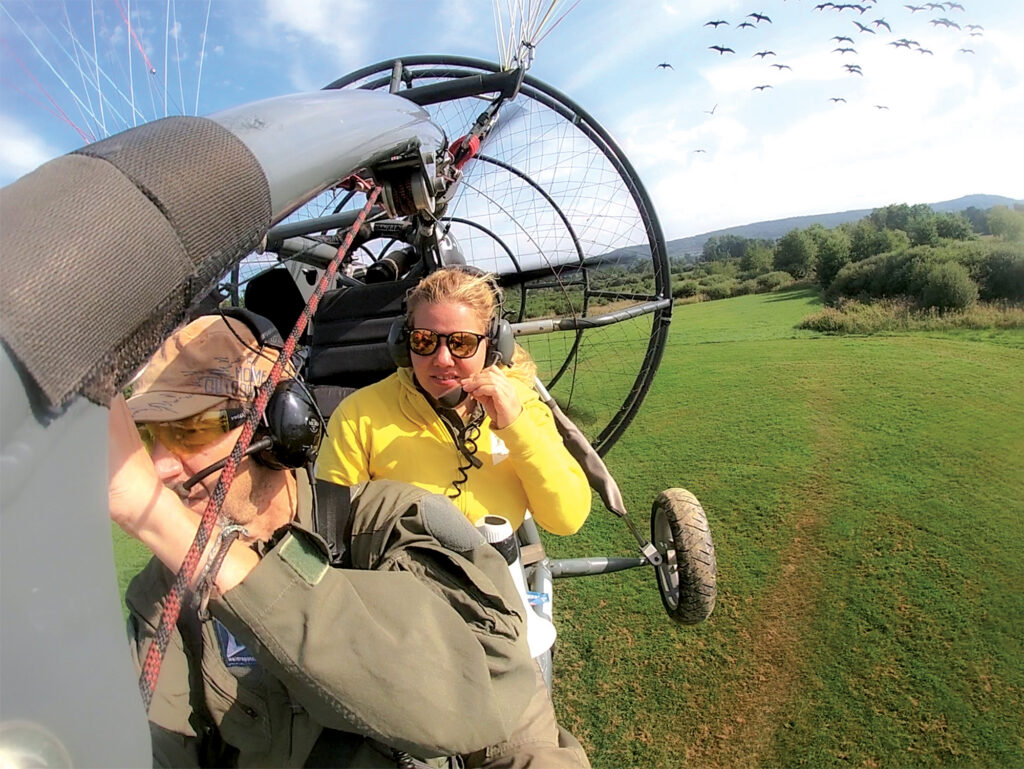
Fritz got into the two-seat aircraft—he overcame his flight sickness years ago—then Steininger got into the backseat, closely watched by the birds. Fritz turned the engine on and a whirring propeller filled the bright yellow chute with air, allowing it to expand. “Come, come, ibis!” Wehner yelled through a megaphone aimed in the birds’ direction. The aircraft began to roll over the meadow, Steininger ran next to it, struggling to keep up, then hid in the high grass.
The aircraft took off. Slowly, Fritz and Wehner circled over the field. The birds were dumbstruck at first. Then, they realized Wehner, their mom, was now airborne. One ibis spread its wings, then another, and another. “That’s crazy—they’re following,” one of the bird watchers, dressed in a safari outfit, said, his binoculars tightly pressed against his face.
Team Waldrapp was enthralled, too. A first flight practice had never gone this well. “The birds are really eager to follow their moms,” said Fritz.
On August 21, with a bright, sunny sky and a weather report that promised decent conditions for the next several days, the team took off. They guided the birds west, along the foot of the Alps toward France, then south until they got to the coast of the Mediterranean, onward through Spain and past the Strait of Gibraltar, where the Atlantic began. Volunteers followed in cars and helped set up tents for the moms and aviaries that kept the inexperienced ibises safe from predators.
Long-legged storks, European bee-eaters with gemstone-blue bellies, and zebra-striped hoopoes flew along. It’s the biggest migratory corridor on the continent, “and being part of that, flying with tens of thousands of birds—you know you’re right where you’re supposed to be,” Fritz said.
Not everything ran smoothly. At times, the birds refused to soar, instead flying underneath and between high-voltage power lines. The team suffered through unbearable heat, often sitting in open fields for hours until their camp for the night was set up, then torrential rains forced them to stay grounded, delaying their journey by days. Somewhere in France, seventeen birds went missing mid-flight. While Helena Wehner continued with part of the flock, Steininger returned to their last campsite, expecting the missing birds would, too. She recovered fourteen, but needed to push on before the remaining three were found. “Whether they’re dead or alive, we don’t know,” Fritz said.
The last leg of the trip was the most arduous. For five days, the levant, a wind that blows from the Mediterranean to the Atlantic, was so strong they couldn’t take off. When they did, they were quickly forced to make an emergency landing in a cotton field, where a baffled farmer was driving his tractor.
But in early October, they made it. In Vejer de la Frontera, a village of white houses and cobblestoned streets, they were greeted by hundreds of children and supporters, some dressed as ibis, cheering, clapping. There were bear hugs and tears of joy and relief.
There’s no doubt the migration was a success. Even so, many questions remained. Would the ibises be able to return to the Alps and teach their offspring the route they’ve once learned from humans? Or would they abandon the difficult journey and remain in southern Spain year-round? What will happen when droughts plague the land and food becomes scarce? And what about all the other migratory birds, given we can’t teach all of them new routes?
Johannes Fritz doesn’t pretend to hold all the answers. He just knows any glimmer is worth a shot. “Sometimes it’s necessary to take risks, to act and see if it works,” he says. Hope counts for something, he says, “and so far, it’s always worked out.”
Helena Wehner plays with one of the baby chicks in April 2023.
Northern bald ibises during a practice flight with Johannes Fritz and the bird moms.
Fritz unravels his flying wing before taking off with the birds for one of their longest test flights, August 2023, in Germany. Below: Fritz and Wehner lead a formation of ibises.
Summer flight school. Below: Wehner hangs out with adult birds on German farmland.
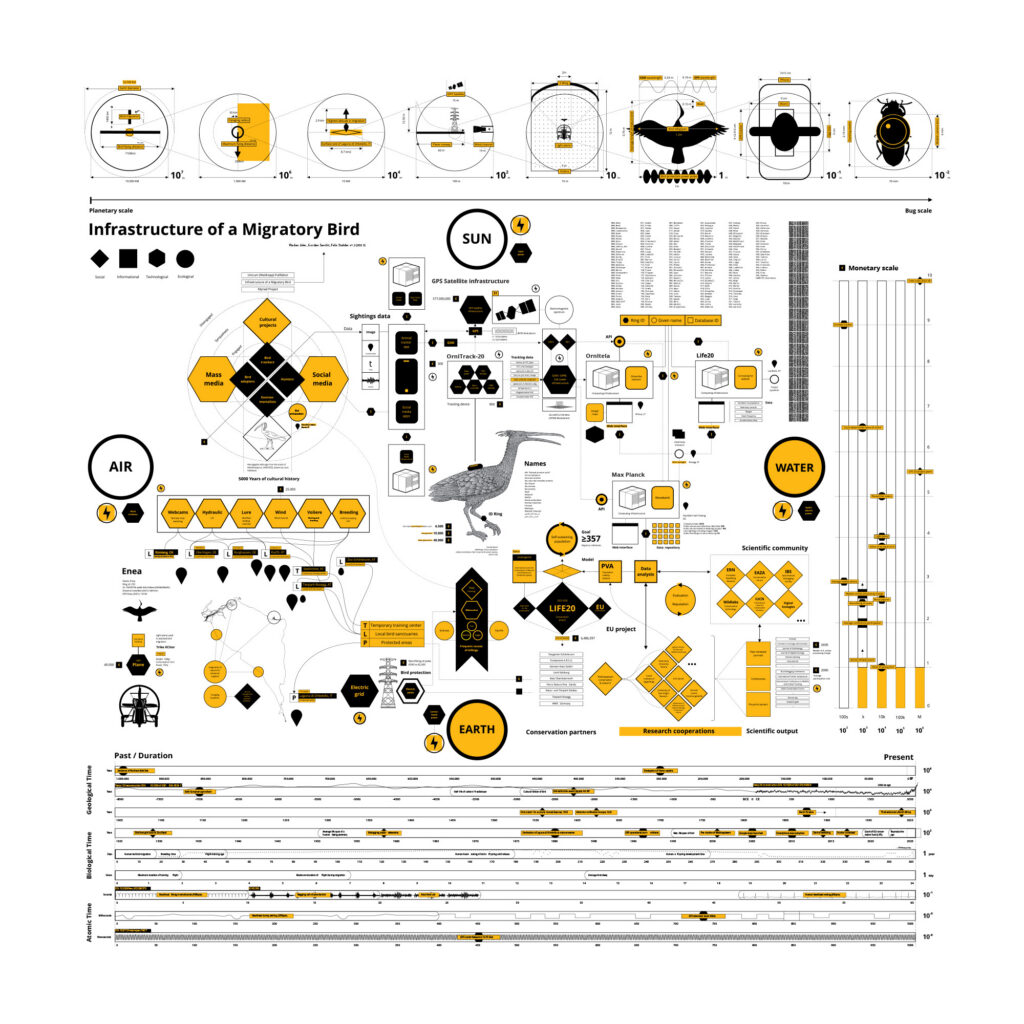
This graphic represents the “infrastructure” of the northern bald ibis and its restoration. It’s a global look at the many factors affecting the birds, from the salaries of researchers to geologic timelines to a schematic of how they’re studied. It also includes a list of some of the tagged birds with their names, which include Quasimodo, Hellfried, and Freckles.


