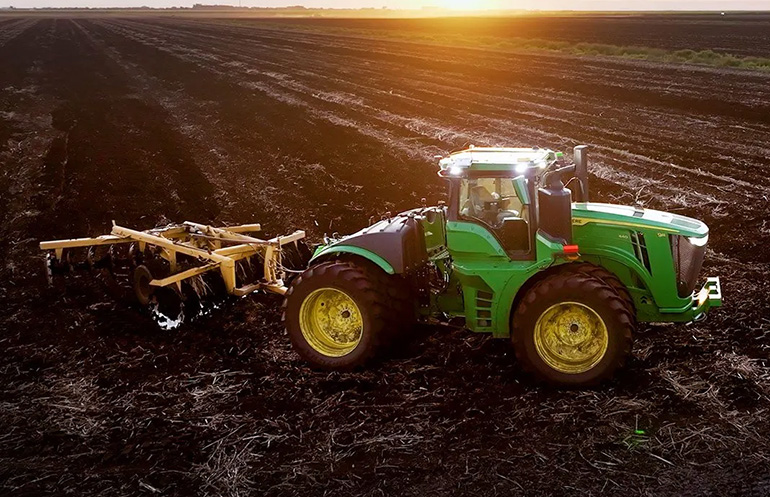
ASI has worked with U.S. Sugar and Everglades Group to deploy autonomous tractors across South Florida. Source: Autonomous Solutions Inc.
American farmers are being asked to feed a growing nation with a shrinking workforce, rising input costs, and weather that has become less predictable every decade. They’ve always adapted — from horses to tractors, from paper records to GPS guidance. The question we hear most often isn’t whether to adopt autonomous technology. It’s whether the technology is ready for the realities of their operation.
After more than 25 years of deploying autonomous fleets in some of the most demanding industrial environments on earth, my answer is yes. And I can show you exactly what that looks like.
This past summer, Autonomous Solutions Inc. (ASI), U.S. Sugar Corp., and Everglades Equipment Group announced the deployment of the largest autonomous vehicle fleet in the history of American sugarcane farming — across hundreds of thousands of acres in South Florida.
This isn’t a pilot. It isn’t a proof of concept. It’s a full operational deployment on one of the most logistically complex agricultural footprints in the U.S., and it’s already delivering results.
ASI, U.S. Sugar, and Everglades Equipment join forces
I founded ASI as a student coming out of Utah State University. We started ASI by asking a question that seemed almost naïve at the time: Why are we still putting people in the most dangerous and tedious seats of machinery? That question has driven everything since.
Today, ASI is trusted by global Fortune 500 companies and industrial operators across multiple verticals. Our Mobius platform has orchestrated hundreds of millions of tons of autonomous work. We’re not theorizing about what autonomous agriculture looks like. We’re already doing it.
One of ASI’s future-of-farming partners in this journey, U.S. Sugar, is a South Florida-based farming and processing company founded in 1931. It is a vital part of Florida’s rural communities, sustainably farming 255,000 acres (103,194.8 hectares) across five counties and providing 3,000 jobs to local residents. U.S. Sugar has said that combining innovation with hard work is the best way to keep operations running and American families fed.
The challenges facing modern agriculture are significant. Recently, Florida farmers struggled through unexpected deep freezes that caused an estimated $3.1 billion in losses to the state’s agricultural supply.
When American farmers are in survival mode, the rest of the nation’s food supply feels the impact. This is where autonomy provides a critical bridge and an additional safeguard against unexpected dilemmas. Collectively, ASI, U.S. Sugar, and Everglades Equipment Group are addressing the challenges with automation.
A gap autonomous systems can fill
Here’s the operational reality I hear from farmers: The weather is the wildcard, but the labor shortage is the multiplier. When a freeze threatens a crop, you need all hands moving fast. If you’re short a crew, or your operators are four miles away on the other side of the operation, crops stay in the field longer than they should. That’s where the losses compound.
Autonomy doesn’t fix the weather. What it does is remove the constraint that turns a weather event into an economic one. It means work continues regardless of crew availability, time of day, or where on the farm the urgent need just appeared.
One operator managing multiple vehicles simultaneously is a fundamentally different labor model and for operations the size of U.S. Sugar’s, it changes the math entirely.
In our recent deployment alongside U.S. Sugar, its John Deere tractors are equipped with Mobius, ASI’s industrial fleet orchestration system. We value the familiarity our clients have with certain equipment and platforms, which is why Mobius is manufacturer-agnostic, able to be integrated onto any existing vehicle and introduced into a fleet quickly and seamlessly.
By combining with existing drive-by-wire systems, we have turned familiar John Deere platforms into fully autonomous workhorses.
Breaking down the impact of the deployment
The early results from the U.S. Sugar deployment are what we expected based on 25+ years of deployment data, but worth stating clearly: Autonomous tractors are delivering higher accuracy in land preparation than human operators, running beyond standard working hours, and doing it consistently across weather and crew variability that would have caused delays in the past. These aren’t projections. This is what the deployment is producing right now, in the field.
The question I get asked most by farmers considering this technology is some version of: “What happens to my people?” It’s the right question. U.S. Sugar has committed to retaining current employees and retraining tractor operators for the higher-skill, supervisory roles this ASI Mobius technology creates.
That’s not a PR position. That’s a business reality: the people who know these fields, who understand the soil, the equipment, and the crop cycles, are exactly who you want managing autonomous fleets. What changes is their exposure to risk and the physical toll the work takes on their bodies over a career. That’s a trade worth making.
Editor’s note: Mel Torrie will speak about “Designing the Robotics Ecosystem for Outdoor Autonomy” at RoboBusiness 2026, which will be on Oct. 20 and 21 in Santa Clara, Calif. Register now to attend.
 Register now and help us celebrate 20 years of RoboBusiness!
Autonomy’s global applications
The South Florida deployment isn’t a proof of concept we’re watching. It’s a model we’re scaling.
Over the next decade, autonomous operations will expand across U.S. Sugar’s full 255,000-acre footprint. The same platform is already trusted across an array of industries running thousands of vehicles around the clock, and agriculture is benefiting by those lessons learned.
The infrastructure, the orchestration logic, the safety protocols — they all transfer. What we’re building in South Florida is replicable everywhere crops need to be planted, tended, and harvested under conditions that wear people out.
While we are starting with land preparation and sugarcane cultivation, the potential is vast. U.S. Sugar intends to expand this technology for other crops, including sweet corn and green beans.
Building resilience for future generations
Farming has always been about doing more with what you have, in conditions you can’t fully control. That hasn’t changed. What’s changed is what’s available in the toolkit.
The farmers who succeed in the next decade will be the ones who figure out how to pair the expertise they’ve built over generations with technology that extends their reach, runs when they can’t, and keeps their people safer in the process. That’s what this work is for — to make it viable for the next generation of people willing to do it.

About the author
Mel Torrie is the founder and CEO of Autonomous Solutions Inc., which has been deploying autonomous industrial vehicle technology since 2000.
ASI’s Mobius platform orchestrates autonomous fleets across mining, construction, agriculture, logistics, and landscaping. Learn more at asirobots.com.
The post How autonomous fleets are changing what’s possible in American agriculture appeared first on The Robot Report.


