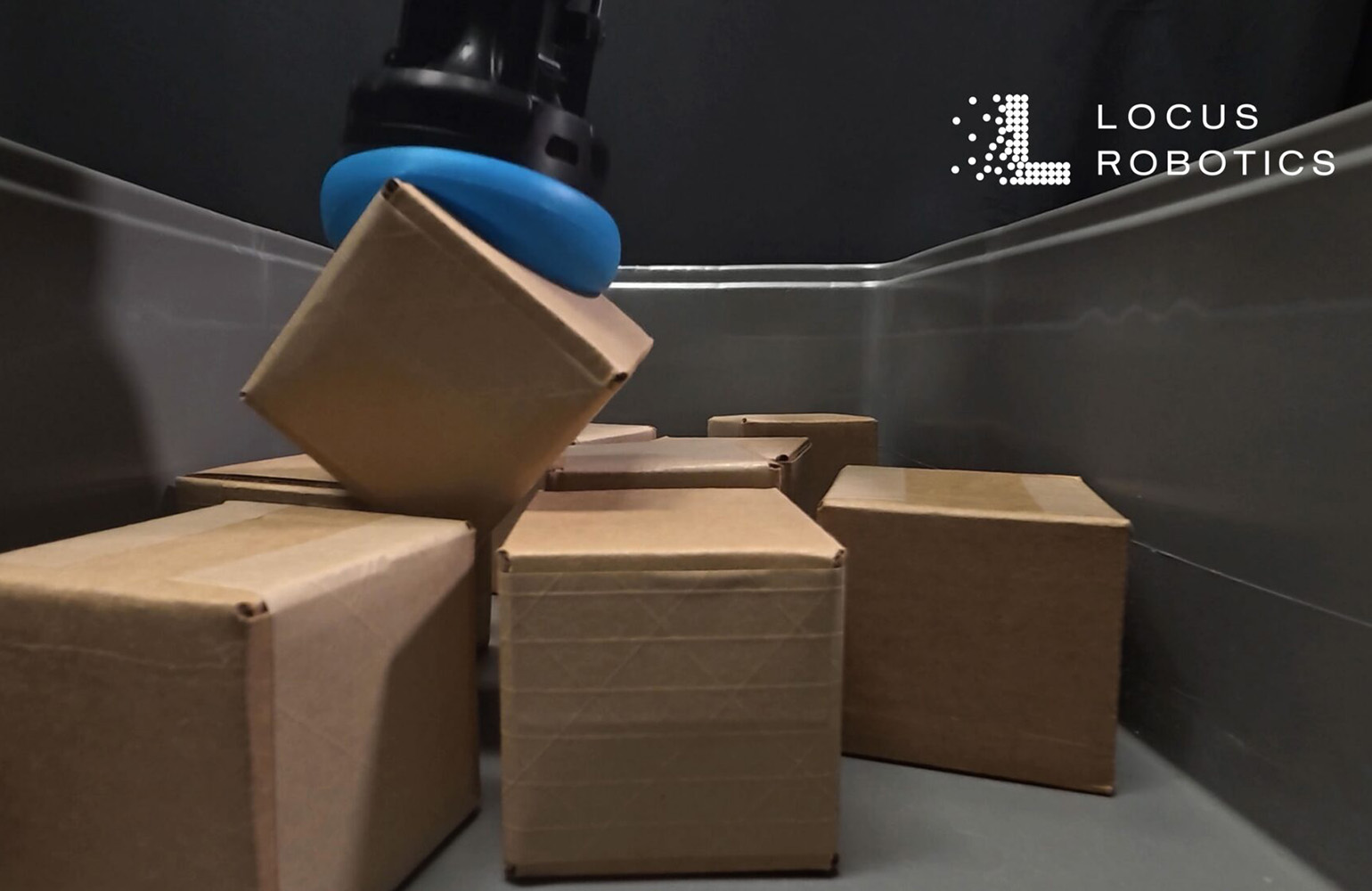
NeuraGrasp can grasp a wide range of items, from small containers to porous polybags and cloth items. | Source: Locus Robotics
Locus Robotics Corp. has successfully tackled many robotic challenges in real working environments. Its autonomous mobile robots, or AMRs, have navigated countless miles in a variety of facilities, and they have aided in more than 6 billion picks. Now, its targeting manipulation.
The company entered the robotic picking space in March 2025 when it unveiled Array, a mobile manipulator equipped with a custom-developed, vision-guided picking arm. Over a year later, Locus acquired Nexera Robotics, which is known for its NeuraGrasp gripping technology.
According to Roy Belak, the senior vice president of robotic grasping at Locus and former CEO of Nexera, by the time it came in contact with Locus, Nexera had already spent years refining its unique, soft end effectors. It had already gone through at least six different product generations, he said.
“Just as we were getting to that point where the technology was showing its compelling capabilities, we were at a fortuitous situation where we met with Locus at MODEX, and I think the history kind of writes itself from there,” Belak told The Robot Report.
The timing was ideal for both companies. Locus wanted to be able to handle more SKUs in its facilities, and Vancouver, Canada-based Nexera was ready to scale.
“We want to see this technology deployed at scale,” said Belak. “That’s something that excites me as somebody who’s an innovator and building something. You just want to see it out there widely, and that seemed like it was a great opportunity.”
What does NeuraGrasp bring to Locus Array?
Nexera met Locus in 2025, when Locus was planning its early market release for Array. At the time, Array had a standard suction-cup gripper. Belak said the companies spent a lot of time figuring out how to fit Nexera’s technology into Array’s development so late in the game.
Luckily, even though Locus was already far into its process of developing Array, the robot was already well prepared for Nexera’s technology. Array already had an air supply, a power supply, and other things that Nexera’s technology needed.
“There was a lot of work that was done prior to the acquisition to make sure the technology could be slipped into the development stream,” recalled Belak. “I think it we had missed that window by another year, it probably would have been really hard to make those changes.”
While Belak did not give an exact timeline of when customers could gain access to Nexera’s technology, he said he is optimistic about the process. Belak said he expects that the next time Array is displayed publicly, it will likely have Nexera technology.
Right now, Locus is in the early stages of deploying Array with its original gripper to customers, so Nexera hasn’t seen the windfall of data that will be coming soon.
“There’s a long line of customers with their hands up that are really excited about Array,” Belak said. It’s in some ways intimidating, because you’re going to take this thing, you’re going to integrate it, and then it’s going to go to many different places. Then we’ll start seeing the data really come back, and we’ll have a chance to just optimize as much as we can during that process.”
Suction versus pinch picking
When taking a step back and looking at the robotics industry as a whole, Belak said that much of robotic manipulation falls on a spectrum between suction-based grasping and pinch grasping.
“The reality is that suction is very good, particularly in warehouse operations,” he said. “Sixty percent to 70% of the time, it’s all you need. It’s when you get to that 30% to 40% and get to the really high coverage ratios.”
NeuraGrasp’s soft gripping technology can help to bridge this gap because it uses both suction and pinching, according to Belak.
“As an industry trend, it’s 100% recognized that pinch grasping is likely going to be very influential in the future of robotic grasping,” he said. “With that said, we are still firm believers that suction gets you a good portion of the way with air. And if it ain’t broke, you don’t throw it away.”
Locus is focusing on reliability and quality picks, not speed
“In the industrial environment, reliability is everything,” Belak said. “Suction technologies, although they have a performance limitation, the beauty of them is that they’re incredibly reliable. As we go to pinch grasping technologies, depending on the level of complexity that’s there, they can border on marginally reliable to very unreliable, or maybe just questionably reliable.”
Belak said it’s important to make robots that can simply do tasks successfully. But after that, the top priority is reliability, because it doesn’t matter how well a robot can pick if it’s constantly breaking down or missing picks. In addition, the quality of the pick is essential, he said.
“There’s a big differentiation between being able to do something, and being able to do the same tasks with high quality. Locus Origin bots are already known for being very high-quality,” Belak said. “We want to bring that same ethos to picking.”
“Picking has historically been a field where the claims have been more focused on the return on investment, without understanding the underlying quality,” he continued. “We can do many picks per hour, but what people don’t focus on is how good are those picks.”
Locus’ team wants to focus on avoiding product damage, double picks, and misspicks, noted Belak. They aren’t often talked about when advertising a robot, but they can eat into a customer’s costs quickly, he added. “Once they have the quality down, then they can worry about increasing speed,” Balak said.
What’s holding back robotic picking?

Nexera’s NeuraGrip can grasp items that were previously difficult to pick, such as porous polybags. | Source: Locus Robotics
Two roadblocks are still hindering the industry, claimed Belak: the development of AI and giving robots a sense of touch. The industry is good at building fancy hands or electromechanical structures, he said. But, when it comes to pinch grasping, the intelligence is still lagging behind.
“[The challenge] is 100% the proprioception and the data metrics and the feedback mechanisms that are there to actually make these hands do things,” Belak said.
This shouldn’t come as a surprise. The robotics industry has raked in millions of dollars of funding in recent years to build a robust physical AI system for robots. And the reality is, human brains evolved over billions of years. Some companies are trying to close this gap by generating as much data as possible, but when you do that, you start to notice the lack of tactile sensing.
“There is one piece of the physical system which is missing, which is the sense of touch on the robots, and particularly robust, reliable touch that doesn’t degrade after very limited usage. That stuff is really tough to simulate or to have the data generated,” Belak said. “I don’t think that simulated data is going to help with this problem very much.”
Nexera does currently use a sense of touch, and it is interested in advancing that in the future. While Locus is still early in its journey with Array, Belak said the company’s manipulation roadmap doesn’t stop with Array.
“Robotic manipulation in general — whether it’s Array, whether it’s other versions of the technology, whether it’s on picking benches, whatever it may be — we have identified that as a pillar of innovation that we want to be exceptional at,” he said.
Editor’s note: Rick Faulk, the CEO of Locus Robotics, will be speaking at RoboBusiness 2026 in Santa Clara, Calif., on Oct. 20 and 21. Faulk will be part of the panel discussion “The RaaS Playbook: Pricing, Service & Scale.”
 Register now and save on your pass to RoboBusiness 2026
The post How Locus is getting a grasp on one of robotics biggest challenges: manipulation appeared first on The Robot Report.


