Subsea cables power the internet under oceans all over the world. But how many cables are there?
As telecom experts, we know because we keep track. And TeleGeography’s interactive submarine cable map recently hit a new milestone: depicting over 709 cable systems!
As of 2026, that’s a whopping 607 in-service systems, with another 102 planned. The number of in-service systems is greater now than in any other year within the last two decades.
How do we count submarine cables?
Thanks to massive infrastructure investments—both along major routes and to small islands—and our ongoing efforts to track global systems in more detail, the number of cable systems we study is constantly increasing.
We focus on publicly-known communications systems and exclude undersea lines exclusively dedicated to power transmission, research networks, and private government use. Once cables are retired, we remove them from our online map.
For more information on the cable-tracking process, you can hear my colleague Greg Bryan and I get into the details on the TeleGeography Explains the Internet podcast. Listen to the full episode here.
What are submarine cable systems?
The number of cable systems we track is different from the total point-to-point connections shown on the map.
Each cable system is uniquely designed to fit its capacity requirements and local geography. As such, it may contain multiple segments or branches, as do over half of the systems on our map.
The difference between cable systems and segments is most easily demonstrated in the Atlantic. Although there are only 14 in-service trans-Atlantic cable systems, 18 segments actually cross this route.
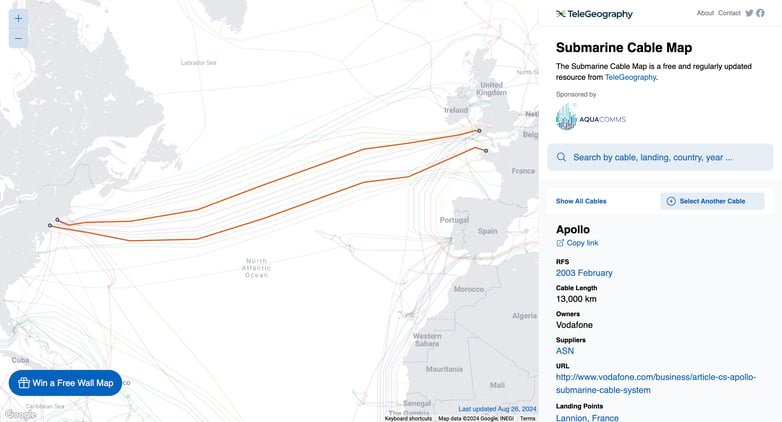
This is made possible by systems like Vodafone’s Apollo, which connects the U.S., France, and the U.K. through two parallel paths—one North, the other South, and each with their own pair of landing stations.
You can also check out this report on submarine cable landing stations.
Using submarine cable data
Some of this interesting data is publicly available through our interactive submarine cable map.
But if you’re looking for the data telecom experts use to keep their pulse on international markets, you need TeleGeography’s Transport Networks Research Service. This platform delivers data and analysis on long-haul networks and the undersea cable market, with forecasts of international bandwidth supply, demand, prices, and revenues.
With detailed profiles of network service providers and submarine cable systems, Transport Networks Research Service is the global telecom industry’s most comprehensive source of data and analysis. Take a quick tour with the video below, and get research samples when you fill out the form on this page.


