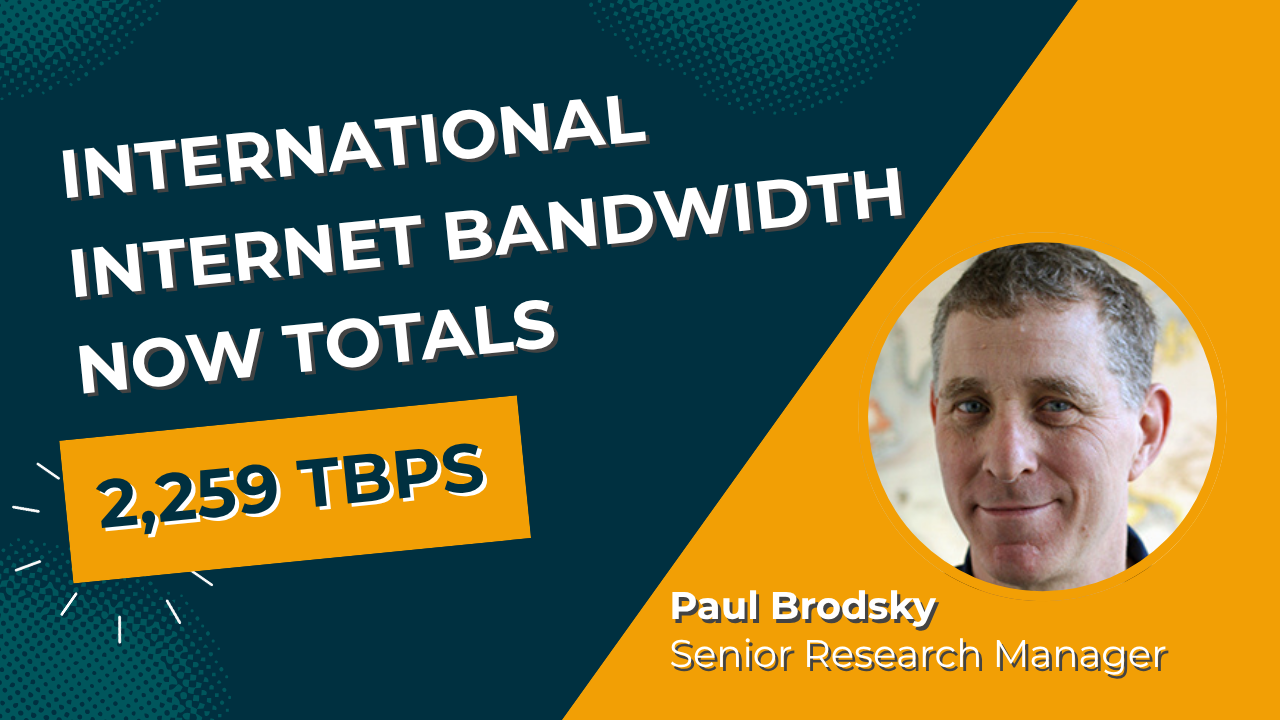
Global internet bandwidth increased by 23% in 2026, maintaining its consistent pace of steady growth.
Total international internet bandwidth now stands at an impressive 2,259 Tbps, representing a 4-year compound annual growth rate (CAGR) of 23%.
The pace of growth has leveled out in recent years, but bandwidth has still more than doubled since 2022.
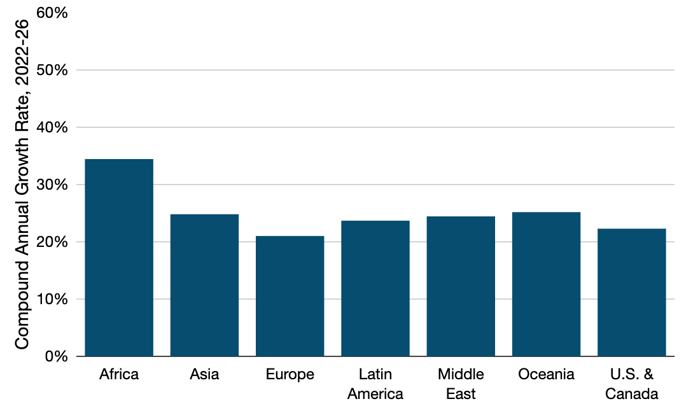
Naturally, capacity growth varies across different regions. Once again, Africa led the way with the most rapid growth in international internet bandwidth, expanding at a compound annual rate of 35% between 2022 and 2026. Oceania followed, growing at a 25% compound annual rate over the same period.
International Internet Bandwidth Growth by Region
International internet traffic growth largely mirrors that of internet bandwidth. Both average international and peak international internet traffic increased at compounded annual rate of 24% between 2022 and 2026—essentially identical to the compounded annual growth rate in bandwidth over the same period.
What’s next for IP networks?
The combined effects of new internet-enabled devices, growing broadband penetration in developing markets, higher broadband access rates, and bandwidth-intensive applications will continue to fuel strong internet traffic growth. While end-user traffic requirements will continue to rise, not all of this demand will translate directly into the need for new long-haul capacity.
A variety of factors shape how the global internet will develop in coming years:
Artificial Intelligence (AI)
This is the most hyped demand driver in recent years, but its impact on international internet capacity is limited thus far. According to interview with numerous public IP backbone operators, AI has not yet generated a massive surge in public IP traffic.
This view is similar to trends observed in access networks by AppLogic. The company’s March 2026 “Phenomenon” study indicates that AI volumes are negligible compared to the video streaming and social media traffic. The study does note AI-based traffic increased at a 90% clip on fixed networks in 2025, with 80% growth observed on mobile networks. If sustained, this rapid growth could eventually have a meaningful impact on international internet networks.
Bypassing the public internet
The largest content providers have long operated massive networks. These companies continue to experience more rapid growth than internet backbones, and they are expanding into new locations.
Many other companies, such as cloud service providers, CDNs, and even some data center operators, operate private backbones that bypass the public internet. As a result, a rising share of international traffic is carried by these networks.
International requirements of new applications
While there’s little doubt that enhanced end-user access bandwidth and new applications will create large traffic flows, it is not clear how much of this growth will require the use of international links.
In the near-term, the increased reliance on direct connections to content providers and the use of caching will continue to have a localizing effect on traffic patterns and dampen international internet traffic growth.
IP transit price erosion
International transport unit costs underlay IP transit pricing. As new international networks are deployed, operational and construction costs are distributed over more fiber pairs and more active capacity, making each packet less expensive to carry.
A majority of global port requirements are now at the 100 GigE level, and 400 GigE is seeing significant growth in markets such as Europe and the U.S. The introduction of new international infrastructure also creates opportunities for more regional localization of content and less dependence on distant hubs.
As emerging markets grow in scale, they too will benefit from economies of scale, even if only through cheaper transport to internet hubs.
Get more internet bandwidth and traffic data
You’ll find more research like this in our IP Networks Research Service, the most complete source of data and analysis about international internet capacity, traffic, service providers, ASN connectivity, and pricing. Get research samples when you fill out the form.


