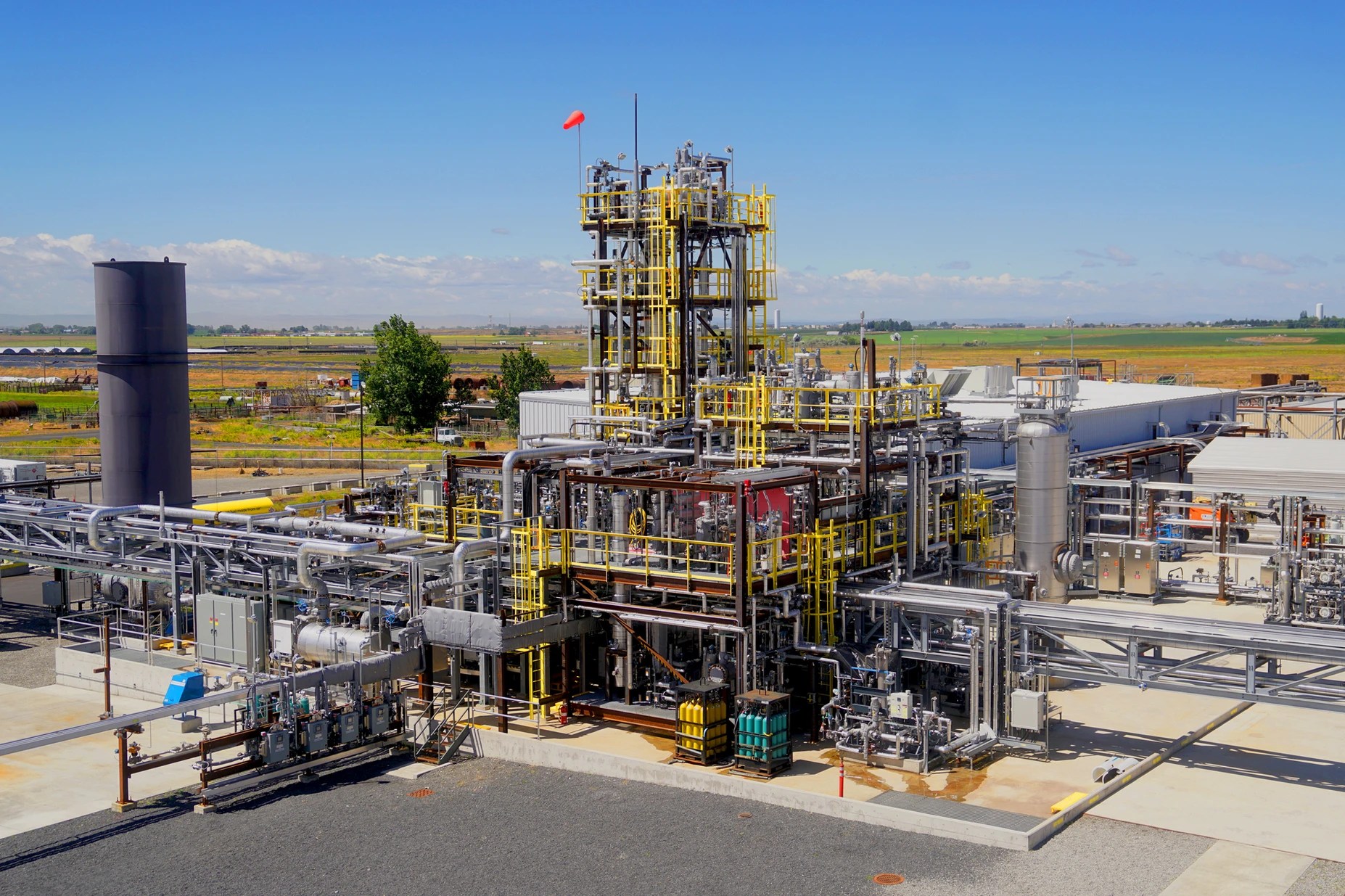
Employees of Microsoft and Shopify will soon be able to use a novel approach to lowering business-travel emissions thanks to the opening of a pioneering facility that uses renewable energy to transform carbon dioxide and water into low-carbon jet fuel.
The facility, in Moses Lake, Washington, is operated by Twelve, a startup that spent the past decade developing its approach to manufacturing sustainable aviation fuel (SAF). The fuel will be used by multiple carriers, including Alaska Airlines, which will sell the associated emissions credits to Microsoft and other partners.
First of a kind
Twelve’s plant, known as AirPlant One, will produce a relatively small amount of “eSAF”: 50,000 gallons annually, compared to the 1.1 million gallons Alaska’s planes burned in 2025. But the plant’s opening is a milestone nonetheless, argued Ryan Spies, managing director for sustainability at the airline. “It’s always so hard to get the first of anything built,” he said. “And in the fuel space probably 10 times harder.”
The technology inside AirPlant One uses renewable energy to transform CO2 and water into a synthetic crude oil that can then be refined to produce eSAF and other products. Twelve claims that the lifecycle emissions associated with its eSAF are up to 90 percent lower than conventional fossil-based jet fuel. It’s also considerably more expensive: Nicholas Flanders, Twelve’s CEO and co-founder, declined to share the cost, but industry estimates peg eSAF as five to 10 times more expensive than conventional fuel.
Cost curve
The premium is covered, at least at present, by companies that want to support the growth of eSAF and reduce business travel emissions. Under the agreement with Alaska and Twelve, Microsoft and other buyers will receive credits that can be netted against Scope 3 emissions. Spies did not specify a price for eSAF credits, but noted that credits on the broader SAF market, which includes fuel made from used cooking oil and other waste biomass, costs between $100 and $300 per ton of carbon dioxide equivalent.
The eSAF industry will also soon have regulatory support. Under the European Union’s RefuelEU aviation program, airports in the bloc were required to use 2 percent SAF in 2025, rising to 70 percent in 2050. A separate sub-mandate for eSAF will begin at 1.2 percent in 2030 and reach 35 percent by 2050.
Scale will be critical if eSAF producers are to cut costs and become competitive with other forms of SAF. Flanders said that Twelve, which closed a $645 million funding round in 2024 and has a contract to supply five European airlines with 260 million gallons of eSAF, is planning an AirPlant Two facility that will produce tens of millions of gallons annually.


