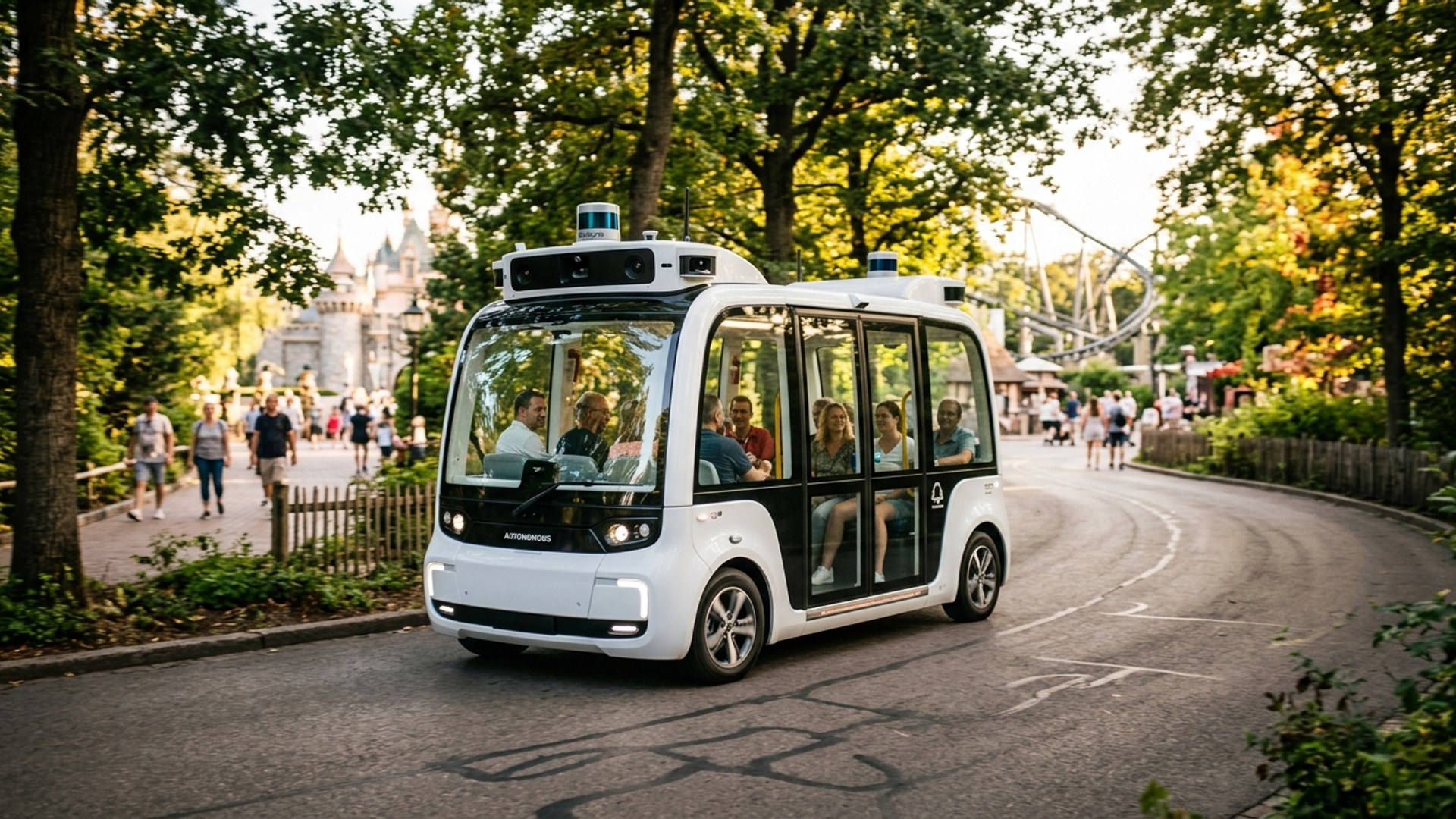
Turkish bus manufacturer Karsan has started carrying passengers aboard its Autonomous e-ATAK at Efteling, the Netherlands’ flagship theme park, in what the company describes as the first autonomous bus operation on public roads in the province of North Brabant. Passenger service began on August 12, 2026, two days after an official launch ceremony at the park, the company announced.
The deployment puts a full-size SAE Level-4 bus into mixed traffic on a route of roughly 6 kilometers, running between the Efteling Hoofdingang and Wonderhotel stops. The shuttle links the park’s main public transport hub with hotels and visitor amenities in the surrounding area, is free to ride, and is designed to accommodate passengers with disabilities.
This is Karsan’s second autonomous deployment on Dutch public roads, and the details of the first one matter for reading the second.
How the Efteling Shuttle Fits the E-ATAK’s Operating Envelope
The service runs on ADASTEC’s automated driving software, the same stack behind Karsan’s deployment at Rotterdam The Hague Airport, which ADASTEC’s deployment record dates to July 2025 as the Netherlands’ first SAE Level-4 automated bus service on open public roads. That operation runs two e-ATAKs between Meijersplein metro station and the airport terminal under a commercial operation permit from RDW, the Dutch vehicle authority, carrying paying passengers within the airport’s extended access zone.
Efteling extends that envelope rather than repeating it. The route mixes public road and private areas shared with cyclists, pedestrians, and hotel traffic, according to ADASTEC CEO Dr. Ali Peker, who called it the first automated bus operation on public roads in North Brabant. Ahmed Hashish, managing director of project partner Dutch Automated Mobility, said the service holds RDW approval to test on public roads, pointing to the Rotterdam operation as the demonstrated safety case.
That distinction is worth keeping in view. Rotterdam runs under a commercial permit; Efteling, per the partners’ own description, operates under a public-road testing approval, with passenger experience, operational performance, and field data collected over a pilot planned to run approximately two months. The findings are expected to feed future autonomous public transport projects in the Netherlands and elsewhere in Europe.
Level 4 here means the vehicle handles all driving within its defined route, with no driver input required inside that operational design domain. It does not mean unrestricted autonomy: the domain is a fixed 6-kilometer shuttle corridor between the Efteling Hoofdingang and Wonderhotel stops, mixing public road and private areas shared with cyclists, pedestrians, and hotel traffic. The broader driverless push is accelerating elsewhere too — Pony.ai and Uber are expanding toward 2,000-plus robotaxis across Europe — while Karsan is adding fixed-route shuttle deployments like Efteling to the e-ATAK’s operating record.
The Partners and the Numbers Behind the Pilot
The project is implemented through a public-private consortium: Karsan, transport operator Arriva, the Province of North Brabant, the Municipality of Loon op Zand, SmartwayZ.NL, Dutch Automated Mobility, Applied Autonomy, and ADASTEC. Representatives of Efteling, RDW, and the regional authorities attended the August 10, 2026 launch ceremony at the park.
Key figures from the announcement:
- Route length: approximately 6 kilometers, between Efteling Hoofdingang and Wonderhotel
- Pilot duration: approximately two months
- Fare: free of charge
- Autonomy level: SAE Level-4, in mixed traffic
- e-ATAK track record to date: more than 100,000 passengers carried across 12 countries, per Karsan
- First U.S. operation: 2021; first full-size autonomous bus in mixed traffic on European public roads: 2022, per the company
“We are extremely proud that Karsan Autonomous e-ATAK has become the first autonomous bus to operate on public roads in the North Brabant region of the Netherlands,” said Karsan CEO Utku Ayyarkın. “Following our operation at Rotterdam The Hague Airport, this second autonomous deployment in the Netherlands further strengthens our position in Europe with another important reference project.”
Efteling’s interest is operational as much as technological. Fons Jurgens, the park’s general director, framed the shuttle as an exploration of how overnight guests can reach the park more conveniently by public transport — a first-and-last-mile problem that a free, wheelchair-accessible shuttle between the transit hub and the hotels addresses directly, and one that mirrors the fleet-infrastructure economics driving robotaxi deployments elsewhere.
What the Two-Month Pilot Is Built to Produce
The pilot’s stated purpose is data: passenger experience, operational performance, and field data analyzed in detail over the roughly two-month run. What the partners do with it is defined in the announcement. The findings are expected to contribute to future autonomous public transport projects planned for the Netherlands and other parts of Europe.
For Karsan, the commercial logic is cumulative references. The company says the e-ATAK has logged operations from the United States to Europe since 2021, and each new permitted deployment (an airport corridor under a commercial permit, now a resort district under a testing approval) adds an operating environment to the record that transit authorities evaluate. As the industry scales, the teleoperation and remote-supervision staffing behind these services is becoming as much a part of the operating model as the vehicles themselves.
The immediate observable is the pilot itself: roughly two months of passenger service in mixed traffic at one of Europe’s most-visited theme parks, running under RDW supervision, with the consortium’s analysis to follow.


