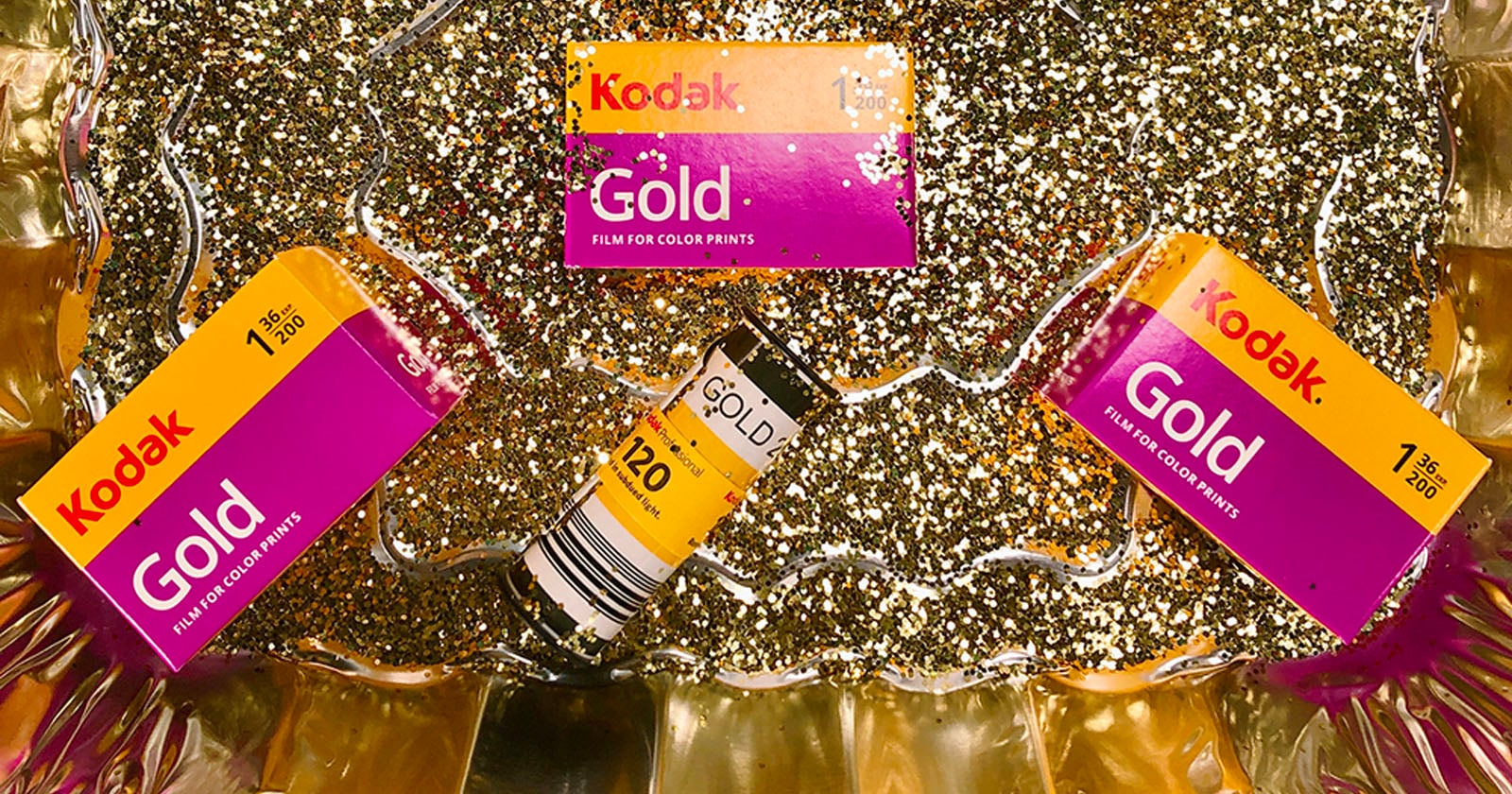
Welcome to another Film Friday spotlight! This time we’re turning our attention to a film that is simultaneously quite popular but still somehow underappreciated: Kodak Gold 200.
Kodak Gold is a “consumer” grade color negative film that performs much better than you might expect. Gold was introduced in 1988, has been around for over 30 years at this point, and is currently on its seventh generation, which was rolled out in 2007. Being a consumer film means a couple of things. The first is that the film aims for a much lower price point than Kodak’s professional films like Portra or Ektar. It also means that in order to be available to the consumer market, it needs to be found everywhere. These two characteristics boil down to give you Kodak Gold’s first two big selling points: it’s inexpensive, and it’s ubiquitous.



But inexpensive isn’t the same as cheap, if you get our meaning. Despite being a “consumer” film, Kodak Gold 200 is much better than you might expect it to be. Oftentimes when a customer asks us which black and white film is good, we respond by saying that they all are, there aren’t really any “bad” black and white films — just films with different qualities. To a large degree, you can make the same statement about modern color films.
The film market has been narrowed down so much, and companies have spent more time refining existing emulsions rather than creating new ones, that the color films you have on the market are all solid choices for one reason or another. Sure, Kodak Gold 200 may not be as fine-grained as Portra 160, but its grain isn’t that bad either. To give you more specific numbers on this, Kodak rates the graininess of their film using a measure called the Print Grain Index (PGI).


Essentially, they make a print using the film and gauge the perceptual amount of graininess at a distance of 14 inches (standard viewing distance for a 4×6 print). A PGI score of 25 is considered the lower visual limit of graininess, while higher numbers represent greater levels of perceived grain. Kodak Gold 200’s PGI score is 44 — well above the visual threshold.
Portra 160 has a PGI of 28 and Portra 400 has a score of 37. So Kodak Gold 200 is quite a bit grainier than Portra 160 and grainier even than Portra 400. For curiosity’s sake, we looked up the PGI for Portra 800. That film scores a 48. So Kodak Gold 200 is almost as visibly grainy as that highest-speed Kodak Portra film.
But don’t let this deter you.
Grain is not a bad thing by default. Some photographers appreciate the texture that grain gives an image, while some prefer the smoothest possible image they can. In Gold’s case, the increased graininess is one of the trade-offs you make for the decreased cost of the film.
Aside from its grain, the other important quality of Gold 200 is its colors. This film has bright colors and gives fairly true renditions of those colors. Its colors are also quite sharp and clear. Yet, Gold 200 still has a palette all its own.
For example, one of our staff took a trip to the Faroe Islands in the spring of 2023 and took a couple of rolls of Gold 200 with them in 120. During the spring, the landscape of the Faroe Islands is dominated by shades of brown and ochre. The images Gold 200 made of these landscapes were quite rich in color, and it handled those shades really well.



Blues seem to be another color this film likes, and in our experience it renders very clean and crisp blues. Reds and oranges have a nice level of pop to them too. Greens, on the other hand, feel a bit less vibrant and a bit more muted.
If you rewind the clock to about 2016, our favorite low-cost film around then was Agfa Vista. It was such a good “bang for the buck” film. We loved it, and our customers loved it. So when it was discontinued, we were crestfallen, and we had to start to look for a replacement.


We ordered some Kodak UltraMax and Gold 200 and started test shooting them. We were pleasantly surprised by both, and it was the lovely qualities that Gold 200 possesses that helped us get over our loss of Vista. These days, Kodak Gold 200 has deservedly earned a permanent spot on our shelves. In a world where film photography has slowly become more and more expensive, it is nice to have a high-performing, but low-cost, option to turn to.


It is worth mentioning that one of the reasons Vista was such a popular film in our lab was because it was an easy film to print. Printing color film is an art all in itself, and it is not as easy as you might think. Not all color films are made equal, and some print better or more consistently than others. Vista was amazing in this regard, and Kodak Gold has proven to be very similar. While you might think that only photo lab techs stand to appreciate this quality of Gold, we’d point out that a film that prints and scans consistently is a huge benefit to you as well. It means that you are likely to get better results regardless of the lab doing the printing or scanning, despite their proficiency or lack thereof. In fact, Kodak films in general tend to all have this quality. Kodak engineers have specifically put time into making their films consistent in regard to how they print and scan, and this attention to detail was not limited solely to their professional films.
So let’s sum this up a bit, shall we?
- The first reason we typically recommend Kodak Gold 200 is the price, hands down. It is a great “value” film.
- But value isn’t the only thing going for it. Gold has surprisingly great color, being both bright and natural.
- It is very versatile in terms of exposure. Kodak claims you can underexpose it by two stops or overexpose it by three stops. This film gives you a big target to hit.
- It’s available in 24 and 36 exposure rolls. This may not seem like a big deal, but sometimes you want a quick roll and don’t want to commit to 36 exposures. Or you shoot half-frame, in which case this is 48 pictures instead of 72 to complete.
- As of 2022, it is once again available in 120 format and brings all its perks to medium format cameras. This larger format also helps mitigate its graininess, giving it far more upside than down.
So don’t sleep on Kodak Gold. It is a sneaky good film that makes excellent images steeped in a classic color film look. And it does all this while saving the pain on your wallet. What more could you ask for? Other than for Kodak to release it in 4×5, perhaps?
Care to try a roll for yourself? Hit up our website or stop by our shop today and nab some today.
This story is brought to you by Blue Moon Camera and Machine in Portland, OR. Blue Moon offers film, development services, printing, and even an ever-rotating line of film cameras and lenses. PetaPixel Members receive 10% off all lab services with Blue Moon: Join today!
Image creditsAll photos are individually credited and provided courtesy of Blue Moon Camera and Machine.
Affiliate Disclosure PetaPixel articles may include affiliate links; we may earn a commission if you buy through one.


