
There’s a lot of excitement right now about agent frameworks,
orchestration patterns, and protocols. All of it matters, but almost none of
it delivers value if you skip the data layer. Before any agent framework can
produce useful outcomes, your data has to be in a shape that a machine can
consume, trust, and act on. In this article, we discuss what your
data needs to look like for agentic AI to derive value from it.
We’ve spent quite a bit of time building data architectures for the human
consumer. We’re about to hand those architectures to a very different kind
of consumer, and most of them aren’t ready for it.
The consumers of your data are changing
For over three decades, we’ve been building data systems for humans.
Dashboards, reports, analyst queries, all of it designed around a person
sitting in front of a screen. And it worked, because humans bring an
enormous amount of implicit context, along with the curiosity to track
down whatever they’re missing from the people around them.
A human analyst knows what “revenue” means in your particular
organization. They know which tables to query and which ones to avoid.
They notice when a number looks off, when a total is suspiciously round,
when a date falls on a public holiday, or when a price seems too low. That
instinct is doing a large amount of invisible context and knowledge
work.
A human hesitates at data that looks wrong; an agent acts on it
anyway
Agents have none of it. They can’t lean on the tribal knowledge and
pattern recognition people accumulate over years, so they need context
made explicit, access in real time, and quality they can rely on. And the
difference that matters most is this: when the data feels wrong, a human
double-checks; an agent confidently acts on it. That behavioral gap is
what the rest of this discussion is built around.
What “AI-ready” has to mean now
For a human consumer, the data only had to be good enough; the
analyst did the rest. The meaning, the sanity check, and the judgment
about whether a number could be trusted all lived in a person’s head.
When the same data is handed to an agent, every bit of that implicit
labor has to move into the data itself. That shows up as five
attributes, each the flip side of something a human used to do for
free.
- Trusted: a person pauses at a number that feels wrong; an agent
acts on it. The confidence a human used to supply has to be built in, so the
data must be accurate, fresh, and validated before the agent ever sees it. - Contextual: a person knows your “revenue” figure already has returns
taken out, and that your fiscal year starts in February; an agent has to be told
both. Meaning that used to live in someone’s head has to be made explicit in the
data. - Traceable: when a person decides, they can explain why afterward; when
an agent decides in 30 seconds, that reasoning is gone unless you capture it as
it happens. You have to be able to reconstruct what the agent did and why. - Governed: a person’s access is bounded by their role and their judgment;
an agent’s has to be bounded by design. Access must be scoped, controlled, and
auditable. - Operational: a person reads a dashboard and then goes and does
something; an agent has to be able to do the something. The data can’t just be
readable, it has to be actionable.
All five come down to the same idea. Each is a job humans used to do
without thinking, now pushed into the data itself. Miss one, and the
agent won’t degrade gracefully the way a person would. It fails
confidently.
None of these attributes builds itself. The rest of the article works
through four topics that do, roughly in the order you should tackle
them.
- Data Contracts and Quality makes data Trusted. We start here,
because a single wrong fact poisons every layer built on top of it. - Traceability and Governance records why an agent acted and bounds
what it can reach, making data Traceable and Governed. - The context layer encodes what your metrics and entities mean,
making data Contextual. - From Searchable to Actionable lets agents query live systems and
write back, making data Operational.
We’ll take them one topic at a time, and show what it takes to build
each attribute in. Work through all four, and the five attributes stop
being abstract goals. They become something you can engineer,
turning ordinary data into AI-ready data.
Data Contracts and Quality: Agents Can’t Smell Bad Data
Humans have a smell test for bad data. They notice when a number
looks off, when a date makes no sense, or when a price seems wrong.
Agents have no such instinct. As Simon Willison puts it, language models are gullible, they believe
whatever they are handed and act on it. Feed an AI agent a wrong
value, and it won’t pause to wonder, it will use the number and
produce a confident, wrong answer. Without trusted data, nothing else
in agentic AI works, so this is where we begin.
Agents treat every value as truth
Consider a concrete scenario. A pricing agent is asked for the
current price of Product X. Yesterday, the price was updated from
$49.99 to $59.99. But the agent’s data source hasn’t refreshed, it
still shows the old number.
The agent doesn’t hesitate, it retrieves $49.99, quotes the
customer, the customer buys, and the company loses $10 on every unit
sold. Every step the agent took was technically correct. It followed
its workflow perfectly. The data it accessed was the
problem.
The leaders most confident their data is AI-ready also name data
readiness their biggest barrier
A human sales rep would have paused: “Wait, didn’t we update this
last week?” They’d double-check. They have institutional memory and a
feel for when something’s off. The agent has neither. Errors don’t
trigger warnings; they cascade silently through the workflow. And
this isn’t a rare edge case. In the 2026 State
of Data Integrity and AI Readiness report, Precisely and Drexel
University’s LeBow College of Business surveyed 505 data and analytics
leaders, of whom 87% believed their data was ready for AI, yet 43% named
data readiness as the single biggest barrier to getting value from it. That
gap between confidence and readiness is the organization-level version
of the pricing agent, sure of itself and wrong. A separate KPMG Global AI Pulse survey of 2,145 leaders points the
same way, with nearly half of executives now seeing AI’s costs exceed its
benefits. Most enterprises are one stale field away from the scenario
above.
Schema is law: data contracts as code
So how do you prevent AI agents from accessing bad or stale
data? The answer is data contracts, treating schema as law,
not a polite suggestion.
This reverses a decade of “schemaless is flexible” thinking,
for human consumers, loose schemas are merely inconvenient, while
for AI agents, they’re dangerous. A data contract, written in the
Open Data Contract
Standard,
the format the Data Contract CLI
uses (and recommended in Thoughtworks tech radar
33),
defines the rules explicitly. A product_pricing contract might
specify:
- Properties with strict logical types.
- A quality rule that
pricemust be greater than zero. - A quality check on
currencythat rejects anything outside USD, EUR, or
GBP. - Critically, a freshness SLA, pricing data must have been refreshed
within the last 24 hours.
In the Open Data Contract Standard, that contract is shown
below.
apiVersion: v3.1.0
kind: DataContract
id: product-pricing
name: Product Pricing
version: 1.0.0
status: active
schema:
  - name: product_pricing
    physicalType: table
    properties:
      - name: product_id
        logicalType: string
        physicalType: varchar(64)
        required: true
        unique: true
        primaryKey: true
        primaryKeyPosition: 1
      - name: price
        logicalType: number
        physicalType: decimal
        required: true
        quality:
          - type: sql
            description: Every price must be greater than zero
            query: SELECT min({property}) FROM {object}
            mustBeGreaterThan: 0
      - name: currency
        logicalType: string
        physicalType: varchar(3)
        required: true
        quality:
          - type: sql
            description: Currency must be a supported ISO code
            query: SELECT count(*) FROM {object} WHERE {property} NOT IN ('USD', 'EUR', 'GBP')
            mustBe: 0
      - name: ingested_at
        logicalType: timestamp
        physicalType: timestamp
        required: true
slaProperties:
  # the rule that would have caught the stale-price scenario
  - property: latency
    value: 24
    unit: h
    element: product_pricing.ingested_at
Enforcement happens along three dimensions.
- Schema enforcement ensures types and constraints are respected and made
explicit by the contract. - Freshness SLAs define the maximum acceptable staleness per dataset,
nightly batch updates aren’t enough when an agent answers in real time.
Key the SLA to when the data was last successfully loaded, not when a value last
changed, so that steady data isn’t flagged as stale and a stalled pipeline can’t
masquerade as fresh. - Quality gates validate contracts in CI/CD, blocking deployments when
they fail.
Notice how this changes the earlier pricing scenario, it
prevents it by design. If the pricing data hasn’t been refreshed
in 24 hours, the contract is violated before the agent ever sees
the data.
The quarantine pattern
Defining a contract is one thing. What happens when data
violates it? You need a circuit breaker and that’s the
quarantine pattern.
The flow works like this. Raw data arrives from source
systems, APIs, databases, streams. Before it enters the agent
accessible data store, it passes through a contract validation
gate that checks three things, does it match the schema, is it
within the freshness SLA, and does it pass the quality
rules?
If it passes all three, it flows into the certified, agent
ready tier. If it fails any one of them, it’s quarantined,
routed to a dead letter queue for human review, with alerts
fired.
Bad data lands in a dead-letter queue, never in front of the
agent
The point is that the agent never sees the bad data. It
doesn’t get poisoned by stale prices or corrupted embeddings. In
the pricing scenario, if the ingested_at timestamp is older
than 24 hours the contract is violated and the record is
quarantined, so when asked about the price the agent says, “I
don’t have current pricing data” rather than confidently quoting
the wrong number. That is a far better failure mode. And it’s a job
for the data architecture, not the model. A better model won’t rescue
you from bad data.
Medallion architecture for agents
A medallion architecture is an analytical data design pattern for
organizing data in a lakehouse,
popularized by Databricks.
Bad data gets quarantined, but where does the good data go?
That’s what the medallion architecture organizes, and its first three
tiers are well established:
- Bronze: raw, immutable ingestion. You keep everything for audit trail
and lineage. - Silver: validated and deduplicated. Schema is applied, data contracts
are enforced, and this is where the quarantine pattern lives. - Gold: certified. This is what the semantic model compiles against,
access is governed, and metrics are trusted.
For agentic architectures, there’s a useful fourth tier worth
adding: Adaptive Gold where agents become active
participants in data curation rather than passive consumers (shown
in the figure below). They monitor their own query patterns,
identify frequently accessed combinations, and materialize optimized
datasets, effectively building their own warehouse views based on
real usage. The idea that agents can actively curate data, rather
than only read it, is already in production, at DataHub’s CONTEXT 2025 summit, Apple
described agents acting as “digital stewards” of its data catalog,
continuously scanning metadata, flagging gaps, and proposing
updates, turning passive documentation into an active governance
partner. Apple’s agents curate the catalog; Adaptive Gold points
that same active-curation pattern at the datasets themselves. That
last step is an extrapolation, but a modest one from something
already running.
Figure 1: Medallion tiers for agents:
data flows from raw Bronze through validated Silver to certified
Gold and agent curated Adaptive Gold, while agents are restricted to
Gold and above.
Bronze and Silver are for humans; agents see only Gold and
above
The key architectural principle is that agents should only
access Gold tier or above. Bronze and Silver exist for
lineage, debugging, and human investigation. Exposing raw or
partially validated data to agents invites the
pricing problem back in.
The same rules for unstructured data
Everything so far has looked like a table, prices, currencies,
timestamps, but most of what agents consume isn’t tabular. It’s
documents, wikis, PDFs, and support tickets, chunked and embedded
into a vector store for retrieval. If your agents do RAG, this is
the data they run on, and it needs the same trust guarantees, even
though you can’t write price > 0 on a paragraph. The patterns
carry over, only the quality dimensions change.
The stale-price scenario has a twin here. A policy document gets
updated, but the vector index isn’t re-embedded, so the agent
retrieves the old version and answers confidently from it, the same
failure as the stale price, only now it’s an embedding rather than a
row. The freshness SLA carries over, but be precise about what
the clock measures, the point isn’t when the content last changed,
it’s when the index was last successfully rebuilt against its
sources. A 24-hour SLA means the re-indexing job must have completed
within the last 24 hours, if it hasn’t, the index is stale and
quarantined even when nothing appears to have changed, because a
silently failed indexer is exactly when you can’t tell whether
something did. That one heartbeat catches both the updated but
unindexed document and the pipeline that quietly stopped.
Contracts move from the content to the surrounding metadata.
You can’t constrain the prose, but you can require that every chunk
carry a source, a version, a timestamp, and an access scope, and
reject anything that doesn’t. That metadata is also what makes
retrieval traceable and governable later.
Quality gates get checks suited to text, reject empty or
truncated chunks, catch near-duplicate documents that skew
retrieval, flag failed extractions and OCR garbage, and watch for
embedding drift. A malformed or empty embedding warps similarity
search, so it never reaches the store, for the same reason a bad
price never reaches the agent, a warped index makes the agent
retrieve confidently wrong content.
Whether the data is a priced row or an embedded paragraph, the
job is identical. The architecture has to smell what’s bad before
the agent does.
Confidence-threshold routing
Contracts, quarantine, and the medallion architecture handle the
clear cases. But there’s a gray area, data that isn’t clearly bad,
but isn’t fully trustworthy either. That’s where
confidence-threshold routing comes in, bridging full autonomy
and full human control.
The agent processes a request and assesses data quality signals,
and checks not just model confidence, but data-level signals
like freshness, completeness, and consistency. If confidence is at
or above the threshold (say 85%), the agent proceeds autonomously.
Below it, the agent defers to a human. The threshold is configurable
per use case, for example, pricing might demand 90%, while an
internal FAQ is fine at 70%.
Let’s return to the pricing scenario one last time. The price
data is three days stale; the freshness SLA says 24 hours. The SLA
violation automatically drives the confidence score below the
threshold, regardless of how confident the model itself feels about
its answer. The agent should respond by pulling a human in:
“I’m not confident this price is current. Routing to a human for
verification.”
Data quality signals should drive the
threshold, not just the model’s own confidence
In other words, data quality signals should drive the
threshold, not just the model’s own confidence. A model can be
sure of a stale answer, and the freshness SLA overrides that
misplaced certainty.
The hard part is turning those quality signals into a single
score and weighing it against the model’s own confidence. That’s an
open design problem, not a solved one. Start with a hard gate rather
than a smooth composite. Any contract or SLA breach forces a human,
regardless of how the other signals look. Add weighted scoring later,
and only once you can show it beats that simple rule.
Where to start
You don’t have to build all of this at once, and most teams
can’t. Contracts, quarantine gates, a medallion architecture, and
confidence-threshold routing are a lot to stand up in one go. The
good news is that they’re additive, each one lowers risk on its own,
and you can layer in the rest over time. Begin with the highest
leverage moves and expand from there.
- Define freshness SLAs for every dataset agents touch. The same
dataset can have different freshness requirements per consumer, such as a
pricing table that’s fine on nightly batches for a dashboard may need near real
time updates when a quoting agent depends on it. - Implement quarantine gates. Validate against contracts before data
enters agent accessible storage. Start with your highest risk datasets such as
pricing, inventory, customer records. - Start with the Data Contract CLI. Bring contract governance into
CI/CD, define contracts as YAML, validate automatically, block deployments on
failure. Treat data contracts with the same rigor you’d give an API
contract. - Add confidence threshold routing. When quality signals drop below a
threshold, defer to a human. Start high (around 90%) and adjust downward as you
build trust and track accuracy.
We’ve made data trustworthy. But when agents act autonomously on that data,
who’s watching?
Traceability and Governance: Auditing Autonomous Agents
Even with perfect data, autonomous action raises a harder question, when a
regulator asks why the agent did what it did, can you answer? Traditional
systems record what happened. Agentic ones have to explain why. That shift, from
what to why, is where governance gets hard.
The audit gap
Picture a bank running agentic AI for trade finance, where the governance
architecture is the real innovation.
An agent processes a letter of credit. It checks KYC data, verifies the
customer isn’t on a sanctions list, evaluates the credit terms, and approves a
$2.4 million transaction, all in about 30 seconds. Six months later, a regulator
asks a simple question, “Why was this approved?”
Traditional audit logs can tell you what happened,
but they can’t tell you why.
Traditional audit logs can tell you what happened, which tables were
queried, at what time, by which service account. What they can’t tell you is
why. Why did the agent check the sanctions list before the credit terms? Why
did it approve despite a minor documentation discrepancy? What alternatives did
it consider and reject? The gap between “what” and “why” is where regulatory
risk arises, and the EU AI
Act‘s Article
12 requires high-risk systems
to keep automatic logs for exactly this reason, so the “why” can be
reconstructed after the fact. Closing that gap is what agentic lineage
is for.
Agentic lineage
The way to close this audit gap is agentic lineage, an extension of
traditional data lineage. Where traditional lineage tracks which sources were
accessed, agentic lineage tracks why the agent decided to access X, because it
found Y in source Z.
Concretely, for the trade finance case, a single trace represents the
end-to-end workflow of processing letter of credit LC-4892. Within that trace,
each span is an individual step:
- Span 1: retrieved customer KYC data from the compliance database, result:
verified. - Span 2: checked the sanctions list via the OFAC API, result: clear.
- Span 3: evaluated credit terms against the policy engine, result: within
limits. - Final span: the decision, APPROVE, with a 94% confidence score and the full
reasoning chain attached.
This is exactly what a regulator needs. Not “the
agent accessed the compliance database at 14:32:07 UTC” but “the
agent checked KYC first, then sanctions, then credit terms, and
approved because all three passed.” The traces and spans
model is borrowed directly from distributed systems
observability, so engineers already understand the mental model from
tools like Jaeger and Zipkin. For the agentic equivalent, Langfuse, Arize
Phoenix, and OpenTelemetry
for AI are the emerging choices. All three feature on the
Thoughtworks Technology Radar, OpenTelemetry at Adopt, Langfuse at
Trial, and Arize Phoenix at Assess.
The regulatory teeth are real
This isn’t a theoretical exercise. The EU AI Act is the most
specific regulation on the books. Article 12 requires
high-risk AI systems to automatically log events over their lifetime
so their operation can be traced, and Article
19 requires
providers to keep those logs for at least six months. Breaching
these record-keeping obligations falls in the Act’s middle penalty
tier, up to €15 million or 3% of global annual turnover,
whichever is higher. For a large company, even 3% of global turnover
runs into the hundreds of millions.
Together, Articles 12 and 19 translate into three obligations for your
architecture:
- Automatically log events across the system’s lifetime, enough to trace
how it operated, not just isolated timestamps. - Retain those logs for at least six months, which means your
observability infrastructure has to handle long-term storage. - Be able to reconstruct the “why” after the fact. The law mandates the
logs; making them answer a regulator’s question is on you. That means
capturing the full reasoning chain, which sources were consulted, what logic was
applied, and which alternatives the agent weighed and rejected.
The EU is furthest ahead, and for now no other jurisdiction has a law quite
like it. But you don’t have to bet on where regulation lands to see the point.
Sooner or later something will force the question of why an agent did what it
did, whether that’s a regulator, an auditor, a customer disputing a decision, or
just your own team trying to debug one. The safe assumption isn’t that a
particular law is coming, it’s that you’ll want to answer that question
regardless. A system you can’t explain is one you can’t fully trust,
defend, or fix.
Staged autonomy
Knowing you need audit trails is one thing; rolling this out safely is
another. You don’t deploy an agent with full autonomy on day one, any more
than you’d hand a brand new employee unrestricted access. Autonomy is earned
in stages:
| Stage | Agent | Human | Monitoring |
|---|---|---|---|
| Shadow Mode | Recommends actions | Reviews recommendation and executes if appropriate | All recommendations are logged to track accuracy over time |
| Supervised | Prepares action and waits for approval | Reviews action and approves or denies | All proposed actions and human decisions are logged |
| Autonomous with guardrails | Agent acts within defined boundaries (best drawn by reversibility, not transaction size) |
Defines guardrails | All actions logged, alerts fired on exceptions |
| Full autonomy | Agent carries out all actions | Spot checks | Continuous, by other agents and humans |
You wouldn’t give a new hire the corporate credit card on day one. They start
with purchase requests, graduate to supervised spending, and eventually earn a
card with limits. Agents should earn trust the same way.
Promotion up this ladder should turn on evidence, not a hunch. That means
testing an agent before each step, not only watching it in production. Agents are
hard to test. They’re nondeterministic, costly to call, and act through tools with
real side effects. So teams mock or replay the tool and model interactions so tests
run deterministically in CI. They score the agent’s decisions with evals rather
than calling live services on every run. Building that harness is a discipline of
its own, and beyond the scope of this article.
Delegated access and just-in-time credentials
As agents earn autonomy, the question becomes, what permissions should they hold?
Three security patterns matter most here.
- Delegated Access: When Alice asks the agent to check her account, the
agent should act with Alice’s permissions, not through a broad service account
that can see every customer’s data. Shared service accounts destroy attribution.
When a regulator asks “who accessed this customer’s data?”, “the service
account” tells you almost nothing. With delegated access, the answer is “Alice’s
agent, acting on Alice’s behalf, with Alice’s permissions.” - Just-in-time Credentials: Instead of a persistent API key that never
expires, issue a short-lived token for each specific task. The agent needs to
check the sanctions list? Issue a token scoped to OFAC API read access for
that specific customer, valid for five minutes. When the task completes, the
token expires. No standing credentials sitting around waiting to be
compromised. - Least Privilege: The agent gets the minimum access the task requires.
Processing a letter of credit doesn’t need reach into HR systems or marketing
data.
Together, these three patterns address the attribution and scope challenges
that undermine many current agentic deployments.
They also defend against the sharpest security risk in agentic systems. Simon
Willison calls it the lethal
trifecta, an agent
turns dangerous the moment it holds all three of access to private data,
exposure to untrusted content, and a way to communicate externally. Put those
together and a single poisoned document or web page can hijack the agent through
prompt injection and quietly exfiltrate whatever it can reach. Delegated access,
just-in-time credentials, and least privilege shrink how much a hijacked agent
can reach, breaking the trifecta. Later we add a second cut at the same problem,
keeping retrieved text out of the authorisation path entirely, so that a poisoned
document cannot grant a permission in the first place.
Where to start
Of the four topics, this is the one where going slowly is the right
instinct. But separate two things that are easy to conflate. Autonomy is
earned in stages, so nobody expects you to grant it all at once.
Observability is not staged at all. It goes in from day one, at full
strength, whatever the autonomy level, because retrofitting it onto a
running system is painful. What you build on top can stay deliberately
conservative; the instrumentation underneath cannot.
- Instrument from day one. Of everything here, this is the one to do
first, adding observability after deployment is far harder. Every agent workflow
should emit traces with spans for each step, including reasoning and sources
consulted. The tracing pattern here is well established, so lean on a proven
tool (like
OpenTelemetry)
rather than building your own. - Start in shadow mode. Lowest risk, highest learning. Agents
recommend, humans decide. You build the audit trail before you need it for
compliance and measure accuracy before granting autonomy. - Implement delegated access. Agents inherit the invoking user’s
permissions and use just-in-time credentials with short expiry windows. No
persistent tokens. - Build to be explainable. Whether or not a regulator ever asks, an
audit trail that answers “why” is what lets you debug a bad decision, defend a
good one, and trust the system enough to widen its autonomy. Wire it in now,
it’s far harder to add later.
Semantic layers bridge the institutional knowledge gap between agents and
human analysts, building on trusted data and auditable actions provided by the
earlier topics.
The Context Layer: Teaching Agents What Your Data Means
Semantic layers provide the explicit context AI agents need when they become
the primary consumers of data, context that human analysts carry implicitly,
based on years of experience.
Your agent doesn’t know what “revenue” means
Ask an agent, “What was Q3 revenue for Product X?” A human analyst knows
precisely what to do, which table to query, whether revenue means gross or net,
what Q3 maps to in your fiscal calendar. They absorbed all of it over years of
institutional knowledge, tribal docs, and Slack threads.
The agent has none of it. It doesn’t know which joins connect products to
orders to revenue, or that your fiscal calendar starts in February. With that
context missing, it either hallucinates an answer or gives up. The semantic
layer fills that gap, supplying the business-domain context.
What the context layer is
A semantic layer is a set of declarative definitions of your metrics, how
revenue is calculated, what an active customer is, what the numbers mean. Every
consumer goes through the same definitions, so they all derive consistent,
accurate results. But an agent that acts needs more than definitions of numbers.
It needs to know what the things are, and what it may do to them. Those are
three separate bodies of definition, and an agent needs all three.
The domain model says what exists. Entities, their relationships, and
the meaning rules of the business: an order belongs to a customer, an active
customer is one who purchased in the last ninety days. It gives the agent the
vocabulary to interpret a request and plan against it. It is consulted, never
executed; no query path to data runs through it.
The semantic model says how the numbers are computed. Metrics and
dimensions, one versioned formula each, compiled to the same SQL every time and
run against the analytical store. This is the semantic layer under a more exact
name, and the job is to put correctness in the compiler rather than in the
model’s guess.
The capability model says what the agent may do. A curated set of
operations against live systems, some that read (check payment status, retrieve
a troubleshooting guide) and some that write (issue a refund). Each carries
permissions and an owner, and the acting ones carry preconditions and a
reversibility class as well.
Nouns, numbers, and verbs. Together they are the context layer, and
what unites them is not that they are all about meaning, because the capability
model plainly is not. It is that each one is a place where a guarantee is
declared once, in version control, instead of being worked out afresh by the
model on every request. The definitions are the layer; the interface, MCP today,
is just the door.
A reader who works with dbt will object that its
semantic models already declare entities, so why
separate the domain model out. Because entities declared inside the metrics layer
are scoped to metrics, and the capability model has to be written in the same
vocabulary as the semantic one or the two drift apart. A refund acts on the same
customer the revenue figure counts. One vocabulary underneath, or you get two.

Figure 2: The context layer: a domain model of entities and
relationships, a semantic model of metrics compiled to SQL against the analytical
store, and a capability model of guarded reads and actions against live systems,
with provenance signals across all three. The domain model has no arrow out
because it is consulted rather than executed; the other two are written in its
vocabulary. Dashboards and analysts reach the semantic model; agents are the first
consumer to need all three, which is the shift this article is about.
All three models are code in source control. They go through code reviews, get
tested in CI, and progress through environments before reaching production. When
the definition of “revenue” or the rule on refunds changes, you change it in one
place and it propagates everywhere. Agents never reach the underlying data
directly; they go through the context layer, which constrains and governs both
what they can ask for and what they can do.
Metrics as code
In practice, the business logic lives right in the definition, revenue =, not buried in a BI tool or an ad hoc SQL view.
order_amount - discount_amount
The agent receives a natural language question, and the semantic model resolves
it to correct, constrained SQL. The agent doesn’t guess table names or join
paths; it uses the definition.
The examples here use dbt
MetricFlow syntax (dbt is
mid-migration from measures to a metrics-first spec; the widely-used form is
shown here, and the concept holds either way). Cube.js, Snowflake, and
Databricks all follow similar patterns. The tool matters less than the
discipline of getting business logic into version controlled code.
semantic_models:
  - name: orders
    model: ref('orders')
    defaults:
      agg_time_dimension: order_date
    entities:
      - name: order_id
        type: primary
      - name: customer_id
        type: foreign
    dimensions:
      - name: order_date
        type: time
        type_params:
          time_granularity: day
    measures:
      - name: revenue
        agg: sum
        expr: order_amount - discount_amount
        create_metric: true
Same question, very different SQL
Let’s consider an example. Ask “What was Q3 revenue for Product X?” of an agent
without a semantic model, and it guesses at table names, uses the wrong
column, has no fiscal-calendar mapping, and misses the join.
-- Before metric definition
SELECT SUM(amount)
  FROM sales_data
 WHERE product = 'Product X'
   AND quarter = 'Q3'
Ask the same question with a semantic model, and the agent is constrained
to the correct table, the net-revenue formula from the YAML definition, the
right fiscal-calendar dates, and the valid join path.
-- Constrained by metric definition
SELECT SUM(order_amount - discount_amount)
  FROM orders o
  JOIN products p
    ON o.product_id = p.id
 WHERE p.name = 'Product X'
   AND o.order_date
       BETWEEN '2025-07-01'
           AND '2025-09-30'
The semantic model doesn’t make the agent smarter. It stops it from
guessing. For an agent that acts on the answer unchecked, that’s what
matters.
How agents use it
Take the semantic model on its own, the path a quantitative question travels.
End to end, the flow looks like this. The agent sends a natural-language
question (step 1). The semantic model looks up metric definitions, valid
dimensions, join paths, and access rules, via MCP (step 2), then generates
constrained SQL (step 3), both inside the same component. The data warehouse
executes the query (step 4). The result flows back to the agent with full
lineage metadata (step 5).
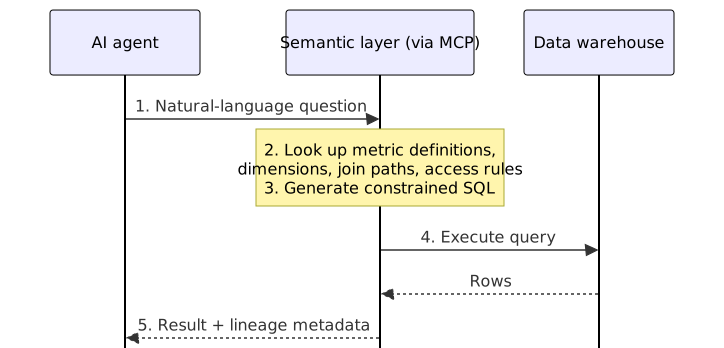
Figure 3: One of the three paths: a quantitative question
answered through the semantic model. Questions about what things are go to the
domain model, and reads or actions against live systems go through the capability
model.
Agents pick from governed metrics, never raw tables they can
misread
The semantic model constrains what the agent can ask for. dbt’s, for
instance, dynamically surfaces only the dimensions applicable to the selected
metrics, which prevents the agent from generating plausible sounding but
incorrect queries. And that lineage metadata in step 5 is the foundation for the
traceability we covered earlier. Context and traceability reinforce one
another.
Where to start
The temptation with a context layer is to model the whole business before
you ship anything. Resist it. Start with the semantic model, because the value is
concentrated in a handful of metrics, the contested ones that mean different
things to different teams. Let your first agent use case set the scope, and grow
the domain model and the capabilities it actually needs rather than the ones you
can imagine. A narrow, correct context layer beats a sprawling, half-agreed
one.
- 1. Find your conflicting metric definitions. Most organizations have
several definitions for their most important metrics, revenue being the classic,
with its gross vs net, with or without returns variations. Those conflicts are
your biggest agent risk and your quickest win. - 2. Pick a tool, but focus on the discipline. Any mainstream semantic
layer tool will do; what matters is the discipline behind it, metric definitions
in version control, one agreed definition per metric, and agents querying
through the layer, not the raw schema. - 3. Route agents through the context layer, never the raw schema. The
agent should see governed metrics and dimensions, not raw tables and joins. MCP
is the common way to expose the layer today, and dbt, Cube, and AtScale all ship
MCP servers, but the principle holds however you connect, the point is the
abstraction, not the protocol. - 4. Test adversarially. The best way to find gaps is adversarial testing,
every hallucination points to a missing definition. Fix the definition, not the
prompt. And don’t boil the ocean, start with the metrics your first agent use
case needs.
Traversing the domain model: knowledge graphs
The semantic model shines for structured metric queries such as “what was
revenue by region.” But some agent tasks demand richer relationship reasoning
across entities, events, and time. Consider a customer who bought Product X, then
churned after a pricing change. A fixed number of hops like that is an ordinary
join. What flat tables handle badly is traversal whose depth you don’t know when
you write the query, following a chain of relationships until you find what you
are looking for. That is the domain model’s territory, the entities and how they
connect.
The common way to store and traverse that map is a knowledge graph, which is a
storage choice for the domain model rather than a fourth thing to build.
GraphRAG from Microsoft uses community detection to
handle abstract queries that traditional RAG can’t, and
Graphiti builds temporally aware knowledge graphs
for evolving facts. (Both sat at Trial on the Thoughtworks Radar as of
2026.) The semantic model still defines the metrics; the graph carries the
connections between customers, products, events, and decisions over time.
Together they give agents something close to institutional memory, the kind of
knowledge that would take a new hire months to absorb.
Now agents have trusted data, governance, and context. But can they
actually act?
From Searchable to Actionable: Agent-Ready Data Access
Once agents understand your data and governance is in place, the question
shifts to access. How do agents reach the data and act on it? The
answer is more than “RAG”. It’s a full spectrum, from retrieval, to real-time
queries, to controlled write-back actions. That whole spectrum is the
capability model, the third of the three, and the write-back end is where its
guardrails earn their keep.
Your agent can read, but it can’t act
Let’s take an example. An employee reports a PO (purchase order) issue. An
ideal agent would do three things, retrieve the relevant troubleshooting guide,
check whether the PO payment service is down right now, and create a
help desk ticket if needed.
Traditional RAG, the pattern most organizations have deployed, only does step
one. It searches documents and retrieves content. It can’t query a live
monitoring system to check service status, and it certainly can’t create a
ticket in ServiceNow or Jira. That gap between searchable and actionable is
the subject of this final topic, and we will use the PO scenario to
elaborate.
The data access spectrum
This framing comes from Microsoft’s Cloud
Adoption Framework for AI, which formalizes it as RAG + MCP-Read +
MCP-Write.
- Retrieval. RAG, vector search, document lookup. The agent finds
relevant content. Most organizations live here today. - Real-Time Query. The agent queries live systems,
checks service status, reads from databases in real time. - Write-Back. The most powerful and most dangerous tier. The agent
creates tickets, updates records, triggers workflows.
Each step up the spectrum adds capability, and risk. The PO scenario maps
cleanly across all three.
- Retrieve the guide (Retrieval)
- Check payment status (Real-Time Query)
- Create the ticket (Write-Back)
The shift to agentic AI requires all three, not just the retrieval
most teams have built.
MCP has quickly become the default way to wire these tiers up, and its rise
has been remarkably fast. But the mechanism matters less than the demarcation.
What counts is keeping retrieval, real-time reads, and write-back as separate,
deliberately governed levels of access, whether you expose them through MCP or
your own native APIs.
Three primitives, one protocol
Agents reach all of this through MCP, the Model Context Protocol. Its
primitives sit on a risk gradient, Resources (read-only) are safe, Prompts shape
behavior, and Tools change state. That gradient maps straight onto the tiers,
Resources to retrieval and Tools to write-back, which is why the safe path is to
expose Resources first and graduate to Tools only under governance. In the PO
scenario, Resources serve the troubleshooting docs, a Prompt guides triage, and
Tools run check_service_status() and create_support_ticket().
Antipattern: naive API-to-MCP conversion
How you design those Tools matters as much as when you reach for them. The
common, costly mistake is to take existing REST APIs and wrap them one-to-one,
so every endpoint becomes a tool. The result is tool sprawl, 50 tools with
names like get_po_payment_status, create_ticket_po_payment,
create_ticket_po_payment_network. The agent then has to choose among 50
barely-distinguished tools with little context, and LLMs are bad at that;
accuracy drops sharply as the tool count climbs. The Thoughtworks Tech Radar put
“naive API-to-MCP
conversion”
on HOLD for exactly this reason.
The better approach exposes the same functionality as a handful of
well-designed capabilities with rich descriptions and parameterized inputs.
check_service_status takes a service name and location, one tool for all
services and all locations. create_support_ticket is parameterized with
category, priority, and description. The descriptions are detailed enough for
the LLM to know when to reach for each one.
Five to ten well
described business capabilities will outperform 50 thin API wrappers almost
every time
The principle is to design capabilities, not endpoints. Five to ten well
described business capabilities will outperform 50 thin API wrappers almost
every time. And this principle is protocol-agnostic, whether an agent reaches
your data through MCP, through another agent, or through whatever standard comes
next, the properties that make it agent-ready are the same, rich descriptions,
parameterized access, clear schemas.
What a capability declares
A rich description tells the agent when to reach for a capability. It says
nothing about whether the agent is allowed to, or what happens if it is wrong.
That is the rest of the declaration. Every capability carries
permissions, who may invoke it and acting as whom, and an owner,
the person accountable when it misbehaves. The ones that act carry two more.
Preconditions are the conditions that must hold before the action may
proceed, checked against live state at the moment of acting rather than against
whatever the agent read earlier in its plan. A refund needs an original payment,
not yet refunded, within the amount the invoking user may authorise.
Reversibility is the class of damage the action can do: cleanly
reversible, reversible at a cost through some compensating transaction, or
irreversible. This is the more useful predictor of safe autonomy than the money
involved. A $50,000 internal ledger correction you can back out is a safer thing
to automate than a $200 payment to an external account you cannot claw back. Where
the staged autonomy ladder earlier keys its guardrails to transaction size, prefer
keying them to reversibility, and let irreversible actions require human approval
whatever stage the agent has reached.
Reversibility predicts safe autonomy better than the size of the
transaction
Which raises the question of where the rules in those preconditions come from,
because most of them are written down in prose somewhere, in a refund policy, a
contract, a compliance manual.
Retrieved text informs, it never gates
Business documents remain where the business writes its rules down. But a rule
that gates an action must not be read and interpreted at the moment of acting.
Rules are extracted from those documents ahead of time, curated by a human, and
stored as declared preconditions in the capability model, each with a link back
to the passage it came from.
At action time the agent may still read unstructured content, a complaint
ticket, a contract clause, to work out what to propose. Only the declared rules
decide what is permitted, and they are checked deterministically against live
state. The boundary is between informing and gating. Retrieved text
can shape what the agent suggests and serve as evidence for a human approver, but
it never carries the authority to authorise the action itself.
That boundary is also a security property. Removing retrieved text from the
authorisation path means a poisoned document cannot grant an agent a permission
it did not already have, which is a stronger claim than merely shrinking what a
hijacked agent can reach. It is not a complete defence, because injected text can
still influence what the agent proposes, and a human approver shown fabricated
evidence may wave it through. What it removes is the path where the document
authorises the action directly, with nobody in between.
The provenance link is what keeps the declarations honest as the documents
move underneath them. Be careful what you promise here. Detecting that a document
changed is easy; knowing that the change invalidated a precondition derived from
it is a judgement, not a diff. What the link buys you is a review queue, the
derived rules flagged for a human to re-check when their source moves, in the
same spirit as keying a freshness SLA to when the index was last rebuilt rather
than to when the content last appeared to change.
Where no declaration covers the situation, the agent does not improvise from
its own reading of policy. It escalates. This is the hard gate from earlier in a
different setting, the same instinct that says any contract or SLA breach forces
a human rather than a lower score. An undeclared case degrades the agent to
supervised, not to autonomous.
Extraction and curation is a pipeline like any other, and it needs an owner,
a cadence, and somebody who clears the review queue. Which is the subject of a
later section, because none of this maintains itself.
End to end: the PO payment scenario
With all three tiers in place, the PO issue we opened the section with runs
end to end, the agent retrieves the troubleshooting guide (a read-only
Resource), checks the live payment status (a Tool that reads), and files a
ticket (a Tool that writes), all in a single workflow.
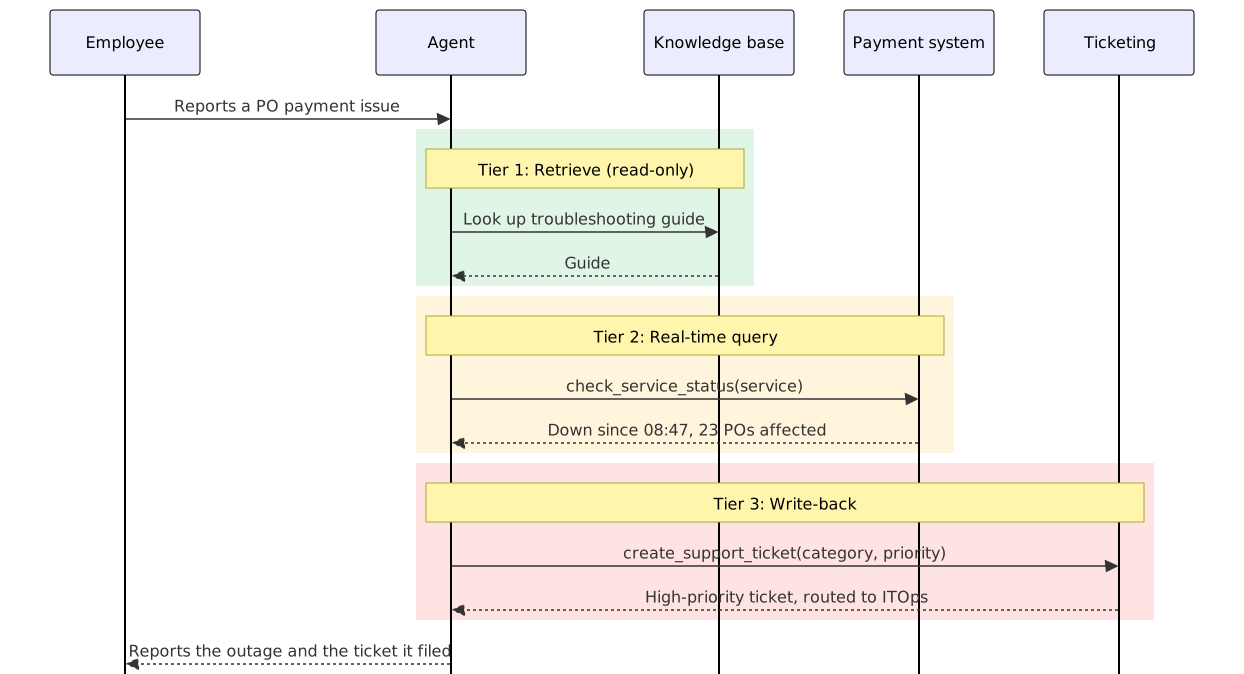
Figure 4:
One agent, three tiers: retrieval, real-time query, then write-back,
combined into a single response.
Done manually, the employee would wait in a queue, explain the issue, have a
support agent check the monitoring dashboard, and get a ticket created. The
agent is now able to do all this in one pass.
Where to start
The safe way in is to climb the tiers, not leap to write-back. Most teams
already live in retrieval, the read-only tier where risk is lowest. Write-back
is where the real danger sits. So earn your way up. Map what each use case
needs, expose read-only access first, and add write-back last, only
once you can log every action. Don’t let the thrill of an agent that can act
rush you past the steps that make acting safe.
- 1. Map your data access tiers. Take your top three agent use cases and
classify what each needs, retrieval, real-time query, or
write-back. Most gaps live in real-time query and write-back. - 2. Design capabilities, not endpoints. Group existing APIs into 5–10
well-described business capabilities. Rich descriptions matter, they’re what the
LLM uses to decide which tool to call. - 3. Start with MCP Resources. Read-only access is the lowest risk entry
point. Expose knowledge bases, config data, and documentation as Resources.
Graduate to Tools only once governance is in place. - 4. Instrument from day one. Before deploying any agent with write
access, log every tool invocation, who triggered it, what was called, when, and
critically, on whose behalf. This feeds the audit trail from the Traceability
and Governance section.
The AI-ready data stack
We’ve now walked through all four topics, contracts that make data trusted,
a context layer that makes it meaningful and actionable, access patterns that let agents act
on it, and observability that makes those actions auditable. Treated separately,
they look like four work streams you could staff independently. But they aren’t
independent. They build on one another, and the order in which they’re built
matters.

Figure 5: The AI-ready data stack: three dependent
layers built bottom-up, with observability cutting across all of them
from day one.
The dependencies run bottom-up. You can’t attach meaning to data you can’t
trust, so context sits on the foundation. You can’t safely let agents act
without that meaning to constrain them, so access sits on context. Skip either
of those and everything above it collapses. That’s exactly why so many agentic
AI programs stall. They jump straight to agent access without building the
foundation underneath. Observability is different. Rather than a fourth tier
stacked on top, it runs alongside all three. Every layer has to be traceable and
auditable from the moment it handles real work. The trust checks, the semantic queries, the agent’s
actions, all of it has to be explainable in production, not whenever you get
around to instrumenting it. It is also much harder to retrofit onto a running
system than to build in from the start. Either way, you wire it in from day
one.
Who owns all this?
The stack has one more dependency the diagram can’t draw. Every layer in it
produces an artifact that has to be kept true, a data contract, a metric
definition, an access scope, an observability trace. Artifacts don’t maintain
themselves. A contract with no owner drifts out of sync with the source it
describes. A definition of “revenue” with no owner forks back into the three
conflicting versions you just consolidated. An access scope with no owner
quietly widens until it’s a standing service account again. The technology is
necessary, but it’s the operating model that keeps it honest.
The discipline that makes this work is treating data as a product. Each
dataset, contract, and metric has a named owner, a published contract and SLA,
and a versioned lifecycle, the same way an API does. You won’t always know every
consumer, and for public or broadly shared data you can’t, which is precisely
why the contract matters, it’s the stable promise unknown consumers build on,
and a deprecation policy is how you change it without breaking them. When the
product_pricing contract blocks a deployment at 2 a.m., someone is accountable
for it. When finance and sales disagree on “revenue,” someone owns the decision.
When a new agent asks for access, someone owns the scope and reviews it. These
aren’t infrastructure questions; they’re ownership questions, and no tool
answers them for you.
A human consumer of an unowned, drifting dataset notices and works around it.
An agent consumes it at machine speed and scale, and propagates the error just
as fast. The faster and more autonomous your consumers, the less you can afford
data without an owner.
Where do you stand?
Before deciding what to build, it helps to locate yourself. Score each
attribute against the signals below, all drawn from the topics above.
| Attribute | Human-era | In Transition | Agent-ready |
|---|---|---|---|
| Trusted | Loose schemas, no freshness SLAs; quality rests on an analyst noticing when a number looks off |
Contracts on a few critical datasets; quality checked but not enforced in CI/CD. |
Contracts enforced as code, freshness SLAs per consumer, quarantine before agent storage, agents read Gold only (tables and embeddings) |
| Contextual | Metric definitions live in BI tools, SQL, and people’s heads; humans supply the context |
Some metrics defined as code, but definitions still conflict and agents may still hit the raw schema |
A context layer in Git: entities and relationships in a domain model, one semantic definition per metric, and a curated set of capabilities; agents route through it, never the raw schema |
| Traceable | Logs show what a person queried and when; the why lives in the analyst’s head |
Traces on some agent workflows; reasoning captured inconsistently |
Every agent workflow emits traces with spans, reasoning, and sources; any decision’s “why” is reconstructable |
| Governed | People access data through their own roles; systems share broad service accounts |
Agents run on scoped but long-lived, coarse credentials | Delegated per-user access, just-in-time credentials, least privilege; lethal-trifecta paths closed |
| Operational | No agent acts on the data; people read dashboards and take actions by hand |
Agents retrieve via RAG; real-time reads emerging; write-back experimental or ungoverned |
All three tiers via well-designed capabilities; write-back gated by staged autonomy and instrumentation |
Don’t average the rows, because the stack is dependency ordered,
your readiness is capped by your weakest foundational layer, a
flawless context layer sitting on untrusted data is still not agent
ready. Find your weakest row, and that’s where the next investment
goes.
Four things to start on
Each topic came with its own starting points. Treat those as tactical
checklists for the work itself. The four below are where to start. The first,
instrumenting from day one, isn’t a build-order step. It runs alongside
everything else, which is why it comes first and never stops. The other
three build from the bottom of the stack up, because you’re only as ready as your
weakest foundational layer. The highest-leverage single move among them is the
context layer, since context moves accuracy further than a bigger model does,
but it only pays off once the data beneath it can be trusted. Build up to
it.
- Instrument from day one. This isn’t a step in the sequence so much as a
constant that runs under all of them. Put traces and spans in every workflow
from the start, because observability is far harder to retrofit than to build
in, and you’ll want audit trails that answer “why” for debugging today and
regulators tomorrow. - Contract everything. Freshness SLAs, strict schema enforcement,
quarantine for bad data. This is the floor the rest stands on, agents can’t
smell bad data, so the data architecture has to smell it for them. - Context over models. Once the data can be trusted, a context layer
is the highest-return thing you can build on top of it. Its semantic model
alone carries the point: in AtScale’s
text-to-SQL
benchmark,
accuracy jumped from under 20% on the raw schema to over 92.5% with a semantic
layer, on the same model. - Read before write. Start with MCP Resources (read-only) and graduate
to Tools (write) only with governance in place. Earn autonomy in stages, shadow
mode, then supervised, then autonomous with guardrails.
When agents become the primary consumers of your data, your data architecture
becomes your AI architecture.
We go much deeper on all of this, and on the broader operational and
analytical data architecture decisions around it, in our forthcoming O’Reilly
book, Data Architecture for Software
Architects.


