.png "Market Connectivity Spotlight: Marseille")
We’re gearing up for the Platform Global conference in Antibes on September 8-10, 2026—an event attended by senior leaders in digital infrastructure and data centers.
Much as this event is a converging point for network and data center experts, the wider Mediterranean region where our beautiful host city sits is a converging point for communications ecosystems. While cities throughout the Mediterranean from Barcelona to Genoa have seen growth in network investment, no city in this region compares with what Marseille has accomplished. So what are Marseille’s specific strengths as a connectivity hub? Thanks to our Market Connectivity Score—an interactive tool in our Data Center Research Service—we have granular data on the Marseille market.
Let’s take a look the Marseille market, its strengths, and how the data breaks down.
Where the data comes from: Market Connectivity Score
First: A quick note on how the Market Connectivity Score tool works. We created this tool to solve specific problems for our customers, helping to answer questions like:
- Where should we invest in cloud infrastructure or data center infrastructure?
- Where is there available power to do so?
- Where is the next big hub going to be?
The Market Connectivity Score tracks 45 different data points for 3,000 cities worldwide, including:
- Data center power,
- Number of ASNs peering locally,
- Cloud onramps, and more.
And those data points create scores in each category for cities on a scale of 0-100.
Marseille connectivity overview
Marseilles is among the world’s prime examples of a digital ecosystem, capitalizing on subsea convergence and geographic advantage. Marseille’s strengths as a connectivity hub can be attributed to a few factors:
- Marseille is among a dozen cities in the world with the highest concentration of subsea cable landings.
- The gravitational pull of subsea development continues for Marseille with at least five new cables planning to land, including Africa-1, SeaMeWe-6, India-Europe Xpress (IEX), and more.
- Marseille is one of just a few global markets with more than 100 Tbps of international internet capacity: a huge amount of internet capacity that connects directly across international borders to the city. By this metric, Marseille is the 6th largest global internet hubbing point behind the FLAPs and Singapore.
- International cities directly connected: closely related to the bw metric, MRS ranks 5th globally (directly behind the FLAPs and ahead of Singapore) for number of international cities directly connected via layer 3 links
Marseille’s connectivity market strengths wouldn’t have been possible without intentional digital infrastructure investment. Before Digital Realty and DE-CIX moved into the market, in 2013, Marseilles ranked around 30th among internet capacity hubs. Data center and peering infrastructure has allowed the tremendous traffic moving through Marseille to interconnect locally.
Let’s take a look at Marseille’s current Market Connectivity Score and its scores across the categories that make up the overall connectivity score.
Overall score: 41.0
Rank: 21
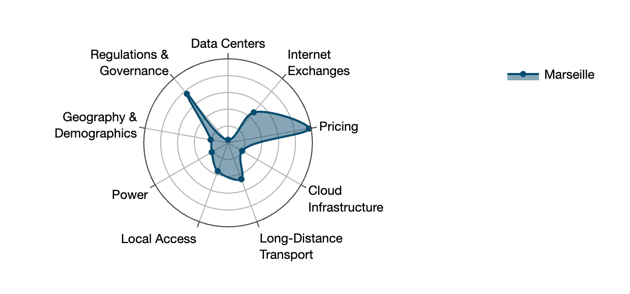
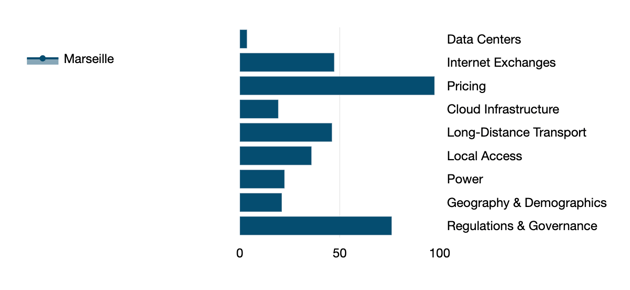
Score breakdown:
- Pricing: 97.5
- Regulations and governance: 76.0
- Internet exchanges: 47.3
- Long-distance transport: 46.2
- Local access: 35.9
- Power: 22.4
- Geography and demographics: 21.0
- Cloud infrastructure: 19.3
- Data centers: 3.6
Subscribers to TeleGeography’s Data Center Research Service can read category definitions, the sources of those definitions, and our data methodology when using the interactive Market Connectivity Score tool.
Ready to connect at Platform Global?
 Register for the Platform Global conference on September 8-10, 2026 to connect with leaders working in Europe’s digital infrastructure.
You can also prep for the event with Senior Research Manager Jon Hjembo’s presentation slides from the 2025 Platform Global conference.


.png&description=Market+Connectivity+Spotlight%3A+Marseille)