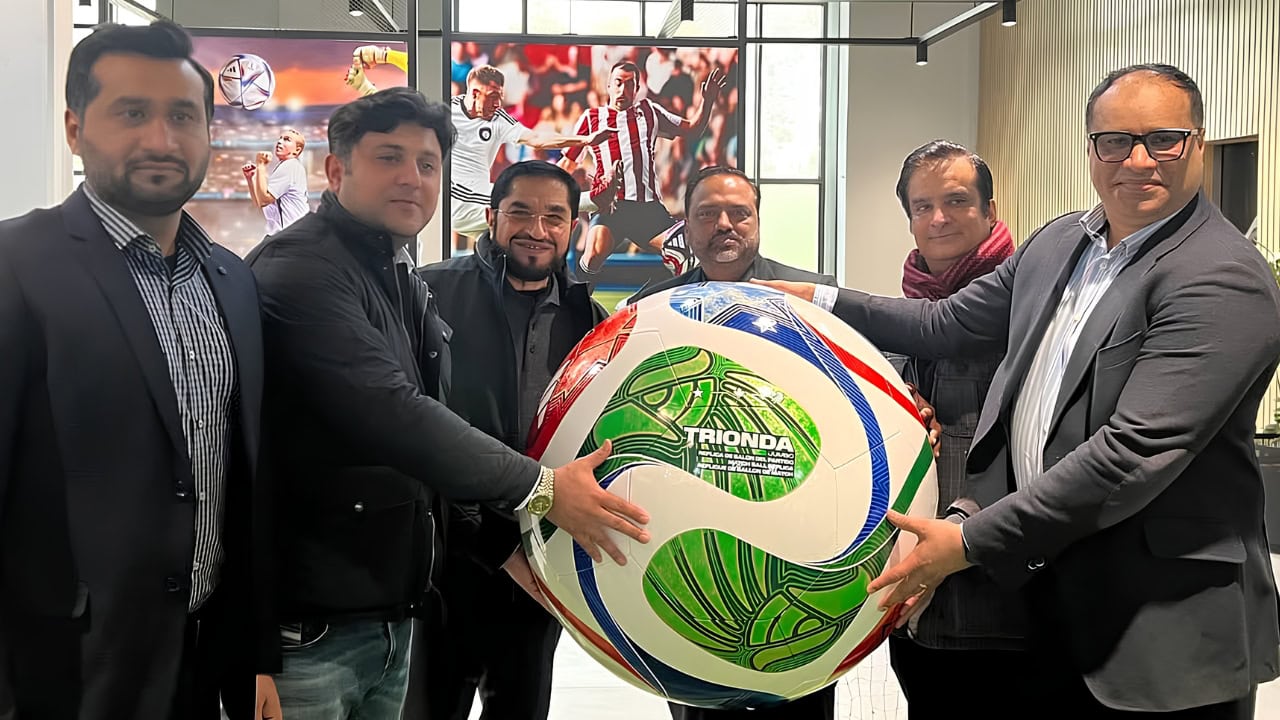
The 2026 FIFA World Cup is currently unfolding across the United States, Canada, and Mexico. Millions of fans are watching these thrilling matches. However, many people overlook one fascinating fact. Every single goal, penalty, and game-winning moment relies on a football manufactured in Sialkot, a city in northeastern Pakistan.
Forward Sports Private Limited, a Sialkot-based company, manufactures this official match ball. FIFA calls it the “Trionda”. Interestingly, a civil engineer named Khawaja Masood Akhtar stands behind this massive achievement. Akhtar previously worked for Pakistan Railways and never actually imagined he would enter the football manufacturing industry. Eventually, his uncle encouraged him to try the sports goods business. Consequently, Akhtar accepted the challenge and started as a production manager.
From a Single Room to the FIFA World Cup
Akhtar founded Forward Sports in 1991. Back then, the company operated out of a single room with just 20 employees. Initially, the early years proved difficult. The company produced roughly 1,000 balls a month and struggled against established players.
Everything changed in 1994. Adidas approached Forward Sports for a partnership, and the company never looked back. Today, thirty-five years later, Forward Sports produces approximately 20.5 million footballs annually. Furthermore, the company has manufactured the official match balls for four consecutive FIFA World Cups. They created the Brazuca for Brazil 2014, the Telstar 18 for Russia 2018, the Al Rihla for Qatar 2022, and now the Trionda for the 2026 tournament.
Globally, people refer to Sialkot as the “Football Factory of the World”. The city produces nearly 70% of all footballs used worldwide. Pakistan exports around 40 million footballs every year. As a result, roughly 300,000 balls leave Sialkot’s factories every single day. This local tradition actually spans over a century. It began as a local craft for repairing footballs and evolved into a massive export industry. In fact, Sialkot has produced official FIFA World Cup match balls since 1982.
Swiss photographer Stefan Bohrer recently documented this incredible scale. Bohrer noted:
Knowing that around 300,000 balls leave these factories every day makes you pause and wonder where they all end up.
Driven by Technology & Innovation
Forward Sports maintains its industry dominance through constant reinvention. The company successfully transitioned from traditional hand-stitched footballs to thermo-bonded technology in 2007. Later, they adopted machine-stitching and laminated football technology. Now, they produce the highly advanced, sensor-equipped Trionda.
Developing a World Cup ball remains a highly specialized process. The entire development cycle takes three to four years. Moreover, FIFA enforces strict testing standards. Engineers rigorously test the balls for seam precision, roundness, durability, and weather performance. They even fire the balls against walls hundreds of times to guarantee consistent impact.
Technology also transformed the company’s production speed. Forward Sports heavily invested in automation, laser-cutting systems, and advanced machinery. Consequently, they reduced delivery times from 90 days down to just 15 days. Akhtar personally visits the research and development department every morning. He credits this continuous investment in R&D as a major reason for their top-tier status.
The Workforce & A Beautiful Irony
Women represent a significant portion of the Forward Sports workforce. To encourage their participation, the company introduced specific workplace improvements, including transportation services and healthcare support. Akhtar directly credits these women for the company’s massive success. Despite the heavy use of automation, the factory still relies heavily on skilled human craftsmanship. Workers meticulously hand-stitch panels, apply logos, add colors, and inspect the finished products before global shipping.
Meanwhile, a beautiful irony surrounds this entire operation. Pakistan currently sits at 198th in the FIFA world rankings. The national team has never come close to qualifying for a World Cup. Yet, every four years, Pakistan manufactures the exact ball that defines the biggest tournament on earth.
Akhtar summarizes his incredible journey perfectly. He stated:
There is no secret formula behind success.
Anything is possible when there is will. Where there is a will, there is a way.


