
1
Agentic AI is moving from research to implementation, with growing industry consensus that future mobile networks must become AI-native. The question now is whether operators will embrace the architectural changes required to support that transition.
For the third year running, the AI Core for Agent Communication Network (ACN) Seminar at MWC26 Shanghai showed the potential of intelligent network agents to move beyond theory and toward practical implementation. AI is being incorporated into telco operations, but it is essential that the telco community does not fall behind the enterprise and hyperscaler sector.
If this is to be the case, agentic AI has architectural requirements for the 6G core, rather than as a software overlay on legacy network functions. Operators are generating gains from integrating AI into their assurance, planning, customer care, and operations. However, there could well be a two-tier system between telcos that use AI to optimize existing domains and those that redesign their core network around AI-native principles.
AI-native is a strategic requirement
Telcos and the 3rd Generation Partnership Project (3GPP) standards body are gearing up for 6G. The 6G core is expected to evolve from a comms-centric 5G ‘service-based architecture’ (SBA) toward a more cognitive and intent-driven architecture. The objective is not only efficiency and simplification, but also a ‘network for AI’ model where AI supervises and coordinates traffic management, service, and resource optimization.
Several telcos are already taking proactive steps to integrate AI, generative AI, and even agentic AI precursors into their operations. Over the past three years, NTT Docomo’s 6G core priorities have emphasized sustainability, efficiency, customer experience, ‘network for AI’, and ubiquitous connectivity. Orange has already been scaling AI in network environments, with 150 use cases rolled out in 2024 that reportedly generated €200 million in value, while its CogNet work with Nokia Bell Labs and IBM aims to move network management from reactive to proactive cognitive operations.
KPN Fieldlabs has also been exploring a holistic SBA plus AI ‘service management and orchestration’ (SMO) framework, including an AI core instance with both agent-based and service-based interfaces. These operators are demonstrating how AI can reshape not only network management, but even the core architecture itself.
How agentic AI fits into the 6G core
Agentic AI has the potential to be a powerful enabler for telcos, but the ROI could be muted if AI is an overlay or constrained to niche, end-user applications. Agentic AI agents must be able to interpret goals, find resources, establish trust, coordinate computing, and complete tasks across a range of domains: end users, applications, devices, and networks. Having attended the past three events, it is striking to see the level of maturity. 5G networks were built primarily for transmitting data, whereas agentic 6G scenarios are about executing and completing tasks.
This agentic AI vision is standards-based. The role, resources, and policy access for AI agents are already being discussed across multiple 3GPP SA2 6G architectural key issues, including ‘non-access stratum’ (NAS) – the core control-plane signaling layer between a device and the network core, location services, ‘AI for network’ (AI4NET), remote and near field sensing, and the data framework.
Agentic AI is not a niche feature; it is designed to handle the traffic and intents from multiple domains (see figure 1).
Figure 1 | 6G logical framework overview
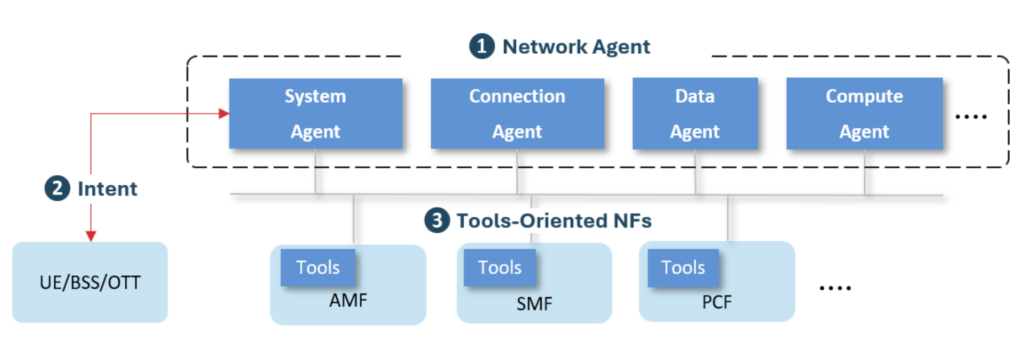
Intent interfaces
In conventional cellular packet core architecture, NAS signaling is highly structured and rule-based. Devices request predefined services, sessions, or mobility procedures. In the AI-native architecture, the NAS evolves toward ‘intent-based’ communication. A device or agent no longer only requests a rigid quality-of-service (QoS) profile; instead, it can signal the objective it is trying to achieve, allowing the 6G AI core to determine how best to fulfill the request.
This creates a more direct link between user objectives, service logic, and network behavior. Instead of reacting to traffic flows after the fact, the network can interpret intent and proactively coordinate connectivity, compute, security, and latency.
During the seminar, Turkcell highlighted its R&D in intent-based comms. One 6G scenario introduces dedicated new 6G core network functions to handle and fulfill intent-based requests, as well as investigating the impact of control-plane AI agents on NAS identifiers and signaling flows. Furthermore, Turkcell has centralized service operations center data that rely on its Teknocan LLM, unified dashboards across backbone, access, core, and ICT domains.
ACN is a flagship test case
At the seminar, China Mobile, Huawei, ZTE, CAICT, and Vivo highlighted the development work achieved, to date, on ACN. The ACN interfaces with identity, trust, routing, discovery, session management, capability exposure, compute collaboration, and low-latency communications. The ACN framework groups this into three areas: agent connection services, agent empowerment services, and agent collaboration services.
China Mobile’s briefing described how its research institute has been able to connect multiple agent types, including robotics, drones, AR glasses, and digital agents. Its Net4Agent work focused on trusted access, dynamic subnetworks, computing offload, and multi-agent coordination, while Agent4Net addressed agentic AI-for-network functions and AI agent protocol design.
The vision for ACN’s intent-based communication is further demonstrated by its internet-of-agents open network protocol (AONP) and its implementation during a pilot in Zhejiang in China. The pilot was able to handle functions such as registration, identifier allocation, authentication, authorization, and routing. There is potential to add AI agents to handle digital identity, agent discovery, task session management, task-level service-level agreements (SLAs), and AI-compute coordination.
Conclusion
Figure 2 | AI software investment and 6G core cap-ex outlook
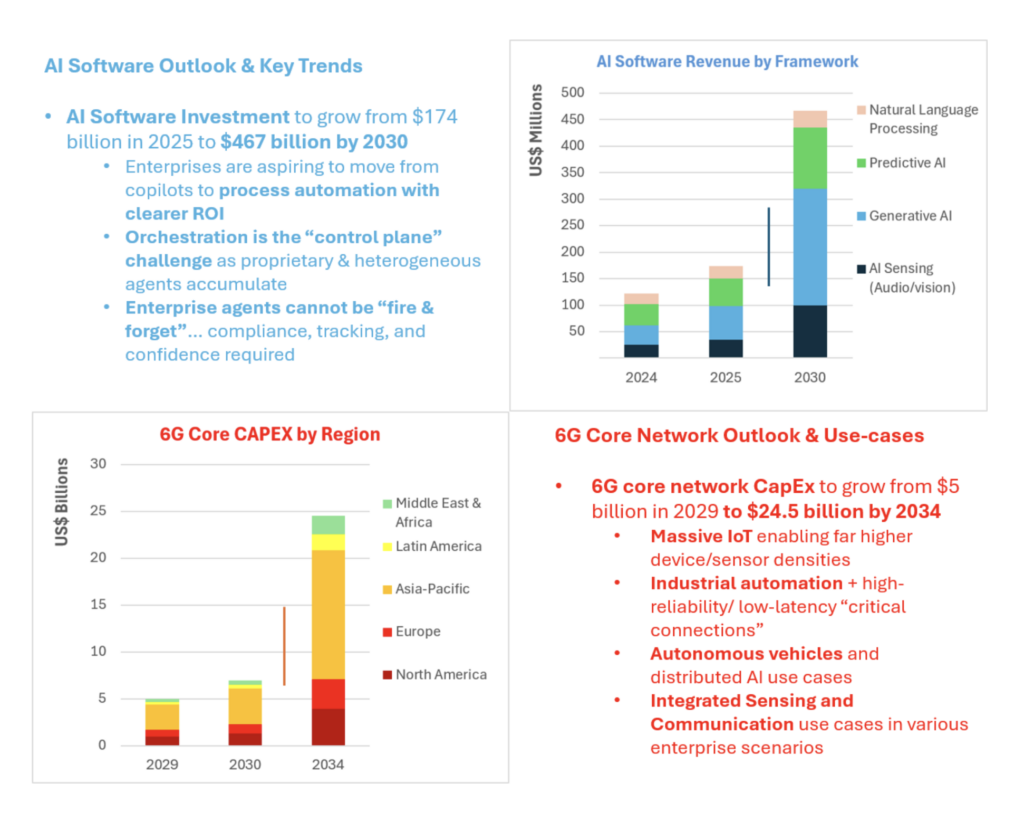
The rate of development in AI is moving at an exponential pace. ABI Research’s own research sees AI utilization in the wider economy as accelerating. The amount of investment in AI sensing (audio/vision), generative AI, predictive AI, and natural language processing (NLP) is expected to grow from$174 billion in 2025 to $467 billion by 2030.
There is significant risk that telcos could be left behind, managing the bit pipe but not securing client-facing, enterprise-orientated opportunities. Forecasting the expected investment into the 6G core network is challenging given some of the binary decisions facing the telco community. If there is sustained commitment from the telco community for a more proactive approach to AI in the core upgrades, investment in the 6G core network should grow from$5 billion in 2029 to $24.5 billion by 2034.
To date, a significant percentage of telcos have been conservative, and perhaps even overly cautious, about the adoption of the latest innovation tech. However, with AI, they are potentially facing another paradigm shift in the technological landscape that could be as impactful as the web 2.0 era that brought in WhatsApp and iMessage.
The rise of WhatsApp and social media severely dented the SMS revenue streams and telcos’ aspirations. Telcos that embrace AI-native core evolution, intent-based interfaces, and agent communication frameworks will place their networks at the heart of the 6G service model and be able to meet their customers’ AI expectations – both consumers and enterprises, and their respective agentic AI agents.


