Picture buying a new car and being told you must pay extra for the right to use fourth gear and drive it at higher speeds. You would probably not be very happy, and yet that was the analogy used by one senior technology executive for a European operator about the summer launch of new services based on the concept of network slicing by BT-owned EE and VodafoneThree in the UK. They are trying to charge more for the experience any customer should already enjoy, he said.
Network slicing works by reserving a block of capacity for a set of customers. While the rest of the network is subject to ordinary congestion at busy times, customers on the more open road of the slice can speed past them like motorists laughing out of their windows at cars in the slower lanes. Both EE and VodafoneThree even leaned into the high-speed analogies by marketing their respective services as “Fast Lane” and “FastTrack.” The launch was an especially big deal for VodafoneThree, which hosted a speed-themed day for reporters and analysts at Thruxton racetrack in southern England.
Yet the network slicing hubbub seems to have come and gone like the screech of a Formula 1 engine past a dumbstruck spectator. Whether the slicing offers for consumers have had any immediate impact on the operators’ service revenues will not be known until they next disclose financial results. But there is a fundamental problem. For 25 years, prices have fallen as network technology has grown more advanced and coverage has steadily improved. Why many customers would suddenly deign to spend more is unclear.
The hope of the operators is that consumers will respond to Fast Lane and FastTrack as they have to the priority boarding services offered by various budget airlines. For a surcharge, those entitle customers to board a flight before other passengers do. The comparison is accurate in that slicing puts some customers ahead of others in the network queue.
No guarantees
Despite take-up, however, priority boarding remains unpopular with many travelers and smacks of profiteering to its critics. Worse still, network slicing cannot possibly provide the same guarantee for someone moving around. Outside areas where there is coverage provided by 5G Standalone (SA) – the version of the technology needed for slicing – customers paying for preferential treatment suffer the same loss of service as everyone else.
This may seem obvious to someone in the telecom industry. It might not be to the businessperson who mistakenly thinks Fast Lane or FastTrack – which VodafoneThree also markets as SuperMobile – guarantees a 5G connection during the train ride to central London. At the time of the Thruxton event, 5G SA connectivity on VodafoneThree’s network was unavailable across nearly 40% of the UK.
That problem should disappear as VodafoneThree extends availability, and by 2030, when 6G will be launching, the company has promised to cover 99% of the UK population. More intractable is the concern that a priority service might not be that much better than a standard offer in coverage zones. If the Fast Lane and FastTrack services proved sufficiently popular to boost the operators’ revenues, service quality would naturally degrade as the slice filled up with traffic.
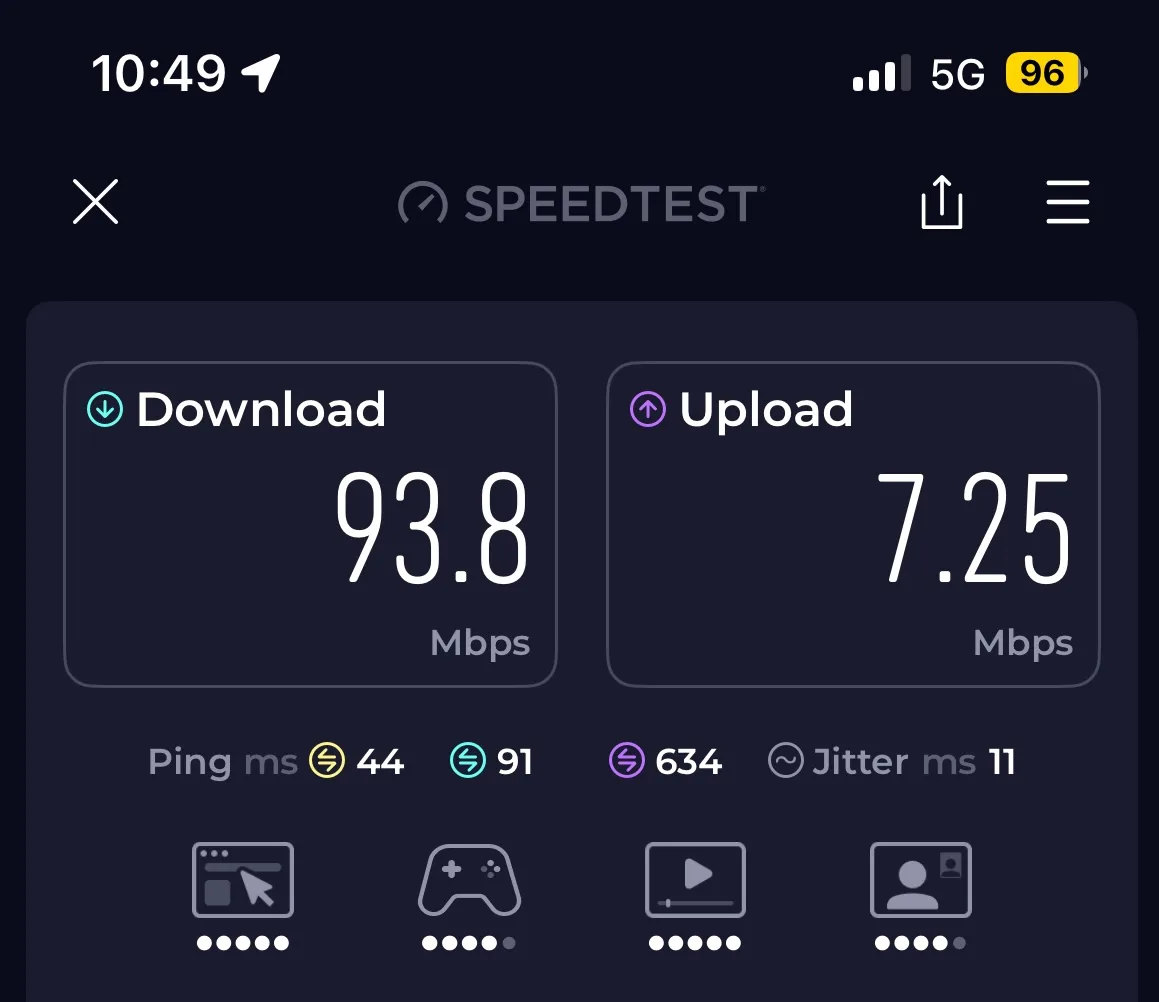
Provisioning more capacity for those customers would mean taking it away from everyone else. EE has attached no minimum speed guarantee to its offer. Despite boasting a larger pool of 5G spectrum, VodafoneThree has set the bar for download connectivity as low as 15 Mbit/s. A speed test (see below) carried out in a densely populated neighborhood of southwest London on September 23, using an iPhone 14 with a basic 5G subscription to EE, showed a download speed of 93.8 Mbit/s.
In the upper echelons of the vendor community, there is some recognition that network slicing probably holds greater value as a business service. “I think one great example of a perfect place for a network slice at an event is point-of-sale terminals,” said Per Narvinger, the head of Ericsson’s mobile networks business group (due to become CEO on October 1), on a call with Light Reading last year. “It is a very small amount of data that you need to send but you really want to be guaranteed that it’s working. The value for those point-of-sale terminals is much larger than the amount of data that you want to transfer.”
In a fixed location and with such limited capacity needs, network slicing in this scenario is unlikely to run into the same problems as a consumer offer. Even so, as valuable as that kind of service level agreement may be to a retailer, the doubt is that it would be a huge money spinner for telcos. There is also an alternative way to do prioritization.
API days
Days after Thruxton, Vodafone’s business in Germany opted instead to highlight its use of a network application programming interface (API) to provide a similar “quality on demand” for customers. Much talked about in recent years, these network APIs are emphatically not part of VodafoneThree’s slicing offer, it subsequently confirmed by email.
“Vodafone SuperMobile does not currently use Quality on Demand (QoD) APIs, but the unique combination of network slicing, partitioning and prioritization all underpinned by the scale and reach of the 5G Standalone network we’ve built,” said a spokesperson. “QoD APIs serve a different but complementary purpose, enabling businesses to optimize their customers’ mobile connections when accessing services such as digital payments, sports broadcasts and delivery services.”
Indeed, there are some key differences between network slicing and QoD APIs, as explained in an insightful blog by Patrick Lopez, the founder and CEO of Core Analysis and a former telco and vendor executive. “Fast Lane runs on EE’s 5G standalone core and moves the customer onto a dedicated slice,” he said. “Vodafone’s API works over 4G and 5G, which means it is not a slice.”
“A priority is not a reservation,” Lopez continued. “It improves the customer’s position in the queue on a congested cell.” While it does not come with VodafoneThree’s 15Mbit/s or any other such guarantee, it also does not demand the availability of a 5G Standalone service and can, therefore, be launched nationally, he added.
The other crucial difference is the paying customer – a business that might serve consumers distributed across various German mobile networks instead of the subscriber to a specific telco. The potential drawback for the business is that services are prioritized only for Vodafone Germany customers. A games developer might see more value in dealing with an aggregator of network APIs, such as Ericsson-owned Vonage, rather than an individual network operator.
As Lopez told Light Reading, “While Vonage acts as a wholesale API vendor for developers seeking network-agnostic telephony services, that does not preclude operators from selling specific slices in their networks.” He sees the emergence of competing approaches as “a sign of market immaturity.”
Vodafone Germany’s reference in its press release to the GSMA’s Open Gateway initiative implies it is adhering to industry-standard APIs defined under the related CAMARA project overseen by the Linux Foundation. That means a developer should not have to rewrite code for other networks. Yet a profusion of API marketplaces might generate doubt. It may also put downward pressure on API prices – good for developers, bad for the telecom industry.
The notion that network slicing, network APIs and related services could in their own right ever be a significant revenue generator for the telecom industry always looked somewhat fanciful. That does not mean there is no money for telecom in providing connectivity services for objects besides smartphones. But the ideal fix for a cornucopia of connectivity problems is abundant capacity on a ubiquitous network that is adaptive, responsive and ultra-reliable. If that cannot be realized through 6G and the software that everyone now unthinkingly describes as artificial intelligence, the industry should be asking why.


