
Far from being a divisive barrier, the presidents’ wall at Bell Labs’ headquarters in Murray Hill commemorated the 15 leaders of the iconic US research organization until earlier this year, when the role was quietly scrapped.
Having celebrated its centenary in 2025, Bell Labs remains a colossus in the history of telecom and tech, a pioneer of the first telephony systems, inventor of the transistor and developer of computer programming languages still used now. But the removal of president as a job title, and the low-key appointment of Guru Parulkar, a former Intel executive, as self-described Bell Labs “head” a few weeks ago, seem to reflect a recent dimming of its prospects under today’s management.
Named after famous telephone inventor Alexander Graham Bell, Bell Labs started life as part of the Bell System monopoly that was ultimately broken up by American trustbusters. Between 1984 and 1996, it operated as a subsidiary of AT&T before most of it was spun off into Lucent Technologies. After that company’s $13.4 billion mega merger with France’s Alcatel, Bell Labs became a unit of Alcatel-Lucent in 2006. A decade later, further consolidation and another €15.6 billion (US$18.1 billion, at today’s exchange rate) deal brought it under the ownership of Finland’s Nokia, where it is now falling victim to cuts.
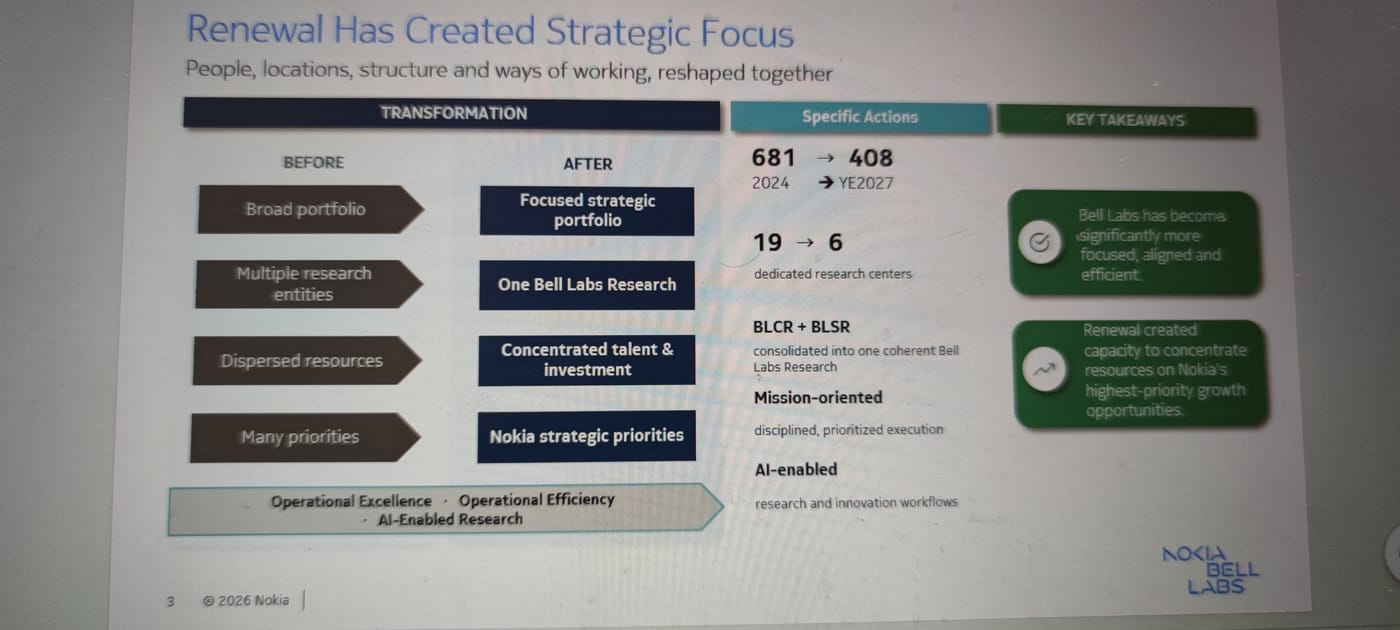
Those look unprecedented this century and raise questions about Nokia’s assurance that Bell Labs forms a critical part of its research activities. After Nokia’s takeover, Bell Labs was understood to have employed about 750 people in research along with between 250 and 300 in standards. By 2024, the number in research had dropped to exactly 681, according to multiple sources with knowledge of the matter. Before the end of next year, Nokia aims to reduce the research headcount at Bell Labs to just 408, said those sources.
This would obviously equate to a reduction of about 46% compared with the figure less than six years ago. It will shrink the number of dedicated research centers from 19 to six, according to an internal slide obtained by Light Reading and verified separately. Bell Labs’ network systems and security research (NSSR) lab, which had operated in Europe and the US, is one activity that has already been discontinued, said sources.
Nokia responded with the following email statement in full: “The AI supercycle presents a defining opportunity to rethink the role of networks in an AI-driven world. With this ambition in mind, Nokia is bringing its research teams back together as one unified Bell Labs, with a sharper focus on the deep technologies that will shape the future of networks and AI. By concentrating world-class expertise on the highest-impact priorities, Nokia will strengthen its ability to translate pioneering research into technologies with real-world applications and commercial impact.”
It added: “This approach builds on the focused, connected research model that enabled Bell Labs to deliver some of the most consequential breakthroughs in modern technology, from the transistor to the UNIX operating system. It aligns with the strategy the company set out at Capital Markets Day and reinforces Bell Labs’ central role in Nokia’s technology leadership and long-term innovation agenda.”
Included beneath this paragraph (the slightly blurred image was a feature of the original photo), Nokia’s internal slide presents the latest restructure as a streamlining and “renewal” that will attach resources to what is described as a “focused strategic portfolio.” But one of Bell Labs’ former presidents is both unimpressed and deeply worried about the implications.
Corporate amnesia
Marcus Weldon ran Bell Labs between 2013 and 2021 and was also Nokia’s chief technology officer for most of that period. In late August, he made some of his feelings about the latest moves clear in a LinkedIn post that was picked up by several titles, including this one. Weldon, who among other things currently advises our parent company Informa Group on its AI strategy, has now shared his concerns about the future of Bell Labs with Light Reading.
They include an unshakeable view that Nokia undervalues the contribution of Bell Labs and does not appreciate its importance to the bigger business. “I can list tens of innovations that transform the Nokia businesses, so there are two degrees of folly,” said Weldon. “One is not recognizing the patents produced as material, profitable value from build-up. Secondly, this idea that nothing of value has been done in 15 years is just ridiculous.”
He blames a corporate “amnesia” for Nokia’s inability to recollect the origins of technology value, pointing out that Bell Labs’ innovations can take many years to percolate through the business. Achievements during his own time as a Bell Labs president included work on virtual radio access network (RAN) technology and even the AI-RAN concept that is now associated with Nvidia, said Weldon. “By the time it becomes part of the business, no one remembers where it came from.”
That sort of amnesia is not new and meant Weldon had to continually fight for Bell Labs and champion its importance to senior management at Nokia, he said. Thanks to those efforts, he was able to defend an annual spending budget of about $250 million, equaling roughly 1% of Nokia revenues. But the latest cuts, which he describes as a “top-down dismissal of the value that Bell Labs provides,” would reduce that figure to just 0.4%, by his calculation.
“That is shocking because that has never, ever been the case in the 100-year history of Bell Labs,” he said. “Even when some of the constituent companies like Lucent and Alcatel were struggling, they did not cut Bell Labs funding below that $200 million, $250 million level.”
Besides building products based on Bell Labs’ research, Nokia also monetizes it directly through the licensing of patents by its Technologies division, recently subsumed into a new Mobile Infrastructure (MI) business group. During Weldon’s time, he said, Technologies would generate annual revenues of about $1 billion on that $250 million in costs – then booked under “Group Common” expenses – making it a highly profitable venture based on patents alone.
The restructuring that created MI makes any comparison between then and now much harder. Before MI came into existence this year, Technologies booked full year sales for 2025 of about €1.5 billion ($1.7 billion) with an operating margin of more than 70%. Within MI, revenues from the licensing of technology standards for the first half of 2026 came to €792 million ($920 million), massively exceeding the €532 million ($618 million) that MI reported in operating profit. “I think the idea is to bring it back in so that it can bolster the mobile business,” said Weldon on the inclusion of Technologies in MI.
The ramifications are troubling. For the first half, the entire Nokia business managed an operating profit of €735 million ($854 million) on a “comparable” basis, Nokia’s preferred metric. If the margins for Technologies were roughly the same as in 2025, Nokia would have owed three quarters of its operating profit to licensing. And if the value of most patents originates with Bell Labs, Weldon’s apparent alarm is understandable.
Cuts at Bell Labs could also have a much bigger impact on Nokia’s involvement in mobile than on its fixed-line activities, judging by Weldon’s analysis. That is partly because standards development is a far more significant effort in mobile, he explained. He also dismisses the suggestion that Nokia would be able to offset the cuts at Bell Labs by continuing to grow the investment in R&D that happens elsewhere in the group.
Across Nokia, R&D expenditure rose 6% year-over-year for the first half, to about €2.3 billion ($2.7 billion), after growing 7% in 2025, to €4.6 billion ($5.3 billion). Since February last year, it has included the investments made by Infinera, the optical equipment specialist that Nokia acquired for $2.3 billion. Infinera’s R&D bill came to about $300 million in 2024, before the takeover.
While Nokia would certainly have teams of people involved in standards development, they are very different from the Bell Labs staff responsible for core research, according to Weldon. “They’re very technical people, but they’re not doing breakthrough research. They’re sort of representing the research to the standards community,” he said. “I would say that number combined with the research number is a critical barometer for successful leadership in future wireless technologies.”
All the eggs in one basket
Weldon also believes that Nokia’s recent tie-up with Nvidia looms large in its shapeshifting. Last year, the Finnish company notably accepted a $1 billion investment from the giant chipmaker and announced plans to develop future 5G and 6G network products using Nvidia’s graphics processing units (GPUs) rather than traditional application-specific integrated circuits (ASICs).
“The AI-RAN that Pallavi talks about has almost no Bell Labs involvement according to my sources, despite Bell Labs inventing AI-RAN and virtual RAN,” said Weldon, referring to Pallavi Mahajan, Nokia’s current chief technology officer. “I think there’s an over-dependence on Nvidia, and advocacy for Nvidia as being the place where that will be developed, not leveraging Bell Labs’ innovations.”
He is one of numerous experts to express concern about that relationship. “I am not arguing against AI-RAN – I’m saying the risk of not having a companion ASIC strategy is the same risk that Nokia took after it acquired Alcatel-Lucent,” he said. “Nokia did not have an ASIC strategy. It had an Intel-centric strategy, and Intel failed them famously due to the 10-nanometer failure.”
That whole affair was subsequently covered in some detail by Light Reading. The risk now, according to Weldon, is obviously not that GPUs won’t exist. It is, in his opinion, that Nokia is putting “all its eggs in one basket” for Nvidia’s commercially unproven, GPU-based AI-RAN technology.
News of cuts at Bell Labs sits in the context of an ongoing and much bigger headcount reduction at Nokia. Having had as many as 103,000 employees in 2018, it finished last year with 74,100, excluding Infinera, which employed 3,418 people in December 2024, two months before it was acquired. Under restructuring plans initiated by Pekka Lundmark, Nokia’s previous CEO, another 4,000 jobs were due to be cut before the end of 2026. But recent decisions could make the workforce even smaller.
In July, when Nokia reported first-half results, current CEO Justin Hotard upped this year’s restructuring costs from €250 million ($290 million) to €800 million ($929 million), with the increase linked to additional planned layoffs in China and Europe. A few weeks later, Nokia confirmed it would close a research facility in Hangzhou, at the cost of 1,600 jobs.
Messaging exchanges between employees in China, obtained by Light Reading, indicate sites in Beijing, Chengdu, Qingdao and Shanghai might also be shuttered. That could have a major impact on headcount, with Nokia still employing around 7,200 people in China, Hong Kong and Taiwan last year.
“As the market share has diminished, I think that’s actually a defensible decision,” said Weldon on reports of cuts in China. When he talks about those at one of Nokia’s oldest US assets, defensible seems to be the last word on his mind.


